Water Softener vs Water Filter: What’s the Difference and Which One Do You Need?
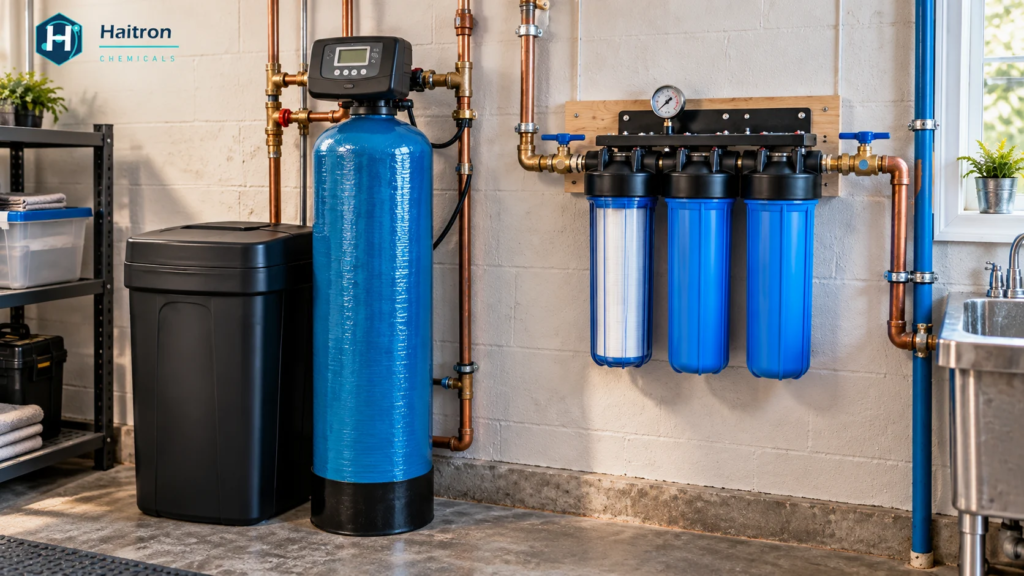
When people compare a water softener vs water filter, they’re really asking which problem each one solves. A water softener removes the minerals that make water “hard.” A water filter removes unwanted things like sand, chlorine, lead, or chemicals, depending on the type.
So the answer depends on your water. Is your problem hardness, contaminants, or both? Many homes, especially those on wells, end up needing both.
We make ion exchange resin, the tiny beads inside water softeners. We don’t sell home softeners or filters, so we have no reason to push you toward either one.
The quick answer
- You see white crust on faucets, spots on glasses, or scale in your kettle. You likely need a water softener.
- Your water tastes bad, smells like chlorine, looks sandy, or a test shows lead, bacteria, or chemicals. You likely need a water filter made for that problem.
- You have both kinds of problems. You likely need both, set up in the right order.
What a water softener does
A softener is a tank filled with small plastic beads called ion exchange resin. As hard water flows past, the beads grab calcium and magnesium. In return, they let go of sodium or potassium. It’s a bit like trading cards: the beads swap one mineral for another.
When the beads fill up, the softener rinses them with salty water to recharge them. This step is called regeneration.
What it’s certified to do
In the United States, home softeners are tested under a standard called NSF/ANSI 44. It covers hardness removal. Certified softeners can also claim to reduce two harmful metals, barium and radium, but that’s optional.
What it doesn’t do
A softener doesn’t remove chlorine, sand, most chemicals, or germs. It also isn’t a lead treatment you can trust. Our article on whether a water softener removes lead explains why.
The same NSF standard makes one more point. Softeners aren’t meant for water that may be unsafe from germs, unless that water is also disinfected before or after the softener.
What a water filter does
“Water filter” is a big family, and each type does a different job:
- Sediment filters catch sand, silt, and rust bits, like a screen on a window.
- Activated carbon filters reduce chlorine taste and smell, plus some chemicals.
- Reverse osmosis pushes water through a super fine layer, called a membrane, that blocks most dissolved things. That includes many metals and some hardness.
- UV lights don’t remove anything. They zap germs so they can’t make you sick.
- Iron and sulfur filters take out iron, manganese, and rotten egg smells.
Here’s the big rule. A filter only handles what it was built and certified for. A carbon filter made for chlorine taste tells you nothing about lead. Always match the filter to your actual problem.
What filters don’t do
Most filters don’t remove calcium and magnesium, so they won’t stop scale. Reverse osmosis is the exception. But it usually sits under one kitchen sink, so it won’t protect the rest of your home from hard water.
Water softener vs water filter: match your symptoms
Here’s a simple way to decide based on what you see, taste, or test:
- White crust, spotty glasses, or soap that won’t lather point to hard water. A softener helps.
- A chlorine taste or smell on city water calls for a carbon filter.
- Sand, grit, or cloudy water calls for a sediment filter.
- Orange stains or a metal taste mean iron. Use an iron filter. A softener only handles small amounts of dissolved iron.
- A rotten egg smell usually means hydrogen sulfide gas. Use an oxidizing filter, but check your water heater first.
- A test showing lead, arsenic, nitrate, or PFAS calls for a filter certified for that exact problem, often reverse osmosis.
- A positive test for coliform bacteria in a well means the well needs fixing first. Then add UV.
Water that looks and tastes fine can still have problems you can’t sense. That’s why testing matters so much.
Check your water before you buy
If you’re on city water, your water company publishes a yearly water quality report. Look for hardness and any contaminants listed.
If you’re on a well, get it tested by a certified lab. Our guide to choosing a water test kit for well water explains what home kits can and can’t tell you.
How hard is “hard”?
The U.S. Geological Survey sorts water like this, in milligrams per liter:
- Soft: 0 to 60
- Moderately hard: 61 to 120
- Hard: 121 to 180
- Very hard: over 180
Softener sellers often use grains per gallon instead. To switch from milligrams per liter, divide by 17.1. Some product pages mix these units up, so it’s worth checking the math yourself. For example, 7 grains per gallon is about 120 milligrams per liter, not 180.
Do you need both?
Many homes do, especially on wells. Hardness, iron, and sand often show up together there.
When you have both, a common whole house order looks like this:
- A sediment filter goes first to protect everything after it.
- An iron or sulfur filter comes next, if you need one, because iron can clog softener resin.
- The water softener goes after that.
- A carbon filter follows, for taste, smell, or chemicals.
- A UV light goes last if germs are a worry, since it works best on clear water.
- Reverse osmosis goes at the kitchen sink if a test shows a health problem.
Salt free conditioners and reverse osmosis
Salt free “softeners” are often called conditioners. They change how minerals act so they’re less likely to form crust. But they don’t actually remove calcium and magnesium, so they aren’t true softeners.
Reverse osmosis removes most dissolved minerals, hardness included, at a single tap. It’s a great drinking water filter, but it isn’t a whole house fix for hard water.
Tips before you choose
- Test first. Don’t buy anything to fix a problem you haven’t confirmed.
- Check the certification against your real goal.
- Size it for your home. Softeners depend on your hardness and water use. Filters depend on flow and what they need to remove.
- Count the running costs. Softeners need salt and use some water to recharge. Filters need new cartridges or media.
- Use less dishwasher detergent after you soften. Glassmaker Libbey says softened water is a common cause of glass etching.
- Keep up with care. A neglected softener stops softening. If yours isn’t keeping up, our water softener repair guide walks you through easy checks.
FAQs
Is a water softener a type of water filter?
Not really. It swaps minerals instead of straining things out. It doesn’t remove most contaminants the way a filter does.
Is softened water OK to drink?
For most people, yes. It has a little added sodium, which matters if you’re on a low salt diet. Learn more about how much sodium a water softener adds.
Do I need a softener on city water?
It depends on your hardness. Check your city’s yearly water report. If your water is hard or very hard, a softener can help.
What certifications should I look for?
Look for NSF/ANSI 44 on softeners. For filters, NSF/ANSI 42 covers taste and smell, 53 covers health claims, 58 covers under sink reverse osmosis, and 55 covers UV.
Does Haitron sell water softeners or filters?
No. Haitron makes ion exchange resin, the tiny beads used inside water softeners. Our technical team can answer questions about resin.
Your next step
Find out what’s really in your water first. Check your city report or test your well, then match the results to the symptom list above. That’s the simplest way to settle the water softener vs water filter question for your home.