Water Softener Repair: Easy DIY Fixes and When the Resin Is to Blame
You turn on the shower, and the water feels hard again. Spots are back on the glasses too. Yet the softener is humming away like nothing is wrong. Sound familiar? The good news is that most water softener repair jobs are small. Often it’s just low salt, a stuck crust of salt, or a clock set wrong. So before you spend money, let’s try a little water softener repair at home first.
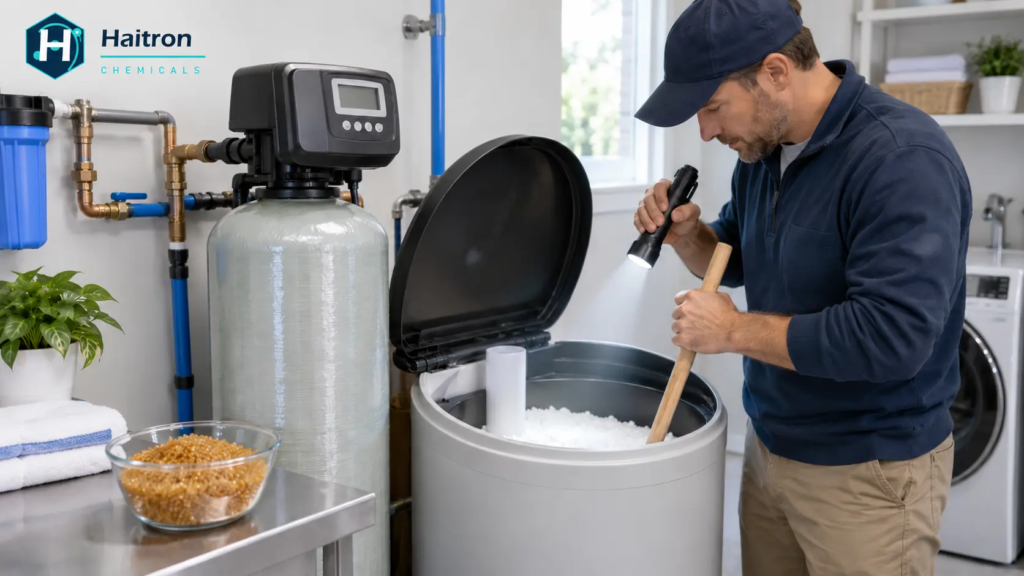
We’ll start easy. Grab a flashlight and a broom handle.
How Does a Water Softener Work?
Inside the tall tank sit thousands of tiny beads. We call them resin. When hard water runs past, the beads grab the calcium and magnesium. Those minerals are what make water “hard.”
Beads can only hold so much, though. Every few days the softener cleans them with salty water from the salt tank. That cleanup is called regeneration.
If you’re curious what those beads are made of, our ion exchange resin page shows the different types.
Signs Your Softener Needs Help
Here’s what people usually notice:
- White spots on dishes or crusty taps
- Shampoo and soap that barely foam
- A salt level that stays the same for weeks
- A salt tank sitting full of water
- Tiny yellow beads in the sink
- Water that tastes a bit salty
Simple Water Softener Troubleshooting Steps
Step 1: Check the Bypass Valve
If the bypass valve gets bumped, water skips the softener altogether. Turn it back to the normal “service” position.
Step 2: Look at the Salt
Lift the lid. HomeGuide says salt should sit around 3 or 4 inches above the water. Buy clean salt pellets if you can. Family Handyman warns that rock salt has dirt in it, and that dirt can clog things up.
Step 3: Break the Salt Bridge
Sometimes salt turns into a hard shell with an empty space underneath. From the top, the tank looks full. Below, no salty water is being made.
Gently push a broom handle into the salt. Hit something hard before the bottom? That’s a salt bridge. Poke it until it cracks. If it won’t budge, GE Appliances suggests pouring in about a gallon of warm water. Not hot.
Step 4: Scoop Out the Mush
Wet, mushy salt can pile up at the bottom and block things. Scoop it out, give the tank a rinse, then pour in fresh pellets.
Step 5: Fix the Clock and Hardness Number
Did the power go out lately? The timer might be off, so the softener cleans itself during the day.
Check the hardness number too. A cheap test kit tells you how hard your water is. The USGS says anything over 180 mg/L is very hard. Your softener may ask for grains per gallon instead. Just divide mg/L by 17.1.
Step 6: Clean the Venturi
The venturi is a tiny part that pulls salty water into the resin tank. A speck of dirt can block it. GE’s guide shows how to take it apart and rinse it. While you’re there, make sure the drain hose isn’t bent.
Could the Resin Be Worn Out?
Done all six steps and the water is still hard? Now we look at the beads. In most homes, resin lasts about 10 to 15 years. City water with chlorine and well water with iron can wear it out sooner.
Tired resin gives a few clues. Your soft water runs out faster. Salt still gets used, but hardness keeps coming back. Or you spot little yellow beads in the sink. HomeGuide points out that beads in your taps usually mean a part at the bottom of the tank is broken as well.
Clean the Resin or Replace It?
Iron sticks to beads like mud on a shoe. A resin cleaner poured into the salt tank can often wash some of it off.
Chlorine is a different story. It slowly breaks the beads apart from the inside. No cleaner can fix that, so new resin is the only answer.
Quick warning here. A few websites tell you to pour bleach into your softener. Bleach is chlorine! Only do this if your softener’s manual says to, and don’t make it a habit.
A Tip From Our Resin Makers
At Haitron, we make the strong acid cation resin that goes inside softeners. One thing hardly anyone talks about is crosslinking. Think of it as how tightly each bead is knitted together.
Our 001×7 grade has 7% crosslinking. Our 001×8 grade has 8%, so its beads are a little tougher. On chlorinated city water, a tougher bead is a smart pick. A carbon filter placed before the softener helps too, because it catches chlorine first.
Living on well water? Iron isn’t the only thing that bothers softeners. It’s worth reading our simple guide to tannin removal from well water.
Water Softener Repair Cost
Here’s roughly what people pay in 2026:
- A service visit: $40 to $100 (Wise Workman)
- New resin beads: $200 to $400 (Angi, August 2026)
- A new salt tank: $125 to $700 (Angi)
- A whole new softener: about $1,500 on average (ConsumerAffairs, February 2026)
Repair or Replace Your Water Softener?
Is your softener younger than 10 years? And is the problem salt, cleaning, or a cheap part? Then fixing it makes sense.
Older than 10 years, with a repair costing more than half the price of a new one? Many experts say replacing is smarter than. A cracked tank points the same way.
There’s a middle path too. If the tanks and valve still work but the beads are done, just swap the resin. People call this a rebed, and it costs far less than a new system. You can see how resin swaps work in bigger systems on our typical cases page.
When Should You Call a Pro?
Call someone if the valve leaks, an error code won’t go away, or a tank cracks. Replacing resin is also easier with a pro, unless you’re handy with pipes.
Common Mistakes to Avoid
- Filling the tank with rock salt
- Whacking a salt bridge with a metal tool
- Pouring in bleach again and again
- Skipping the filter on well water
- Buying a new softener when only the resin was bad
FAQs
Why is my water softener full of water?
Usually a salt bridge or a blocked salt line is to blame. Culligan says to check those first.
Why isn’t my softener using salt?
Look for a salt bridge, a clogged venturi, or a timer that never starts the cleaning cycle.
How long does a water softener last?
Plenty of softeners last around 15 years. The resin often needs changing somewhere between year 10 and 15.
Can I replace the resin myself?
You can, if you’re okay draining the tank and taking off the valve. Just pick resin made for softening in the right bead size.
Does a softener make my water salty?
It adds a little sodium, but not much. Our guide on how much sodium a water softener adds explains it simply.
Final Thoughts
Most water softener repair starts with salt, settings, and a quick clean, so try those first. Still hard water after that? Check the resin before you buy a whole new unit, because fresh beads can bring an old softener back to life. Smart water softener repair saves real money. And if you’re not sure which resin fits your system, just reach out to our technical team. We’re happy to help.