How to Remove Manganese From Well Water: Find the Right Fix for Your Test Results
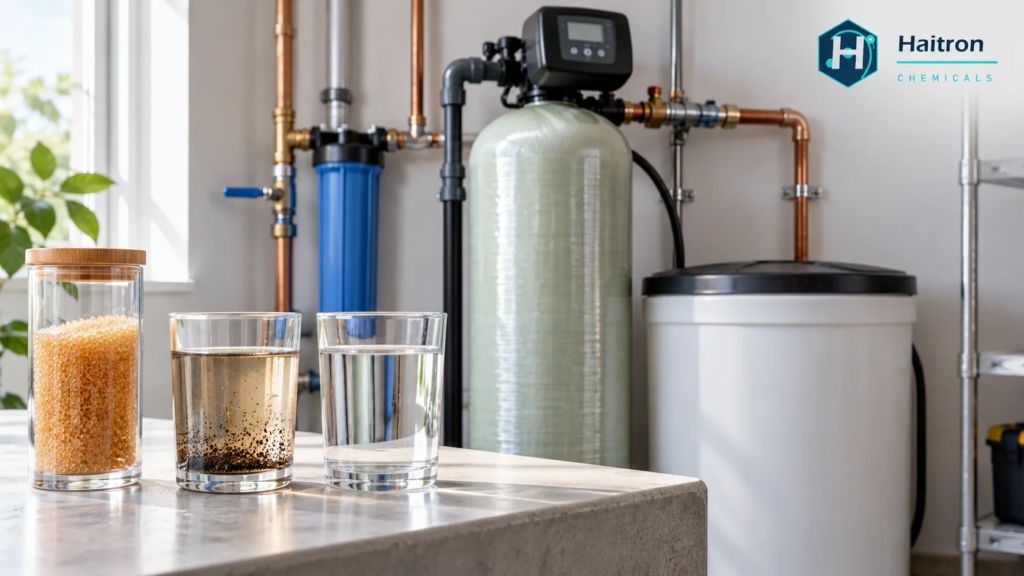
If you want to know how to remove manganese from well water, start with a lab test, then pick the treatment that fits your numbers. Low levels of dissolved manganese can come out in a water softener. Higher levels need an oxidizing filter or a chemical injection system.
The right choice depends on your manganese level, your iron level, and your water’s pH. Here’s how to work it out.
What Manganese in Well Water Looks Like
Manganese is a natural metal in rock and soil. As groundwater moves through the ground, a little dissolves into your well. Common signs include:
- Black stains from well water on toilets, sinks, and laundry
- Black specks inside your dishwasher
- A bitter, metallic taste in water, coffee, or tea
- Water that looks clear at first, then turns dark after it sits
Dissolved manganese is like sugar stirred into tea. You can’t see it until air turns it into tiny black bits.
Iron and manganese often show up together. Iron leaves orange stains, and manganese leaves darker ones.
Is Manganese in Well Water Safe to Drink?
Small amounts are mostly a nuisance. Larger amounts can harm health, especially for babies.
| Guideline | Level | What it means |
| EPA secondary standard | 0.05 mg/L | Stains and bad taste start |
| EPA health advisory (2004) | 0.3 mg/L | Long term health limit, and the limit for babies under 6 months |
| Health Canada limit (2019) | 0.12 mg/L | Health based limit |
| WHO guideline (2022) | 0.08 mg/L | Provisional health based guideline |
Nobody enforces these limits on a private well, so testing is up to you. In 2019, the USGS estimated that about 2.6 million people in the US may drink groundwater with manganese above 0.3 mg/L.
If your result is above 0.3 mg/L, don’t use that water to mix baby formula until it’s treated.
Step 1: Test Your Well Water for Manganese
The first step in how to remove manganese from well water is getting real numbers from a certified lab. Your local health office can give you a list.
Ask the lab to check:
- Manganese and iron
- pH, which shows how acidic your water is (think of a scale from lemon juice to baking soda)
- Hardness, the minerals that leave white spots on dishes
- Bacteria, including iron bacteria if you see slime in your toilet tank
Also mention any bad smell. A rotten egg smell changes which system makes sense, and our guide on why your water smells like rotten eggs explains the cause.
Take the sample from a tap before any filter or softener.
For a quick home check, let a clear jar of water sit for a day. If black specks form later, your manganese is dissolved, the only kind a softener can remove.
How to Remove Manganese From Well Water: Your Main Options
Most homes treat all the water coming into the house, so stains stop everywhere.
| Your test result | What usually works | What it treats |
| Low, dissolved manganese in hard water, pH above 6.7 | Water softener | Whole house |
| Iron plus manganese about 3 to 10 mg/L | Oxidizing filter, such as manganese greensand | Whole house |
| Iron plus manganese above 10 mg/L | Chemical injection plus a filter | Whole house |
| Low manganese in drinking water only | Reverse osmosis at the kitchen sink | One tap |
Ranges come from Penn State Extension (2025). Unsure if you need a softener or a filter? Our article on water softener vs water filter explains the difference.
Water Softener
A softener holds tiny resin beads. They swap hardness minerals and dissolved manganese for sodium, a bit like trading cards. The softener flushes the manganese away when it cleans itself, which is called regeneration.
Penn State Extension says softeners work best when pH is above 6.7, hardness is 3 to 20 grains per gallon, and manganese is low. The beads are usually strong acid cation resin, the same type used for everyday water softening.
One rule matters most. Don’t let air or chlorine reach the water before the softener. They turn manganese solid, and those solid bits coat the beads like mud on a sponge. Keeping regeneration on schedule helps too, and our guide on how often a water softener should regenerate shows you how.
Manganese Greensand Filter
An oxidizing filter turns dissolved manganese into solid bits and traps them in one tank. Manganese greensand is the classic choice for iron plus manganese of about 3 to 10 mg/L.
It needs regular backwashing (rinsing the tank in reverse) and recharging with potassium permanganate. That chemical is toxic, so store it safely.
A Birm filter needs no chemicals, but it needs a pH of at least 7.5 for manganese, and results vary a lot. Think of it as mainly an iron filter.
Chemical Injection Plus a Filter
For high levels, a small pump adds chlorine, potassium permanganate, or hydrogen peroxide to the water. A holding tank gives it time to react. A filter then catches the solid bits, and carbon can remove leftover chlorine taste.
It also helps with rotten egg smells and bacteria, but it needs more upkeep.
Air Injection and Ozone
Air injection works well on iron. For manganese, results depend on pH, because oxygen reacts with manganese slowly in most well water. Ask for a written guarantee at your pH. Ozone costs more, but it treats metals and bacteria together.
Reverse Osmosis for Drinking Water
Reverse osmosis pushes water through a very fine screen that holds back metals. An under sink unit can remove more than 90% of manganese at low levels, according to WaterWorld. It only treats one tap, though.
What Doesn’t Work
- Plain sediment filters, since dissolved manganese slips through
- Polyphosphate feeders, which Penn State Extension calls generally ineffective
- Boiling, which only concentrates metals
Three Quick Examples
These are sample results, not real homes.
- Home A has manganese at 0.2 mg/L, iron at 0.5 mg/L, hard water, and a pH of 7.1. A water softener fits.
- Home B has manganese at 0.8 mg/L, iron at 3 mg/L, and a pH of 6.4. A greensand filter fits, but ask the installer about the low pH.
- Home C has manganese at 2 mg/L, iron at 12 mg/L, and a rotten egg smell. Chemical injection with a filter handles all three.
Common Mistakes to Avoid
Most failures in how to remove manganese from well water come from skipping a step:
- Buying a system before testing
- Testing for iron but not manganese
- Putting air or chlorine in front of a softener
- Expecting reverse osmosis to stop stains
- Never retesting after installation
Returning stains usually mean the media needs care or your well has changed.
Frequently Asked Questions
Can a water softener remove manganese?
Yes, if the manganese is low and dissolved and nothing adds air or chlorine first.
Will a whole house sediment filter remove manganese?
No. It only catches solid bits. Dissolved manganese passes right through.
Why is there black gunk in my dishwasher?
Dishwasher soap raises the water’s pH, which turns dissolved manganese into black bits. It’s a good sign you should test your water.
How often should I test my well water?
Test once before choosing a system, again a few weeks after installing it, then every year.
Can Haitron help me choose resin for manganese?
Yes. Haitron makes ion exchange resins, including softener resin. If you build or service softeners, share your test results with our technical team for a resin match.
Final Thoughts
Learning how to remove manganese from well water comes down to one habit. Test first, then match the fix to your numbers. Low levels often need only a softener, while higher levels call for an oxidizing filter or chemical injection.