Hard Water vs Soft Water: The Real Difference
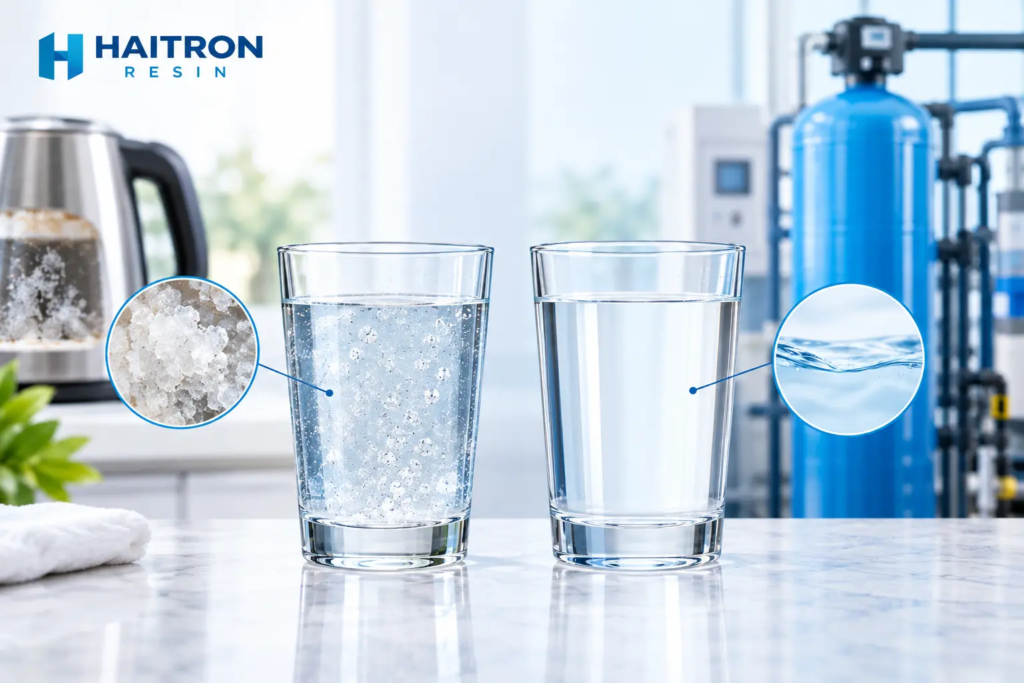
The difference between hard and soft water comes down to one thing. Hard water carries dissolved calcium and magnesium. Soft water carries very little of either. That is the whole difference between hard and soft water in one line.
But the word soft means one thing at your kitchen tap and something very different at the inlet of a boiler.
Key Takeaways
- Water hardness is the amount of dissolved calcium and magnesium, reported as calcium carbonate.
- The USGS calls water soft below 60 mg/L and very hard above 180 mg/L.
- ASME allows under 0.3 mg/L of hardness in boiler feedwater, and almost none at high pressure.
- Naturally soft water and softened water are not the same product.
- Boiling removes only part of the hardness, never all of it.
What Makes Water Hard
Rain starts out soft, with almost nothing dissolved in it. Then it soaks into the ground. Moving through limestone, chalk, and gypsum, it picks up calcium and magnesium. The more it picks up, the harder it gets.
This is why water hardness changes so much from one town to the next. It follows the rock, not the pipe.
You can spot it without a test kit. Hard water fights soap, so you get less lather and a film on your hands, plus limescale on kettles and heating elements. Soft water lathers easily and leaves no scale.
How Water Hardness Is Measured
To see the difference between hard and soft water on paper, you need a number. Hardness is always written as calcium carbonate, or CaCO3. There is no calcium carbonate floating in your water, so that wording confuses people.
It is just a shared yardstick. Calcium and magnesium have different weights, so labs convert both to one comparable unit.
Here is what each unit equals in mg/L as CaCO3:
- 1 mg/L, also written as ppm, equals 1
- 1 grain per gallon, or gpg, equals 17.1
- 1 German degree, or dH, equals 17.8
- 1 French degree, or fH, equals 10.0
- 1 Clark degree, used in older UK reports, equals 14.3
- 1 mmol/L equals 100.1
The scale used to judge those numbers is not the same everywhere. In the United States, the USGS calls water soft from 0 to 60 mg/L, moderately hard from 61 to 120, hard from 121 to 180, and very hard above 180. In the UK, the Drinking Water Inspectorate treats anything up to 100 mg/L as soft and only calls water very hard above 300.
So the same water can be labelled hard in one country and soft in another. Look at the number, not the word.
Where the Line Sits Depends on the Job
This is the part most guides on the difference between hard and soft water leave out.
For a home, water below about 60 mg/L feels soft. Soap works and scale stops forming.
Now take that same water to a plant. ASME guidance for industrial watertube boilers allows less than 0.3 mg/L of total hardness in feedwater at low pressure. Above 900 psig the limit drops to 0.05 mg/L. Above 1000 psig it has to be non detectable.
Read those two numbers together. Water that a homeowner and the USGS both call soft is still hundreds of times too hard for a boiler. Cooling towers, reverse osmosis feed, and electronics rinse water each sit at their own point on that line, which is why the treatment path changes with the duty. Our application fields page sets out where each one lands.
Soft is not a property of water. It is a spec for a job.
Temporary and Permanent Hardness
Not all hardness behaves the same way when heated.
Temporary hardness is tied to bicarbonate. Heat the water and it drops out as solid scale. That white crust inside your kettle is temporary hardness leaving the water.
Permanent hardness is tied to sulfates and chlorides. Heat does nothing to it. It stays dissolved and passes straight through.
This matters when choosing equipment. Where hardness sits mostly with alkalinity, a weak acid cation resin does the job with far less regenerant than a standard softener needs.
Naturally Soft Water Is Not Softened Water
These two get treated as the same thing. They are not.
Naturally soft water is low in almost everything. Few minerals, low dissolved solids, often slightly acidic. That sounds ideal until you meet the downside. The World Health Organization notes that water under roughly 100 mg/L is more aggressive toward pipework. UK guidance goes further and recommends that artificially softened supplies keep at least 150 mg/L of hardness for that reason.
Softened water is different. The calcium and magnesium are gone, but nothing really left the water. Sodium took their place. The trade adds roughly 8 mg/L of sodium for every grain per gallon of hardness removed, and total dissolved solids stay exactly where they were.
A salt free water softener is a third category. It changes how the minerals behave so they do not stick, but the hardness is still there when the water reaches the tap.
Softening Is Not Demineralization
A softener is a tank of strong acid cation resin loaded with sodium. Hard water flows through. Calcium and magnesium stick to the beads and sodium goes out in their place. When the beads fill up, a brine rinse strips them clean and the cycle starts again.
That removes hardness. It does not lower conductivity or dissolved solids, because one ion simply swapped for another.
When a process needs water that is genuinely pure rather than just soft, softening alone is not enough. Removing both the positive and negative ions calls for a full demineralization train or a mixed bed resin polishing stage.
Frequently Asked Questions
Is soft water the same as demineralized water?
No. Soft water has had calcium and magnesium swapped for sodium, so the dissolved solids are unchanged. Demineralized water has had nearly all ions removed, so conductivity is very low. Soft water is a scale spec. Demineralized water is a purity spec.
Does boiling hard water make it soft?
Only partly. Boiling drops out temporary hardness as scale. Permanent hardness stays dissolved no matter how long you boil. That is why kettles scale up but the water inside never becomes truly soft.
Why does soft water feel slippery?
Because no soap scum forms. In hard water, calcium reacts with soap to make a sticky film that grips your skin. Take the calcium away and the soap rinses off cleanly. That feeling gets mistaken for leftover soap.
How hard is too hard for a boiler?
Follow the pressure. ASME guidance sets feedwater hardness below 0.3 mg/L at low pressure and non detectable above 1000 psig. Household soft water is nowhere near clean enough on its own.
Is hard water bad for your health?
No. Neither the WHO nor the EPA sets a health limit for hardness. The calcium and magnesium in it are the same minerals found in food. The problems are practical ones, such as scale, poor lather, and shorter appliance life.
The Short Version
The difference between hard and soft water is dissolved calcium and magnesium, and nothing more complicated than that. What changes is how much of it your application can tolerate. A house needs comfort. A boiler needs almost nothing at all.
So the real question is not the difference between hard and soft water, but which number your process needs to hit.
If you are sizing or replacing resin, send your hardness figure in mg/L or grains per gallon, plus your alkalinity split, flow rate, feed temperature, and target outlet hardness. Haitron can then match the resin grade to the duty instead of guessing from a model number. Request a quote and we will take it from there.