Chloramine Removal: What Works for Your Home, Fish Tank, and Brewing
Looking for chloramine removal that actually works? For your home’s water, use catalytic carbon. Showers and small batches are best handled with vitamin C. If you keep fish, choose a water conditioner made for chloramine.
Boiling, letting water sit out, and water softeners won’t remove it. This guide shows you which method fits your needs, and how to check that it’s working.
Why chloramine is harder to remove than chlorine
Chloramine is chlorine joined to a little ammonia. Water companies use it because it lasts longer in pipes. That same staying power makes it stubborn.
Plain chlorine floats out of water on its own, and ordinary carbon grabs it in seconds. Chloramine is different. It can take weeks to fade from standing water, and boiling doesn’t remove it.
Carbon still works, but in a slower way. Instead of just trapping chloramine, carbon breaks it apart on its surface. Think of it like a sponge that has to scrub, not just soak. The Water Quality Association says ordinary carbon needs about 10 minutes of contact to do this. Catalytic carbon works faster.
Breaking chloramine apart also leaves behind small leftovers, like ammonia and chloride. For people, that’s rarely a concern. For fish, it matters a lot.
Chloramine removal methods compared
| Method | Does it work? | Best for | Watch out for |
| Catalytic carbon | Yes | Whole house, under sink | Needs enough contact time |
| Regular carbon (pitcher, fridge filter) | Partly | Better taste | Too little contact time |
| Reverse osmosis (RO) system | Yes, through its carbon | Drinking water | The carbon prefilter does the work |
| Vitamin C | Yes | Showers, baths, buckets | Plain ascorbic acid can lower pH slightly |
| Chloramine rated conditioner | Yes | Aquariums and ponds | Basic dechlorinators leave ammonia |
| Campden tablets | Yes | Home brewing | Follow brewing dose guidance |
| Boiling | No | Nothing | Chloramine doesn’t boil off |
| Letting water sit | No | Nothing | It can take weeks |
| Water softener | No | Nothing | Chloramine damages the resin |
Catalytic carbon
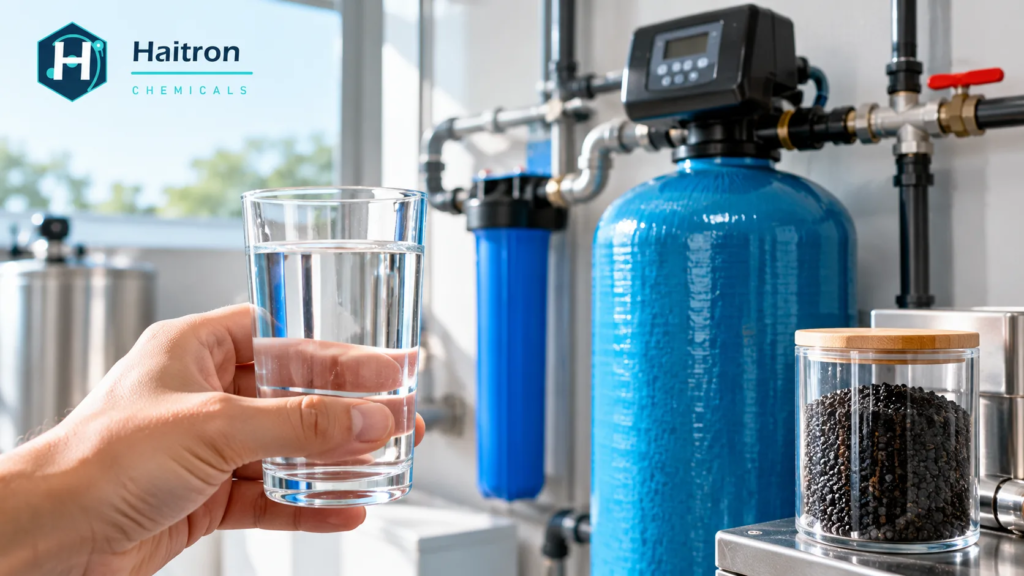
Catalytic carbon is activated carbon that’s been treated to break chloramine apart faster. It’s the usual choice for whole house filters on chloramine water.
When you shop, look for a filter certified to reduce chloramine, not just “chlorine taste and odor.” NSF has a free online list where you can check which products carry a chloramine claim.
Reverse osmosis
Here’s where brands disagree. Some filter companies call RO the best answer. Some water utilities say RO doesn’t remove chloramine.
Both are partly right. A home RO system includes carbon prefilters, and that carbon removes the chloramine. The membrane alone isn’t what it. So an RO system works well, as long as its carbon stage is made for chloramine and you change it on time.
Vitamin C
Vitamin C neutralizes chlorine very fast, and water utilities list it as a chloramine fix too. It’s the active part of many shower filters and dechlorination tablets.
A US Forest Service study found about 2.5 parts of vitamin C (ascorbic acid) neutralize 1 part chlorine. That’s roughly 1 gram per 100 gallons for each 1 mg/L of chlorine. That study tested chlorine, so for chloramine, follow the product label.
One small tip: sodium ascorbate, a gentler form of vitamin C, won’t change your water’s pH. Plain ascorbic acid can lower it a little.
Water conditioners for fish and ponds
A basic dechlorinator breaks the bond between chlorine and ammonia. But it leaves the ammonia floating free in the water, and ammonia is toxic to fish. The risk is higher when the pH is above 7.
So use a conditioner labeled for chloramine that also handles ammonia. Dose it for the full amount of new water you’re adding.
Best chloramine removal for your needs
| Your use | Best method | Good to know |
| Drinking and cooking | Under sink catalytic carbon or RO with carbon | Check for a chloramine claim |
| Whole house | Catalytic carbon tank | Size it for your busiest water use |
| Shower or bath | Vitamin C filter or tablet | Water moves too fast for small carbon filters |
| Aquarium or pond | Chloramine rated conditioner | It must handle ammonia too |
| Home brewing | Campden tablets or carbon | Treat all your brewing water |
| Garden | Usually nothing | Soil breaks chloramine down quickly |
| Home dialysis | Your provider’s system | Follow your doctor’s instructions |
| Water softener | Catalytic carbon before the softener | See the section below |
Is your carbon filter big enough?
Contact time is how many minutes water spends inside the carbon. Experts call it empty bed contact time. You can work it out with simple math: carbon volume divided by water flow.
Here’s an example. A common whole house tank holds 1.5 cubic feet of carbon. That’s about 11 gallons, since 1 cubic foot equals 7.48 gallons. If water flows at 7 gallons per minute, the contact time is only about 1.6 minutes.
That’s far short of the 10 minutes ordinary carbon needs. That’s why whole house chloramine systems use catalytic carbon. Before you buy, ask the maker for the chloramine rating at your busiest flow rate.
Protect your water softener
A water softener won’t remove chloramine. Worse, chloramine slowly damages softener resin.
Resin beads are held together by tiny links, a bit like the knots in a net. Chloramine slowly cuts those knots. Over time, the beads swell, turn soft, and pack down. One water treatment company reports that about 1 ppm of chlorine can cut resin life in half.
There are two fixes:
- Put catalytic carbon first. It removes chloramine before it ever reaches the resin.
- Use tougher resin. More crosslinking usually means better resistance. Our strong acid cation resin comes as 001×7 (7% DVB) and 001×8 (8% DVB). The 8% grade gives up a little capacity for a sturdier bead.
If hard water keeps coming back sooner after each cycle, check your settings first. Our guide on how often a water softener should regenerate helps you rule that out.
How to check your chloramine removal is working
Testing is easy and cheap. Here’s how:
- Buy test strips that read total chlorine. Chloramine shows up there, not in free chlorine.
- Test your tap water before the filter, then test the water after it.
- The water after the filter should read at or near zero.
- Retest every month, and anytime the taste changes. A rising number means the carbon needs replacing.
Not sure if you need a filter, a softener, or both? Our guide on water softener vs water filter explains what each one does.
FAQs
Does a Brita or fridge filter remove chloramine?
Only partly. Small filters don’t give water enough contact time. Check the product’s certification for a chloramine claim.
Do shower filters remove chloramine?
Vitamin C shower filters can. Small carbon only shower filters struggle, because water rushes through too fast.
How long does it take to remove chloramine from aquarium water?
With a chloramine rated conditioner, it works almost instantly. Just follow the label dose for your tank size.
Is it safe to drink water without removing chloramine?
Yes. US health agencies say chloramine is safe to drink at the levels water companies use. Removal is mostly about taste, fish, brewing, and protecting equipment.
Can Haitron help protect my business’s softener from chloramine?
Yes. Just send us your water analysis, and our team will recommend the right resin and pretreatment for your system.
Key Takeaway
Good chloramine removal starts with knowing your use. Choose catalytic carbon for your home, vitamin C for showers, and a chloramine rated conditioner for fish. Then test before and after to make sure it’s really working.