How to Remove Nitrate from Water: Methods, Costs & the Right Fix for Your Supply
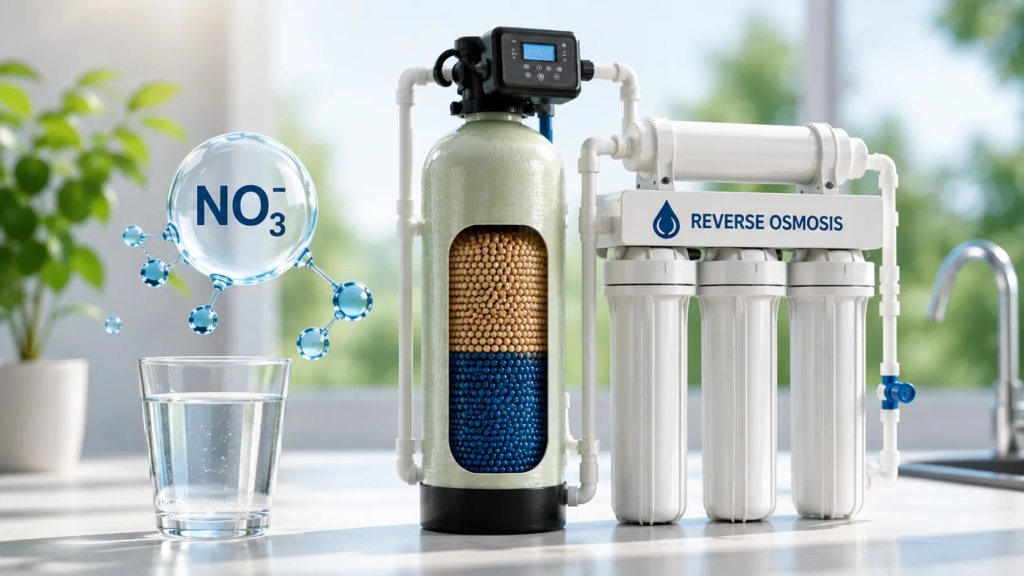
Nitrate removal from water isn’t complicated once you know which methods actually work. Your real options are ion exchange, reverse osmosis, electrodialysis, or biological denitrification. Skip the boiling, the carbon filters, and the regular water softener, none of them touch nitrate, no matter how long you run them. If you’re just treating water at one tap, reverse osmosis is usually your best bet. If you need to treat your whole supply or you’re dealing with continuous flow, nitrate selective ion exchange tends to work better.
On this page: what nitrate removal actually means, which methods genuinely work, how ion exchange pulls nitrate out, how to choose the right system, cost and performance, what doesn’t work, common mistakes, FAQs, and a glossary.
Key takeaways
- Test your water first. Nitrate has no taste, smell, or color, so you won’t know it’s there otherwise.
- Never mix up results reported “as nitrate” with results reported “as nitrogen.” They’re two different scales.
- Boiling, carbon filters, and standard water softeners won’t remove nitrate.
- A good ion exchange system needs the right resin, properly metered regeneration, and regular testing to keep working.
What Does Nitrate Removal from Water Mean?
In short, it means pulling the dissolved nitrate ion (NO₃⁻) out of water, or converting it, using a treatment process built specifically for dissolved ions, not just filtering it out.
Nitrate is dissolved in water, not suspended in it. That’s why a sediment filter can’t catch it, no matter how fine the mesh is.
Two health agencies set two different limits, using two different units:
- U.S. EPA: 10 mg/L, measured as nitrate nitrogen (NO₃-N)
- WHO: 50 mg/L, measured as nitrate ion (NO₃⁻), which works out to about 11.3 mg/L as nitrogen
50 mg/L as nitrate ion converts to roughly 11.3 mg/L as nitrate-N (using the WHO factor of 0.226). Never read a “50” against a “10” limit as if they’re on the same scale, because they aren’t.
Local standards vary by country, so match your lab report’s unit to your local limit before drawing any conclusions. See the EPA drinking-water regulations and WHO nitrate and nitrite fact sheet for the full detail.
Which Treatment Methods Actually Remove Nitrate?
Five methods actually get the job done: ion exchange, reverse osmosis, electrodialysis, biological denitrification, and distillation. Each one fits a different situation, so the right pick depends on what you’re treating and how much of it.
| Method | Best fit | Main limitation |
| Nitrate-selective ion exchange | Whole-supply, commercial, municipal flow | Produces nitrate-rich regeneration brine |
| Reverse osmosis | One drinking tap, multi-contaminant reduction | Produces reject water; needs membrane upkeep |
| Electrodialysis | Engineered central treatment | Higher complexity; concentrate disposal needed |
| Biological denitrification | Municipal/industrial plants with trained staff | Needs close biological control + post-treatment |
| Distillation | Small quantities | Slow, energy-intensive |
When it comes to nitrate removal from water, WHO names four methods as genuinely effective: ion exchange, reverse osmosis, biological denitrification, and electrodialysis. Coagulation, sedimentation, standard filtration, and chlorination simply don’t work, since nitrate is too soluble for any of them to touch.
If you’re only treating one kitchen tap, look for an RO system with a verified nitrate/nitrite reduction claim. That claim is optional under NSF/ANSI 58, so a label that only mentions TDS reduction hasn’t actually proven anything about nitrate.
How Does Ion Exchange Remove Nitrate from Water?
water flows through resin beads loaded with chloride. The resin grabs onto nitrate and releases chloride in its place. Once the resin’s capacity runs out, a salt (sodium chloride) brine flush strips the nitrate back out and reloads the resin with chloride.
This is anion exchange resin at work, which is a different chemistry than the cation resin found inside an ordinary water softener. Two vessels can look identical on the outside and still do completely different jobs.
Standard SBA Resin vs. Nitrate-Selective Resin
Standard strong base anion (SBA) resin does remove nitrate, but sulfate competes for the same binding sites, and it often wins that competition. As sulfate levels rise, nitrate capacity drops accordingly. Nitrate-selective SBA resin is built to favor nitrate over sulfate, which makes it the safer starting point when you’re dealing with high-sulfate water.
Resin selection should never be a guess. Base it on a full feed analysis covering nitrate, sulfate, chloride, alkalinity, TDS, pH, hardness, flow, and your target outlet quality. Haitron’s strong base anion resin family is worth looking at here, though you’ll want to confirm the exact nitrate-selective grade and check its data sheet before ordering.
What Is Nitrate Dumping?
It’s when an exhausted standard resin lets go of nitrate it had already captured, because a competing ion (usually sulfate) knocks it loose. Treated water can end up briefly carrying more nitrate than the raw feed did.
Nitrate-selective resin, metered service cycles, sufficient salt dosing, and timely regeneration all help reduce this risk, according to a current Purolite/Ecolab application guide.
How Do You Choose the Right Nitrate Treatment?
In short, effective nitrate removal from water comes down to running five steps in order. Don’t just size a system by tank diameter alone.
- Confirm the problem: Use an accredited lab, and note whether the result reads as nitrate, nitrate-N, nitrite, or nitrite-N.
- Test feedwater: Sulfate and other major ions change resin capacity and membrane performance, so test for those too.
- Define scale: For one tap, certified RO is often enough. For a whole building or continuous industrial flow, engineered ion exchange usually fits better.
- Plan waste: RO produces concentrate. Regenerable resin produces brine. Your disposal options can end up changing which method wins.
- Verify performance: Test the treated water right after commissioning, then keep testing on a schedule matched to loading, volume treated, and local rules.
Your supplier needs the water analysis, peak and average flow, daily volume, outlet target, regeneration method, temperature, and any pretreatment already in place. That’s the minimum needed to size a system correctly.
What Affects Cost and Performance?
There’s no universal price tag here. Flow rate, nitrate and sulfate loading, media type, pretreatment, automation, water recovery, and waste disposal all move the number up or down.
A cheaper resin isn’t automatically the cheaper choice, either. If sulfate causes early breakthrough or forces frequent regeneration, that upfront “savings” disappears fast once you factor in operating costs. It’s worth comparing lifecycle cost and verified treated-water performance, not just the sticker price on the media itself.
Which Common Treatments Do NOT Remove Nitrate?
boiling, carbon filters, sediment cartridges, chlorination, and standard water softeners all fail to remove nitrate.
Boiling doesn’t destroy nitrate at all. It just evaporates the water and concentrates whatever’s left behind, nitrate included. If your test result exceeds the applicable limit, switch to a safe alternative water source until a qualified local professional confirms your treatment plan. This matters most when you’re preparing infant formula.
Common Nitrate-Treatment Mistakes
- Comparing nitrate-ion and nitrate-N results without converting the units first
- Picking a resin without measuring sulfate and the full water chemistry
- Running an ion exchange bed past its safe service volume
- Assuming every RO system carries a certified nitrate claim
- Ignoring brine or concentrate disposal requirements
- Skipping post-installation and breakthrough testing
Frequently Asked Questions
Does reverse osmosis remove nitrate from water?
Yes, it can, though the results really come down to the whole system setup and how well it’s maintained, not just what’s printed on the RO label. If you plan to drink the water, make sure the specific model you’re looking at has a verified nitrate/nitrite reduction claim. Ideally one that’s been tested under NSF/ANSI 58.
Can a normal water softener remove nitrate?
No, it can’t. A standard softener works using cation resin, and that resin is built to target positively charged hardness minerals such as calcium and magnesium. Nitrate happens to carry a negative charge, so removing it calls for anion exchange or some other method designed specifically for that job.
Does boiling water remove nitrate?
No, it doesn’t. Boiling won’t get rid of nitrate in any way. What actually happens is the water evaporates while the nitrate is left behind, so if you boil it for a long time, the concentration can end up higher than when you started. If your test results come back above the limit, your best move is switching to an approved alternative water source.
Is ion exchange better than reverse osmosis for nitrate?
That really depends on what you’re working with. Ion exchange usually performs better when you’re dealing with continuous flow or need to treat an entire supply, whereas reverse osmosis tends to be the smarter pick for a single tap, especially if you also want broader contaminant reduction. In the end, your water chemistry, your flow rate, and how you’re able to handle waste are what settle the question.
How often should treated water be tested?
The first test should happen right after installation. After that, how often you retest depends on things like how much your raw water varies, the volume you’re treating, how the resin is holding up, and whatever rules apply in your area. There’s really no single schedule that fits every system out there.
Can activated carbon remove nitrate?
Not really, no. Regular activated carbon is useful for filtering out other contaminants and can work well as a pretreatment step, but it isn’t built to handle dissolved nitrate. That job needs a technology made specifically for it.
What is the best way to remove nitrate from water?
Honestly, it depends on the scale you’re working at. If you just need one drinking tap covered, a certified RO system usually does the trick. But if you’re treating a whole building’s supply or running continuous flow, nitrate-selective ion exchange tends to be the more practical route.
What is nitrate dumping?
This happens when a standard anion resin becomes exhausted and ends up releasing nitrate it had already captured, usually because a competing ion, most often sulfate, pushes it back out.
How do I choose a nitrate-removal resin?
Start by getting a full water analysis done rather than guessing. You’ll want numbers for nitrate, sulfate, chloride, alkalinity, TDS, pH, flow rate, and the outlet quality you’re aiming for. Once you have that data, let it guide your resin choice instead of the other way around.
Glossary
- Nitrate (NO₃⁻): A dissolved ion that carries a negative charge. It shows up most in water touched by fertilizer runoff or septic systems.
- Nitrate-nitrogen (NO₃-N): Nitrate measured through its nitrogen content. It’s the unit the U.S. EPA leans on when setting its regulatory limit.
- Strong base anion (SBA) resin: A resin that strips out negatively charged ions, nitrate and sulfate among them, by trading them for chloride.
- Nitrate-selective resin: An SBA resin designed to favor nitrate over sulfate, lowering the odds that nitrate dumping will happen.
- Breakthrough: The stage where a resin bed has maxed out and can’t grab any more target ions, so they start leaking into the treated water.
- Nitrate dumping: A sudden burst of nitrate escaping resin that had already caught it, set off when a competing ion forces it out of exhausted resin.
- Regeneration brine: A salt (sodium chloride) mix used to bring worn-out resin back to its chloride form so it can keep working.
- Reject water: The concentrated leftover stream a reverse osmosis system pushes out as waste.
Final Decision
Before choosing anything, match your lab report’s unit to the correct local limit. For nitrate removal from water at a single drinking tap, certified point-of-use RO is usually the right fit. But if you’re dealing with continuous, whole-supply, or higher-flow treatment, properly designed nitrate-selective ion exchange tends to work better, especially once you factor in sulfate competition.
Ready for a recommendation? Send Haitron your feed analysis, including flow rate, daily volume, target outlet nitrate, sulfate level, regeneration plan, and location. Haitron will confirm the exact resin grade and documented operating limits before putting together a quote.