Does a Water Softener Remove Lead? A Simple Guide
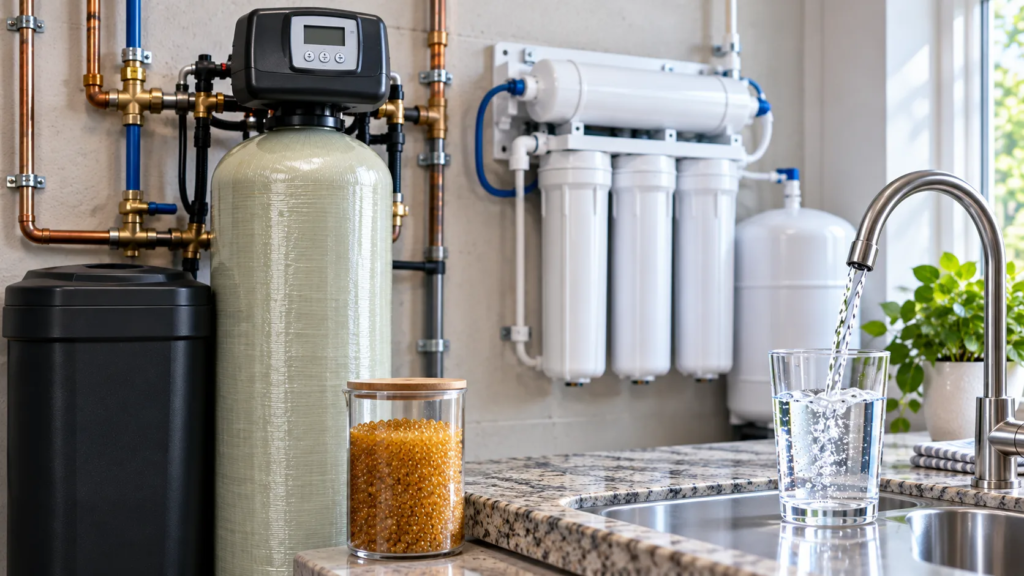
Does a water softener remove lead? Only a little, and not in a way you can trust. A water softener is made to fight hard water, not to keep lead out of your glass. So if you are asking “does a water softener remove lead,” the safe answer is no. You need a special lead filter.
Let’s find out why, using easy words.
What Is Lead, and Why Is It Bad?
Lead is a heavy gray metal. Long ago, people used it to make water pipes and to join pipes together.
Lead is bad for our bodies. It is extra bad for babies, young kids, and moms who are expecting. The EPA says the safest amount of lead in drinking water is zero.
Here is the tricky part. You can’t see, smell, or taste lead in water.
How a Water Softener Works
Some water carries lots of rock minerals. We call this hard water. It leaves white spots on cups and taps. You can learn more in our guide on hard water vs. soft water.
A water softener is a big tank full of tiny beads. The beads grab the minerals that make water hard and swap them for a little bit of sodium.
Those beads are made from ion exchange resin. They are great at catching hard minerals. But a softener is a mineral catcher, not a safety filter.
Does a Water Softener Remove Lead at All?
It can catch one kind of lead, but not the other. Lead hides in water in two ways.
Dissolved lead has melted into the water, like sugar in tea. The softener beads can grab some of this lead, the same way they grab hard minerals.
Lead bits are tiny flakes and specks, like sand in water. The beads can’t grab these. They slip right past.
The Water Quality Association says about 40 to 60 percent of the lead in city water is usually in these tiny bits. So a softener can miss about half the lead, or even more.
Why a Water Softener Is Not a Lead Filter
Here are four big reasons.
1. Lead often gets in after the softener. Most lead does not come from rivers or the ground. It comes from old pipes, old faucets, and the metal glue (called solder) used to join copper pipes. A softener usually sits where water first enters your home. Any lead picked up after that point goes straight to your tap.
Homes built before 1986 are more likely to have lead pipes, lead solder, and old brass faucets.
2. Softeners are not tested for lead. Water products get tested by groups like NSF. Softeners are tested for hard water. They are not certified to remove lead.
3. Busy water flow makes it weaker. When the shower, washing machine, and kitchen tap all run at once, water rushes through the tank fast. The beads have less time to catch anything.
4. It gives no warning. When a softener stops working, you see spots and scale again. With lead, you get no clue at all. The water looks and tastes the same.
Does Softened Water Make Lead Worse?
You may read online that softened water pulls lead out of pipes. Experts don’t fully agree on this.
Some state health offices advise care when adding a softener to a home with lead pipes. But an EPA study found that softened water did not cause more lead to leak from pipes.
So here is the simple rule. A softener isn’t proven to make lead worse, but it doesn’t fix lead either. If your home has old pipes, test your water after you install one.
What Removes Lead From Water?
Good news! You have safe choices.
A certified lead filter. Pick a pitcher, faucet, or under-sink filter that says NSF/ANSI 53 and lists lead reduction on the box. It catches both kinds of lead. Just change the cartridge on time.
A reverse osmosis system. An RO filter under your sink pushes water through a super fine screen. It removes most lead, including the tiny bits. Look for NSF/ANSI 58. Bonus: it also takes out the extra sodium a softener adds.
Distilled water. Distilled water has no lead, so it works for drinking in a pinch. Read more in our post about how you can drink distilled water.
New pipes. Replacing lead pipes and old faucets fixes the problem at the start. Ask your water company if it has a lead pipe replacement program.
What does not work: boiling. The EPA says boiling water does not remove lead. As water boils away, the lead left behind can get a little stronger.
Do You Need a Lead Filter? Quick Check
You should get a certified lead filter if:
- Your home was built before 1986
- You have old brass faucets
- Your water company says you have a lead service line
- You have a baby, young kids, or someone pregnant at home
- Your lead test shows any lead
If your home is newer and a lab test shows no lead, you may not need one.
What About Well Water?
Can a water softener remove lead from well water? Not well enough. Lead is rarely found in underground water itself. In homes with wells, it usually comes from old plumbing or pump parts.
So test the water at your kitchen tap, not just at the well. Our page is well water safe to drink explains well testing step by step.
How to Test Your Water for Lead
- Find a certified lab. Your water company or state can give you a list. Some test for free.
- Collect “first draw” water. That’s water that sat in your pipes for 6 hours or more, like first thing in the morning.
- Take the sample from the tap you drink from.
- Read your results. Lead is shown in ppb (parts per billion). Lower is better, and zero is best.
- Test again after plumbing work or a new filter.
Until you get results, use only cold water for drinking and cooking.
Lead Rules Are Changing
Right now, water companies must act if too many homes test above 15 ppb. A new EPA rule lowers that to 10 ppb starting November 1, 2027, and asks most cities to replace lead pipes within 10 years.
Even if your city passes, your own pipes can still add lead. Only a test at your tap tells the truth.
Quick Questions
Do water softeners remove heavy metals?
They can catch a few dissolved metals. But they are not made or tested to remove lead, so don’t count on it.
Is softened water safe to drink if I have lead pipes?
Softening does not make lead safe. Use a certified lead filter for drinking and cooking water.
Should I keep my water softener?
Yes, if you have hard water. It still protects your pipes and appliances from scale. Just add a lead filter for drinking water. Still shopping? Check how much is a water softener costs before you buy.
Final Thoughts
So, does a water softener remove lead? It can catch a little dissolved lead, but it misses lead bits and any lead your pipes add after it. That’s why you should never trust it to keep your family safe from lead. Test your tap water, and if you find lead, add a filter certified to NSF/ANSI 53 or 58. Now you know the real answer to “Does a water softener remove lead?” and you can keep every glass of water clean and safe.