How to Remove Sulfate From Water: What Works at Home and at Scale
Want to know how to remove sulfate from water? For drinking water, use reverse osmosis, which removes 93 to 99% of it. Small batches are best handled with distillation. If you need to treat the whole house, anion exchange is the way to go.
Water softeners and carbon filters won’t remove sulfate. This guide shows which method fits your sulfate level, and one trap that catches many well owners.
Sulfate or hydrogen sulfide? Check first
These two sound alike, but they’re very different problems. Sulfate is a dissolved mineral, a bit like salt in water. Hydrogen sulfide is a gas that smells like rotten eggs.
| Question | Sulfate | Hydrogen sulfide |
| What it is | A dissolved mineral | A dissolved gas |
| Smell | None | Rotten eggs |
| Taste | Bitter or medicinal at high levels | Like sulfur |
| Main problem | Upset stomach at high levels | Bad smell, black stains, corrosion |
| How to treat it | Reverse osmosis, distillation, anion exchange | Aeration, oxidation, special filters |
If your water smells bad, start with our guide on why your water smells like rotten eggs. Some wells have both problems, because certain bacteria can turn sulfate into that smelly gas.
How much sulfate is too much?
Here’s what different sulfate levels mean for your drinking water:
| Sulfate level (mg/L) | What it means |
| Under 250 | Below the EPA taste guideline. Treatment usually isn’t needed. |
| 250 to 500 | Water may taste bitter or medicinal. Treat it if the taste bothers you. |
| Over 500 | Above the EPA health advisory for a laxative effect. Don’t use it for baby formula. |
| Over 1,000 | Stomach effects get stronger. Treat your drinking water. |
(mg/L means milligrams per liter. It’s the same as parts per million, or ppm.)
Taste also depends on which mineral the sulfate is paired with. The EPA says people may taste sodium sulfate from 170 to 370 mg/L, calcium sulfate from 180 to 640 mg/L, and magnesium sulfate from 320 to 480 mg/L.
Adults often get used to high sulfate water over time. Babies and visitors are more likely to get an upset stomach. Young farm animals can be harmed too.
How to remove sulfate from water: methods compared
| Method | Sulfate removal | Best for | Downsides |
| Reverse osmosis (RO) | 93 to 99% | Drinking and cooking water | Wastes some water, removes other minerals |
| Distillation | Nearly 100% | Small daily amounts | Slow, uses electricity |
| Anion exchange | High, until the resin fills up | Whole house, livestock, larger supplies | Adds chloride, nitrate risk, needs salt |
Reverse osmosis
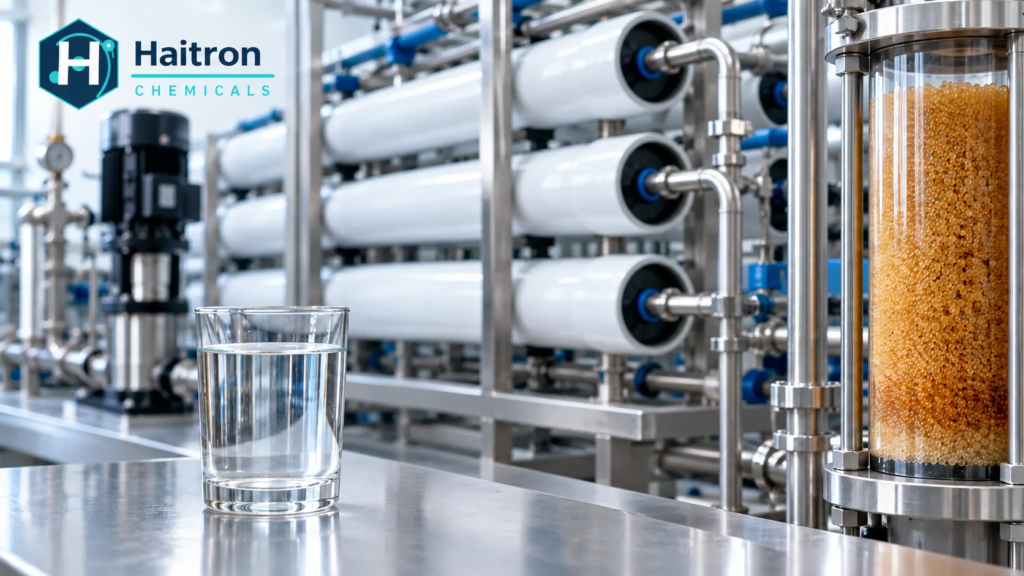
Reverse osmosis pushes water through a very fine membrane. Think of it like a super tight sieve that holds back dissolved minerals.
It’s the simplest fix for drinking water. Some RO units are certified by NSF for sulfate removal, so look for that claim. If your water is also hard, a softener before the RO helps the membrane last longer.
Distillation
A distiller boils water and catches the steam, leaving the sulfate behind. It removes nearly all of it. But it’s slow, so it works best for just a few gallons a day.
Anion exchange
An anion exchange unit looks a lot like a water softener. The difference is the resin inside. Its tiny beads hold chloride. As water flows through, the beads grab sulfate and let go of chloride instead. When the beads fill up, the unit gets recharged with salt water.
That swap means your water gains chloride. For every 100 mg/L of sulfate removed, the water gains about 74 mg/L of chloride.
Here’s an example. If your well has 400 mg/L of sulfate and the unit removes it all, you’d gain about 296 mg/L of chloride. That’s above the EPA taste guideline for chloride, which is also 250 mg/L. So for very high sulfate water, reverse osmosis may be the better choice.
The nitrate trap with anion exchange
We make anion resin, and this is the warning we share most often.
Standard anion resin has favorites. It likes sulfate most, then nitrate, then chloride. That’s great for grabbing sulfate. But it can cause trouble if your water also has nitrate, which is common in farm wells.
As the resin fills up, sulfate keeps pushing nitrate off the beads. Near the end of a cycle, the water coming out can hold more nitrate than the water going in. This is called nitrate dumping.
One water industry example shows how bad it can get. Water with 80 ppm nitrate and 85 ppm sulfate produced treated water with nearly 165 ppm nitrate. That matters, because nitrate is dangerous for babies.
So before you pick anion exchange:
- Test for nitrate as well as sulfate.
- If you have nitrate, recharge the unit well before the resin is full, or use RO for drinking water.
- Know that nitrate selective resins prefer nitrate over sulfate, so they aren’t a sulfate fix on their own.
For reference, our 201×7 strong base anion resin is a Type I gel resin in chloride form, with a capacity of at least 1.35 mmol/mL. The right size of unit depends on your full water test, so check that first.
What doesn’t remove sulfate
When people look up how to remove sulfate from water, they often try these first. None of them work:
- Water softeners remove calcium and magnesium, not sulfate. Our guide on water softener vs water filter explains what each system really does.
- Carbon filters, pitchers, and fridge filters don’t remove dissolved sulfate.
- Boiling makes sulfate stronger, because the water leaves as steam and the sulfate stays behind.
Industrial sulfate removal
Factories and treatment plants use bigger tools, often together:
| Method | How it works | Typical use |
| Lime treatment | Forms gypsum that settles out | Cuts high sulfate by around 80% |
| Barium salt polishing | Forms barium sulfate, which barely dissolves | Final cleanup step |
| Nanofiltration and RO | Membranes block sulfate | Among the most effective options |
| Ion exchange | Resin swaps sulfate for another ion | Polishing lower salt water |
| Electrocoagulation | Electric current forms clumps you can remove | Certain wastewater cases |
FAQs
Is sulfate in water harmful?
Usually not at normal levels. Above about 500 mg/L, it can cause diarrhea, especially in babies and people who aren’t used to it.
Why does my water taste bitter?
Sulfate paired with sodium or magnesium is a common cause. A lab test for sulfate will tell you for sure.
Can I test for sulfate at home?
Home test strips can give you a rough idea. For a reliable number, send a sample to a certified water lab.
Should I test for nitrate too?
Yes, especially on farm wells. Nitrate affects which treatment is safe, and it’s dangerous for babies.
Can Haitron help me choose a sulfate removal system?
Yes. For livestock, commercial, or industrial systems, just send us your full water analysis. Our team will recommend the right resin and setup.