How Much Is a Water Softener?
A water softener costs $500 to $2,500 for the unit on its own, or $1,200 to $3,800 fitted by a plumber. The single biggest thing driving that price is how much ion exchange resin is inside the tank.
Most buying guides answer how much is a water softener with a list of prices and stop there. They never explain what you are actually paying for. We manufacture the resin that goes inside these systems, so this guide looks at the question from the inside out.
What you can expect to pay
Prices vary by system type:
- Single tank salt based (ion exchange): $500 to $1,700 for the unit
- Dual tank salt based: $1,000 to $5,000
- Salt free conditioner: $800 to $4,000
- Magnetic or electronic descaler: $200 to $600
Ranges published across the industry run from $200 all the way to $6,000, with roughly $1,500 the most commonly quoted average. That spread confuses people. It exists because some sources quote the unit alone, some quote it fitted, and some include reverse osmosis systems that are not softeners at all.
What installation adds
Professional installation usually adds $200 to $500 on top of the unit price, and more if the plumbing needs reworking.
Costs climb when your water line is hard to reach, when a drain connection has to be run for the regeneration cycle, when an electrical outlet needs adding, or when local permits are required. A straightforward garage or basement fit near existing pipework sits at the cheap end.
Why capacity is really about resin volume
Softeners are sold by grain capacity, but grain capacity is just a measure of how much resin is in the tank.
A typical home system holds this much strong acid cation resin:
- 24,000 grain: around 0.75 cubic feet
- 32,000 to 48,000 grain: 1 to 1.5 cubic feet
- High capacity units: 2 cubic feet or more
More resin means more hardness removed between regenerations. It also means a bigger tank, a bigger valve and a higher price. So when you compare two units and one costs twice as much, check the resin volume before you assume you are paying for a brand name.
Not all resin is the same
Here is the part almost nobody explains, and it matters more than the badge on the front.
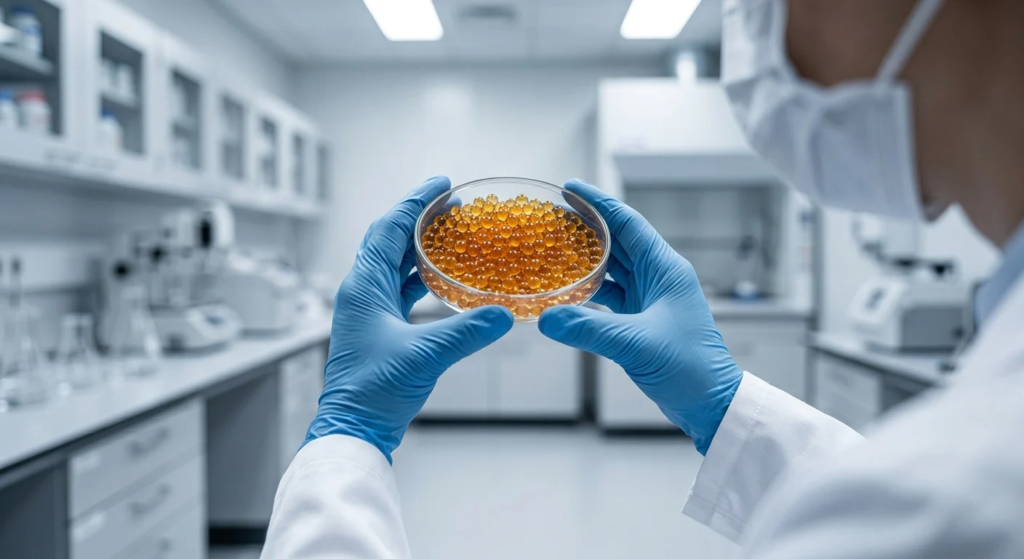
Resin beads are graded by crosslink percentage, which describes how tightly the polymer structure is bound. Standard 8 percent crosslink resin typically lasts 8 to 12 years. Higher grade 10 percent crosslink resin lasts 12 to 15 years or more.
Bead quality matters too. Uniform, whole beads pack evenly and let water flow through the bed predictably. Cheaper resin carries more cracked and fragmented beads, which channel water around the bed instead of through it. The softener still runs. It just stops softening properly, years earlier than it should.
This is the honest reason a $500 unit and a $1,800 unit behave so differently over a decade. Budget systems save money on resin volume and resin grade, and you feel it in year six rather than year one.
Running costs
Budget $10 to $25 a month for a salt based system once it is installed.
That covers salt, which usually runs $5 to $10 a bag, plus the water used during regeneration and a small amount of electricity. Choosing between evaporated salt, solar salt, rock salt and potassium chloride affects both your monthly cost and how clean the brine tank stays, and our guide to water softener salt types breaks down which suits which system.
Salt free conditioners have no salt cost, but they do not remove hardness. They only reduce scale formation.
What shortens resin life
Resin degrades, and how fast depends almost entirely on what you send through it.
Iron is the worst offender. Dissolved iron gets exchanged onto the resin along with calcium and magnesium, but it does not rinse off cleanly during regeneration. It builds up and coats the beads, a problem called iron fouling. If you are wondering whether a water softener removes iron, the short answer is only a little, and it pays a price for doing it.
Chlorine attacks the polymer structure in municipal supplies, slowly breaking down the crosslinks. Our article on whether a water softener removes chlorine explains why a carbon prefilter is worth fitting.
Undersizing forces the system to regenerate constantly, which ages the bed faster. Freezing damages beads permanently.
Clean municipal water with a correctly sized system is where you get the full 15 years.
Replace the resin, not the softener
When a softener stops working after a decade, the resin has usually failed while the tank and valve are still fine.
Replacing the resin costs $200 to $400, or roughly $295 per cubic foot fitted. A new system starts around $1,695. A replacement valve runs about $545.
So before you accept a quote for a whole new unit, ask what actually failed. A useful rule of thumb: if the repair costs more than half the price of a new system, replace. Below that, re bedding gives you another decade for a fraction of the money.
Companies that sell softeners rarely lead with this advice. We make resin, not softeners, so we have no reason to hide it. You can see the full range of ion exchange resins we produce if you want to understand what goes into these systems.
Is it worth the money?
For genuinely hard water, usually yes.
Scale shortens the life of water heaters, dishwashers and washing machines, and forces heaters to work harder. You use noticeably less soap and detergent. Over the 10 to 20 year life of a system, avoided appliance replacements often outweigh the purchase price.
For mildly hard water, the maths is much closer. Test your hardness before deciding.
Frequently asked questions
How long does a water softener last? Usually 10 to 20 years. Mid range systems with quality valves often pass 15. Budget units frequently fail at 5 to 8.
Can I install one myself? Yes, if you are comfortable with plumbing. DIY saves the $200 to $500 labour cost but may affect the warranty.
How do I know when the resin is spent? Water tests hard right after a full regeneration, the system regenerates more often than it used to, or small beads appear at the taps.
Does a bigger softener cost more to run? Not necessarily. A correctly sized system regenerates less often, which uses less salt and less water.
What size do I need? Multiply the people in your home by daily water use, then by your water hardness in grains per gallon. That gives your daily grain requirement.
How much is a water softener compared with the cost of hard water? Over ten years, scale damage to heaters and appliances often costs more than the system itself in hard water areas.
The short version
So, how much is a water softener? Between $500 and $2,500 alone, or $1,200 to $3,800 installed. The price tracks resin volume and resin grade more closely than anything else, so check the cubic feet of resin and the crosslink percentage before you compare two quotes.
If you have a technical question about the resin in your system, or you specify resin for water treatment at scale, get in touch with our team.