What Are Ion Exchange Resin Beads? A Practical Guide
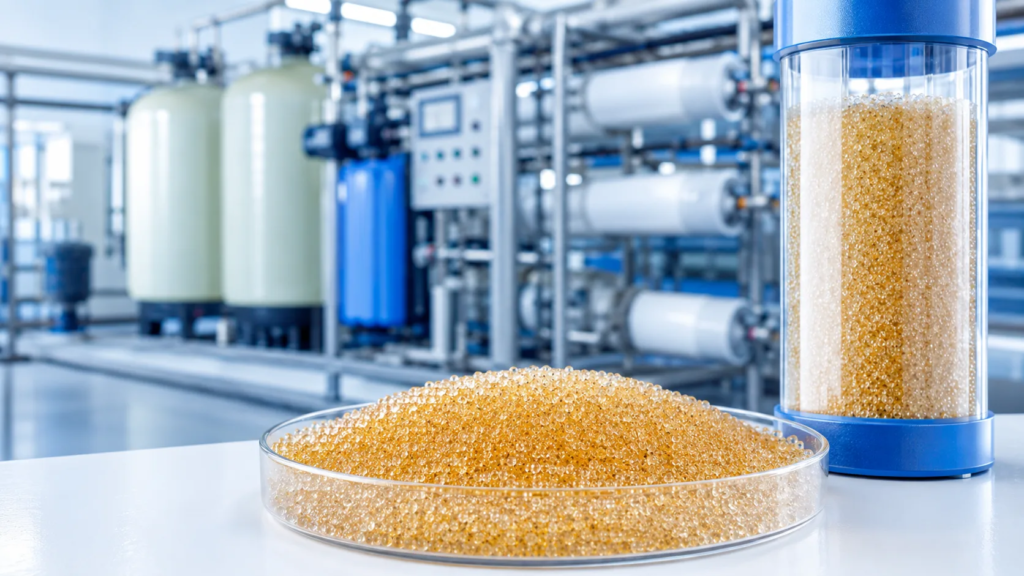
Ion exchange resin beads are these tiny round polymer particles, and what they do is pull dissolved ions out of water (or other liquids) by swapping them out for different ions that carry the same charge. That’s really the whole trick behind them. And they’re not just some filter sitting there; they’re actually the part doing all the real work inside water softeners, deionizers, and demineralization systems. Basically the purifying happens because of them, not around them.
What Are Ion Exchange Resin Beads?
Ion exchange resin beads are tiny, insoluble polymer spheres, usually somewhere between 0.3 and 1.2 mm in diameter, built with charged chemical sites both on their surface and throughout their internal structure. As water flows through a bed of these beads, ions present in the water bind to those charged sites, and in return, the resin releases a different, harmless ion into the water. The end result is water that has fewer of the original dissolved ions and more of whatever ion the resin was preloaded with.
This is exactly why the same underlying technology can be used both to soften hard water (by removing calcium and magnesium) and to fully demineralize water for industrial or pharmaceutical purposes (by removing nearly all dissolved ions).
How Do Ion Exchange Resin Beads Work?
The Ion Exchange Reaction, Simplified
Each bead is filled with fixed functional groups, chemical sites that are permanently bonded to the polymer, and these sites carry an electrical charge. A cation resin bead has negatively charged sites that attract positively charged ions such as calcium, magnesium, or sodium. An anion resin bead has positively charged sites that attract negatively charged ions such as chloride, sulfate, or bicarbonate.
Before the resin is put to use, it’s “charged” with a specific ion, usually sodium for softening or hydrogen and hydroxide for demineralization. As water passes through, the resin swaps out its stored ion for the unwanted ion found in the water. In water softening, for instance, calcium and magnesium ions attach themselves to the resin, while sodium ions are released into the water in their place.
Regeneration: Why Resin Isn’t a One-Time-Use Product
Resin beads only have a limited number of exchange sites. Once most of those sites are filled with captured ions, the resin becomes “exhausted” and stops working the way it should. Regeneration is what reverses this process: a concentrated salt solution (for cation resin) or an acid or caustic solution (for anion resin) is passed through the bed, pushing the captured ions off the resin and replacing them with fresh sodium, hydrogen, or hydroxide ions. This is exactly why softeners and deionizers require regular regeneration cycles instead of running nonstop forever.
What Are Ion Exchange Resin Beads Made Of?
Most commercial resin beads start life as a polystyrene base. That base gets cross-linked with divinylbenzene (DVB), and this step is what gives the bead its strength and controls how much it swells once it’s sitting in water.
The amount of DVB crosslinking makes a real difference. It’s usually around 8%, though this number shifts depending on the resin grade. Basically, that percentage decides how tough the bead is, how much it can actually exchange, and how it holds up once you throw different working conditions at it.
From there, functional groups get chemically bonded onto the polymer. Strong acid cation resin relies on sulfonic acid groups, while strong base anion resin uses quaternary ammonium groups. These groups are really what give ion exchange resin beads their ability to exchange ions in the first place.
Main Types of Ion Exchange Resin Beads
Cation Exchange Resins
- Strong Acid Cation (SAC): This type works across the full pH range, so it’s a go-to choice for water softening, and it also handles the cation stage during demineralization.
- Weak Acid Cation (WAC): It’s limited to a narrower pH range, but it makes up for that with extra exchange capacity, which comes in handy for jobs like alkalinity reduction.
Anion Exchange Resins
- Strong Base Anion (SBA): Removes a wide range of anions, silica included, which is exactly why it’s used in full demineralization systems.
- Weak Base Anion (WBA): Mostly deals with strong acids, and it’s often brought in as a cheaper first stage, with an SBA step following to finish the polishing work.
Gel Type vs. Macroporous Structure
| Feature | Gel Type Resin | Macroporous Resin |
| Structure | Homogeneous, no visible pores | Permanently porous, sponge-like structure |
| Exchange capacity | Generally higher | Slightly lower |
| Resistance to fouling/oxidation | Lower | Higher |
| Best suited for | Clean water, standard softening/demineralization | Water with organics or oxidizing contaminants |
| Physical robustness | Good under normal conditions | Better resistance to osmotic shock |
Neither type is universally “better.” It really comes down to the feed water quality and what the application actually needs.
Where Are Ion Exchange Resin Beads Used?
- Water softening: This is the one most people run into at home; residential and commercial softeners use it to strip calcium and magnesium out of the water supply.
- Demineralization/deionization: Boiler feedwater, power plants, and industrial process lines lean on this whenever the water needs to come out about as pure as possible.
- Pharmaceutical and laboratory water purification: Comes up wherever the rules demand water that’s essentially ion free, no exceptions.
- Food and beverage processing: Plays a role in sugar decolorization, clarifying juice, and handling general process water along the way.
- Metal recovery and wastewater treatment: Handy for pulling specific metal ions out selectively or recovering them for reuse.
How Do You Choose the Right Resin Beads?
- Identify your target ions. For softening, you’re dealing with calcium and magnesium, so cation resin does the job. Full demineralization is a bigger ask that needs both cation and anion stages working together.
- Check your feed water quality. If organics or oxidizers are on the higher side, that usually steers you toward macroporous resin rather than the gel type.
- Match resin type to pH range and application. Strong acid and strong base resins can shrug off broader conditions, while weak acid and weak base resins are better matched to narrower, more targeted uses.
- Confirm capacity and bead size specs actually fit your system’s flow rate and vessel design before moving forward.
- Verify certification, something like NSF/ANSI 61, if this resin is ever going to touch drinking water.
- Ask about regeneration chemical compatibility with your current setup before you lock anything in.
Common Mistakes and Misconceptions
- “Resin beads purify water forever.” Not really; capacity is limited, and sooner or later regeneration becomes necessary.
- “All resin beads are interchangeable.” Gel versus macroporous, strong versus weak, these don’t just swap in for one another. Performance shifts a lot depending on what you’re actually using them for.
- Ignoring feed water quality. Choosing resin based on price alone, while skipping checks for organics, iron, or oxidizers in the source water, is one of the more common reasons systems foul out early.
- Skipping certification checks for potable water applications, which tends to turn into a compliance headache further down the road.
Frequently Asked Questions
Are ion exchange resin beads safe for drinking water?
Resins built for potable water go through standards such as NSF/ANSI 61, which sets rules for materials that touch drinking water. Check the certification yourself rather than assuming any given resin grade automatically qualifies.
How long do ion exchange resin beads last?
There’s no set number for this; water quality, how often you regenerate, and the operating conditions all shape the outcome. Resin sitting in oxidizers or fouling contaminants breaks down quicker than resin on cleaner feed water.
Can ion exchange resin beads be reused?
Yes, and honestly that’s the entire reason regeneration exists. Resin that’s regenerated properly can go through cycle after cycle of reuse before wear finally means it’s time to swap it out.
What’s the difference between ion exchange and reverse osmosis?
Ion exchange pulls ions out through chemical exchange happening on the resin beads themselves. Reverse osmosis, on the other hand, forces water through a membrane that physically blocks dissolved solids. In practice, the two often get paired up.