Water Softener Salt Types: How to Choose the Right One
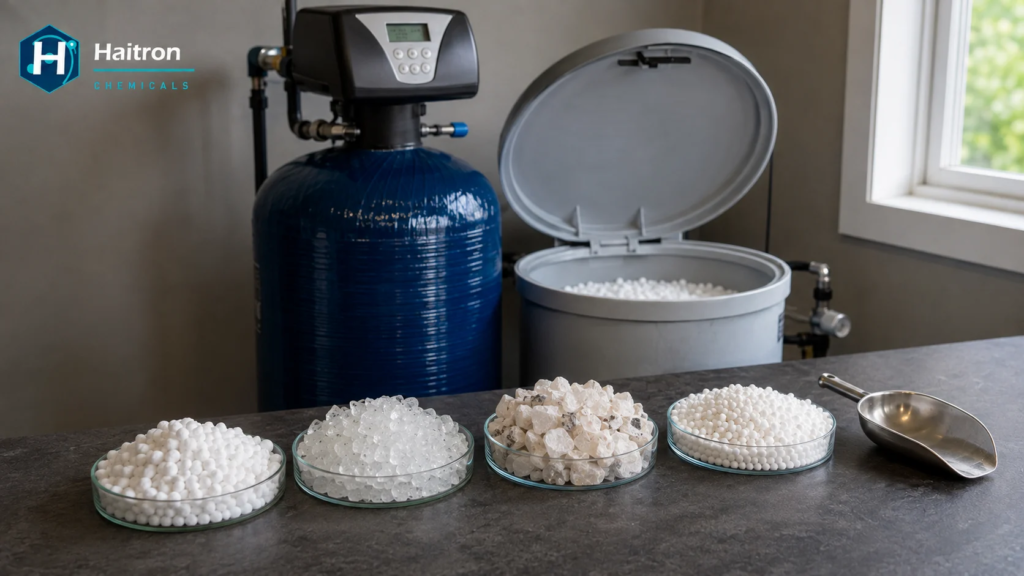
Water softener salt comes in four types: evaporated salt, solar salt, rock salt, and potassium chloride. The first three are all sodium chloride. They differ in purity and in how they are made. Potassium chloride is a different compound that leaves potassium in your water instead of sodium. For most homes, high purity evaporated salt is the safest default. This guide covers what separates the types, what each one puts into your water and your drain, and how to match a type to your softener.
How Salt Type Affects a Water Softener
A softener does not use salt directly. It dissolves salt into brine. That brine then flows through the resin bed and strips off the calcium and magnesium the resin has collected. The valve draws a set volume of brine on each cycle.
GE Appliances states the point plainly in its support documentation. The softener cannot tell whether the brine tank holds sodium chloride or potassium chloride, and it makes the same amount of brine either way.
So the exchange chemistry is the same across every sodium chloride product on the shelf. What changes is how completely the salt dissolves and what it leaves behind. Those two things decide your maintenance, not your water quality.
Water Softener Salt Types Compared
| Type | What it is | Common forms | Dissolving | Residue left in tank | Best for |
|---|---|---|---|---|---|
| Evaporated salt | Brine evaporated under heat until sodium chloride crystallises, then compacted | Pellets, cubes, tablets | Fast and near complete | Minimal | Most softeners, hard water, humid utility rooms |
| Solar salt | Seawater or brine evaporated by sun and wind in shallow ponds | Crystals, some pellets | Slower, less complete | Moderate | Low to moderate hardness on a budget, if the tank gets cleaned |
| Rock salt | Mined halite with little processing | Coarse chunks | Uneven | Highest | Only where the softener manual specifically allows it |
| Potassium chloride | A different salt, KCl instead of NaCl | Pellets | Comparable to evaporated | Minimal | Sodium restricted households, brine discharge rules |
| Block and tablet salt | Compacted high purity sodium chloride, EN 973 grade in Europe | Blocks, curved blocks, tablets | Designed for the cabinet it fits | Minimal | Softeners built for that exact format |
Purity is the number brands compete on. Published figures vary between products and between sources. Read the purity claim on the bag as a per product spec, not a fixed property of the category.
Evaporated Salt: The Default for Most Softeners
Evaporated salt is made by driving water off brine under heat until sodium chloride crystallises. The crystals are then compacted into pellets, cubes or tablets. It is the highest purity grade in general sale, and it dissolves close to completely.
GE Appliances recommends nugget, pellet or coarse solar salt at 99.5 percent purity or higher. Evaporated pellets clear that bar comfortably. Choose them if your water is hard, your household uses a lot of water, or the brine tank sits somewhere humid.
Solar Salt: Cheaper, With a Cleaning Trade-off
Solar salt is made by letting sun and wind evaporate seawater in shallow ponds, leaving crystals behind. Diamond Crystal, which manufactures both formats, describes crystals as the pond evaporated product. Pellets, cubes and blocks are made by compacting smaller granules together, and those larger pieces are less prone to forming a crust.
Solar salt costs less per bag and performs well at low to moderate hardness. It carries more insoluble material, so residue builds up faster in the tank. That is a maintenance cost, and it only bites if nobody cleans the tank.
Rock Salt: Cheapest Per Bag, Most Expensive Per Problem
Rock salt is mined halite, sold with minimal processing. Its insoluble minerals never enter the brine. They settle at the bottom of the tank, where they can block the brine well, the screen and the injector. A blocked brine draw is what actually stops a regeneration from working.
Unprocessed rock salt does not normally meet the 99.5 percent purity floor GE Appliances specifies. Unless your manual names rock salt, the money saved on the bag tends to come back as a service call.
Potassium Chloride: Same Softener, Different Chemistry
Potassium chloride regenerates the same resin in the same softener. It leaves potassium on the resin instead of sodium. Two things change when you switch.
Why You Need More of It
The weight difference is arithmetic, not marketing. Sodium chloride has a relative molecular mass of 58.45, as stated in EN 973. Potassium chloride sits at 74.55 according to the NIST Chemistry WebBook. A pound of potassium chloride therefore holds about 22 percent fewer exchange units. Matching a given salt dose by weight takes roughly 28 percent more.
That is the chemical floor. Published guidance ranges from 10 to 30 percent because it mixes two different fixes: raising the salt dose, and raising the hardness setting so the valve regenerates sooner. GE Appliances takes the second route and tells owners to set hardness 20 percent higher on potassium chloride.
Who Should Not Drink It
WHO drinking water guidance is specific here. Potassium from softeners is not a concern for the general population. It flags people with kidney dysfunction, heart disease, coronary artery disease, hypertension, diabetes, adrenal insufficiency or existing hyperkalaemia. It also flags people taking medicines that interfere with potassium handling, along with older adults and infants. WHO recommends those groups seek medical advice about avoiding water treated by potassium chloride softeners. It notes the usual practical fix as well: keep one unsoftened tap, or a reverse osmosis unit, for drinking and cooking.
Block, Tablet and Granular Salt: What the Rest of the World Buys
Outside North America the format names change. Non electric twin cylinder softeners common in the UK, including Kinetico and Harvey units, take compressed blocks. Most single tank electric softeners in Europe take tablet salt in 10 kg and 25 kg bags. Granular salt still serves older units and dishwashers.
Europe also has a product standard that the US buying guides never mention. EN 973 covers sodium chloride used to regenerate ion exchangers in drinking water treatment. It recognises rock, sea and evaporated sources in both free flowing and compacted forms, and it sets purity criteria, impurity limits and test methods. On an unfamiliar European brand, EN 973 on the bag is a meaningful signal.
Formats are not interchangeable. A block cabinet will not run on tablets. Check the manual before switching format, not just before switching brand.
What Each Salt Type Adds to Your Water
| Regenerant | What ends up in your softened water | Published rate | What goes to drain |
|---|---|---|---|
| Sodium chloride (evaporated, solar, rock, block, tablet) | Sodium | About 7.5 mg of sodium per quart for each grain per gallon of hardness removed, per Penn State Extension | Chloride, plus the calcium and magnesium flushed off the resin |
| Potassium chloride | Potassium | Roughly 12.75 mg of potassium per quart for each grain per gallon, published in manufacturer FAQ tables and consistent with the ratio of atomic weights | Chloride, plus the same hardness ions |
A worked example. Water at 15 grains per gallon, softened with sodium chloride, gains about 113 mg of sodium per quart. That is roughly 28 mg in an 8 oz glass. The same water on potassium chloride gains about 190 mg of potassium per quart instead. Salt grade changes neither figure. Only the incoming hardness and the choice of regenerant do.
Choose Your Salt in Three Questions
- What does the manual specify? Format is not negotiable, and manufacturers publish a minimum purity. If that answers it, stop here.
- Is anyone on a restricted sodium diet, or does your area restrict brine discharge? If yes, consider potassium chloride, subject to the medical caveat above. A separate unsoftened drinking tap solves the same problem for less money.
- Who cleans the brine tank, and how often? If the answer is nobody, buy high purity evaporated pellets. If it happens on a schedule, solar salt is a fair saving.
What Changing Salt Will Not Fix
Salt type is a maintenance decision, not a performance upgrade. It will not solve any of these:
- Iron staining. A softener removes only a limited amount of dissolved iron. See does a water softener remove iron.
- Chlorine, taste or odour. Different problems, different media. See Does a water softener remove chlorine?
- Hard water right after a regeneration. Usually a valve setting. Check the water softener hardness setting first.
- Capacity that has faded over years. Resin degrades. Premium salt does not reverse it.
Salt consumption is driven by the dose setting and the regeneration frequency, not by the brand in the tank. NSF/ANSI 44 awards an efficiency rating only to demand initiated softeners that remove at least 3,350 grains of hardness per pound of salt and use no more than 5 gallons of regeneration water per 1,000 grains. California sets a stricter bar of 4,000 grains per pound. If salt use bothers you, that is where the saving lives.
Salt, Chloride and the Drain
Every regeneration sends chloride to the drain, whichever salt you use. The Minnesota Pollution Control Agency treats chloride as a permanent pollutant. One teaspoon of salt is enough to permanently pollute five gallons of water, and there is no feasible way to remove it afterwards. The Minnesota Department of Health names home softeners as one contributor, and notes that wastewater plants are not built to remove chloride.
Switching to potassium chloride changes the cation, not the chloride. If discharge is the real concern, the levers that work are a demand initiated softener, a correct hardness setting, the lowest workable salt dose, or a salt free water softener where scale control rather than true softening is the goal.
Frequently Asked Questions
What is the best water softener salt?
High purity evaporated salt pellets suit most residential softeners. They dissolve almost completely, leave little residue, and clear the purity minimum manufacturers publish. The better answer is always the grade and format named in your manual, since some cabinets only accept blocks or tablets.
Can I mix different types of salt in the brine tank?
You can, and the softener will still regenerate, but there is no benefit. Grades dissolve at different rates, and the lower purity product still leaves its insolubles behind. When changing type, run the tank low first, then refill.
Is potassium chloride better than sodium chloride?
It removes hardness just as effectively but adds potassium instead of sodium. However, it costs more and requires about 25% extra. Choose it only for sodium restrictions or discharge rules.
Does salt type affect how long the resin lasts?
Not directly. Resin life depends mostly on chlorine, iron and oxidants in the feed water, plus mechanical attrition. Low purity salt shortens service life indirectly, by fouling the brine draw until incomplete regenerations become normal.
Can I use table salt in a water softener?
No. Use only salt sold for softener regeneration. Table salt is too fine, and it often carries anti-caking additives.
Why is there sludge at the bottom of my brine tank?
That is the insoluble fraction of the salt, and lower purity grades leave more of it. It matters once it reaches the brine well, screen or injector. A blocked brine draw means the resin never fully regenerates, so the water goes hard while the tank still looks full.
Where Ion Exchange Resin Fits In
Everything above happens in the brine tank. The softening happens in the resin bed, where strong acid cation resin holds the exchange sites that trade sodium or potassium for calcium and magnesium. Salt grade decides how reliably that bed gets recharged. Resin quality and sizing decide how much it can hold.
Haitron manufactures that side of the system: strong acid cation resin for softening and demineralization, weak acid cation resin for hardness linked to alkalinity with lower regenerant demand, and mixed bed resin for high purity duties. If you are specifying or replacing resin rather than buying a bag of salt, send your feed water analysis, target hardness, vessel size and current regenerant dose. Request a quote and the technical team will match the resin family to the duty.
Conclusion
Every sodium chloride grade regenerates the resin identically once dissolved. The real choice is purity, dissolution, and how much brine tank maintenance you are willing to do. Buy the format of your manual names, buy purity if nobody cleans the tank, and treat potassium chloride as a substitution for sodium restriction rather than an upgrade.