Water Softener Resin: How It Works, How Long It Lasts, and When to Replace It
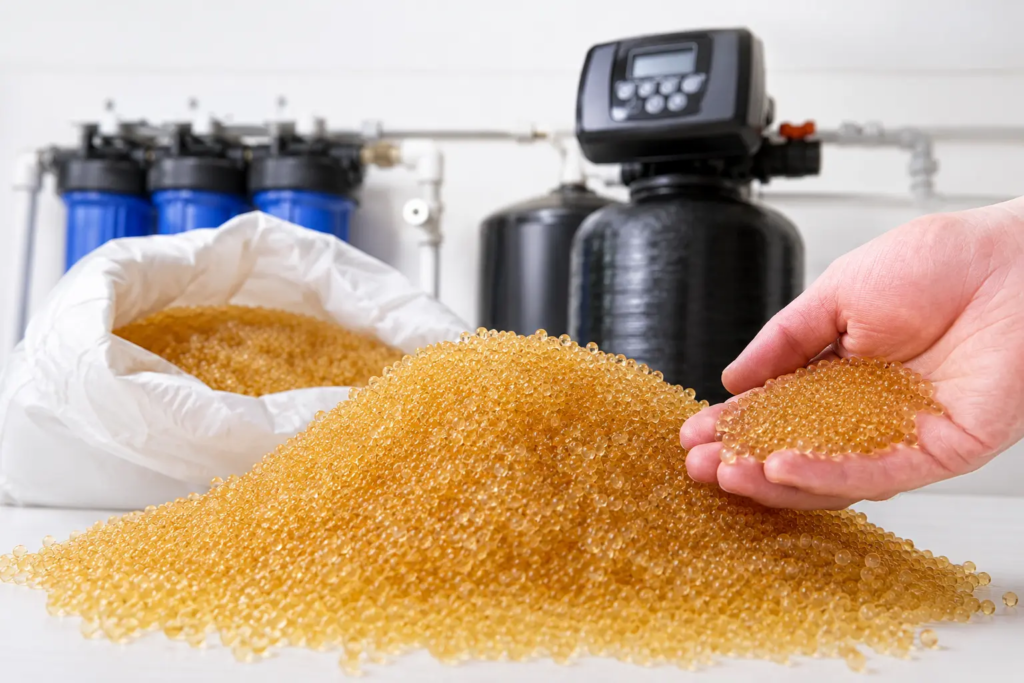
Water softener resin is the bed of small plastic beads sitting inside the tall tank of your softener, and it’s really what removes the hardness from your water. Each bead is made of sulfonated polystyrene, crosslinked with divinylbenzene, and loaded with sodium ions. Those sodium ions swap places with the calcium and magnesium in your water, which is what makes the water soft. Everything else in the machine, including the valve, the timer, and the salt, is just there to keep those beads working properly.
That matters because when softened water suddenly stops feeling soft, most homeowners jump to blame the salt or decide they need a whole new unit. But often the resin itself is perfectly fine, and the real problem is a small twelve dollar part that failed. Other times, the resin truly is worn out, and a ninety dollar bag of new beads can bring a fifteen year old system right back to full performance. Knowing which situation you’re actually dealing with is the difference between spending a quiet Saturday afternoon fixing it yourself and getting hit with a two thousand dollar invoice.
What Water Softener Resin Is and How Ion Exchange Actually Works
The chemistry inside a resin bead
Softening resin is what’s called a strong acid cation, or SAC, exchange resin. The polystyrene backbone gives each bead its structure, divinylbenzene stitches the chains together, and sulfonic acid groups attached to that backbone create the negatively charged exchange sites.
Those sites hold onto sodium ions pretty loosely. Calcium and magnesium, on the other hand, carry a 2+ charge and get held much more tightly. So as hard water flows through the bed, the resin gives up two sodium ions for every single hardness ion it captures. Most beads measure somewhere between 0.3 and 1.2 mm across, which is roughly the size of coarse sand.
How regeneration resets the resin
Once all the exchange sites are filled up with hardness minerals, the bed is considered exhausted. That’s when the brine draw comes in, flooding the resin with a concentrated sodium chloride solution. Because there’s so much more sodium available at that point, the reaction reverses itself, and sodium pushes the calcium and magnesium off the sites and sends them down the drain.
A complete regeneration cycle moves through four stages: backwash, brine draw followed by a slow rinse, then a fast rinse, and finally brine refill. The resin itself is never used up in this process. In theory, it could keep cycling forever, and the only reason it eventually fails is because water damages it over time.
Types of Water Softener Resin and Which One Suits Your Water
Standard 8% crosslink vs 10% crosslink resin
Crosslink percentage is basically the amount of divinylbenzene packed into each bead. The more crosslinking a bead has, the tougher and denser it becomes, which makes it better at resisting oxidation, at the cost of slightly lower capacity per unit volume.
| Factor | 8% crosslink | 10% crosslink |
| Typical use | Well water, unchlorinated supply | Chlorinated or chloraminated city water |
| Chlorine resistance | Baseline | Substantially better |
| Capacity per cubic foot | Marginally higher | Marginally lower |
| Cost | Baseline | Roughly 25–50% more |
| Best for | Budget builds, clean source water | Anyone on municipal water long-term |
On chlorinated municipal supply, 10% crosslink resin is usually the better buy. You pay a bit more once, but you typically extend the bed life in a meaningful way.
Fine mesh resin for iron bearing water
Fine mesh resin uses smaller beads, and that increase in surface area helps it remove iron more effectively from well water. The tradeoff is a higher pressure drop, along with the need for a matched, finer distributor screen. Don’t fit fine mesh water softener resin without first confirming that your valve and screen are actually suited for it.
What certifications to insist on
NSF/ANSI 61: covers drinking water system components and their health effects
NSF/ANSI 372: confirms lead free compliance
NSF/ANSI 44: the standard specific to softener systems, including salt efficiency ratings
WQA Gold Seal: an independent, third party certification
Unbranded resin that comes with no data sheet and no certification is really the one genuine trap to watch out for in this category.
How Long Water Softener Resin Lasts (and What Shortens It)
Water softener resin typically lasts somewhere between 10 and 15 years when it’s working with clean, low-chlorine water, but that drops to about 5 to 10 years on chlorinated municipal supply. These numbers come from widely used industry service-life ranges, not some fixed laboratory constant, so your actual water chemistry is really what decides where you’ll land.
Chlorine and chloramine: the number one killer
Free chlorine goes after the divinylbenzene crosslinks that hold each bead together. As those bonds start breaking down, the beads swell up, soften, and eventually turn into a mushy mass that lets water channel straight past the exchange sites instead of through them.
The degradation is roughly proportional to how much chlorine the resin has been exposed to over time, so both the concentration and the total volume of water treated play a role. A carbon prefilter placed ahead of the softener is honestly the single most effective protection you can add.
Iron, manganese and organic fouling
Ferric iron tends to precipitate inside the bead and coat it, and manganese along with dissolved organics can cause something pretty similar. The good news is that fouled water softener resin isn’t chemically destroyed, it’s just blocked. That’s exactly why fouling is often reversible in a way that chlorine damage simply isn’t.
Physical attrition and osmotic shock
Every single regeneration cycle causes the resin beads to swell and shrink as the ionic strength around them changes. Over thousands of cycles, some beads eventually crack and break apart, and those fine fragments wash out during backwash. This causes the bed volume to slowly drop over time. It’s a normal, gradual process, and on its own it rarely causes the system to actually fail.
Signs Your Water Softener Resin Needs Replacing
Symptoms that genuinely point to resin
- Hardness keeps coming back even though you’ve got adequate salt and a confirmed working brine draw
- Softening capacity has been dropping steadily over the years, not something that happened overnight
- You start noticing resin beads in the aerators, toilet tanks, or shower head
- Pressure drop across the softener has been rising
- You spot visible rust brown staining on the bed during an inspection
Faults people blame on resin that aren’t resin
Rule these out first, since in actual service work they explain the majority of “no soft water” calls:
- Salt bridge or salt mush sitting in the brine tank
- Blocked or worn injector or venturi
- Failed brine valve or a kinked brine line
- Wrong hardness setting after the water utility made a change
- Failed valve seals or motor
- Bypass valve that got accidentally left open
The bead squeeze test
Scoop a small sample from the top of the bed. Healthy water softener resin feels firm, looks translucent amber, and rolls easily between your fingers. Oxidized resin, on the other hand, crushes into mush without much effort and looks dull, swollen, or fragmented. Fouled resin looks stained but still stays firm, and that’s actually a good sign, since it means you’re looking at a cleaning candidate rather than something that needs full replacement.
Resin Capacity, Sizing and Salt Efficiency Explained
Why grain capacity is not a fixed number
A “32,000 grain” softener isn’t actually locked in at exactly 32,000 grains. How much capacity you actually get depends on how much salt you’re dosing per regeneration.
| Salt dose per cubic foot | Approx. capacity per ft³ | Approx. salt efficiency |
| 6 lb | ~20,000 grains | Highest (~3,300+ grains/lb) |
| 10 lb | ~24,000–27,000 grains | Moderate |
| 15 lb | ~30,000–32,000 grains | Lowest (~2,000 grains/lb) |
Manufacturers tend to advertise the 15 lb figure, but efficient operation actually lives closer to the 6 lb figure. NSF/ANSI 44 efficiency ratings are based on that high-efficiency dosing, which is exactly why an “efficiency-rated” softener will often quote a lower headline number than you might expect.
How much resin your tank actually holds
| Advertised size | Resin volume | Approx. tank size |
| 24,000–32,000 grain | 1.0 ft³ | 9″ × 48″ |
| 40,000–48,000 grain | 1.5 ft³ | 10″ × 54″ |
| 64,000 grain | 2.0 ft³ | 12″ × 52″ |
Make sure you leave 30 to 50% freeboard above the bed so the backwash has enough room to actually lift and reclassify it. Overfilling is one of the most common mistakes people make when doing this themselves, and it tends to push resin straight into your plumbing.
Cleaning Water Softener Resin Before You Replace It
When a resin cleaner works
Cleaning is worth a shot when the resin is fouled but still structurally sound, meaning the beads are firm, you’re seeing iron staining, and there’s been a gradual capacity loss on well water. Citric acid or sodium hydrosulfite based cleaners, dosed into the brine tank according to the label directions, can recover a decent share of the capacity you’ve lost.
Just make sure you pair it with the actual underlying fix, whether that’s iron pretreatment, a sediment filter, or simply regenerating more often.
When cleaning is a waste of money
If the beads crush between your fingers, no cleaner is going to save them. Oxidative damage is irreversible since the crosslinks are already gone, and at that point new water softener resin is the only real remedy.
Here’s a simple way to decide: firm beads with staining means you should clean. Mushy beads means it’s time to replace them. And if the bed looks clean but the capacity is still gone and the softener is over 12 years old, it’s probably worth pricing out a full new unit.
How to Replace Water Softener Resin Step by Step
Tools, materials and time required
- The correct resin volume for your tank, plus gravel underbed if one was originally fitted
- A wide funnel, tape, a bucket, a pipe wrench, and silicone safe lubricant
- Two people if you’re dealing with anything 1.5 ft³ or larger, since full tanks get heavy fast
- Time needed: 2 to 4 hours. Difficulty level: moderate DIY
The replacement procedure
- Put the softener into bypass mode and shut off the water supply.
- Trigger a manual regeneration briefly just to depressurize things, then unplug the unit.
- Disconnect the drain line along with the inlet and outlet plumbing.
- Unscrew the control valve from the tank. Expect some resistance, since it’s usually on there tight.
- Tape over the riser tube opening so nothing accidentally falls inside.
- Flush the old resin out using a hose, or carefully tip the tank over outdoors.
- Inspect the riser tube and the lower distributor basket, and replace either if they’re cracked.
- Refill the gravel underbed if you’re using one, half fill the tank with water, then funnel in the new resin.
- Remove the tape, lubricate and refit the valve o-ring, then reattach the valve.
- Reconnect the plumbing, open the bypass slowly, and run two full regeneration cycles before putting the system back into use.
Mistakes that ruin a DIY resin change
- Leaving the riser tube uncovered, since resin getting into the tube means starting the whole job over
- Overfilling the tank and losing your freeboard
- Reusing a distributor basket that’s already cracked
- Mixing old resin with new, which drags the new resin’s performance down to match the old bed
- Skipping the initial rinse cycles, which ends up sending fines through your whole house
Water Softener Resin Cost, Alternatives and the Replace-or-Upgrade Decision
What resin replacement costs
Estimated ranges, varying by region and grade:
| Item | Typical range |
| Standard 8% resin, 1 ft³ | $80–$150 |
| 10% crosslink resin, 1 ft³ | $130–$220 |
| Fine mesh resin, 1 ft³ | $130–$250 |
| Professional labour | $150–$400 |
| New mid-range softener installed | $1,200–$3,000 |
When a new softener beats new resin
If the valve is still in good shape and the unit is under roughly 12 years old, it usually makes more sense to just replace the resin. But if the control valve is on its way out, parts are hard to find or discontinued, the unit was undersized to begin with, or it’s an old time-clock model, you’re better off replacing the whole softener. Even on its own, switching to a modern metered valve can cut down salt and water use quite a bit.
Myths vs facts, and where the industry is heading
| Myth | Fact |
| Resin gets “used up” and needs topping up | Resin is regenerated, not consumed; it degrades but isn’t depleted |
| More salt means softer water | Beyond the setpoint, extra salt only wastes salt |
| Beads in the water mean bad resin | Usually a cracked distributor or riser tube |
| Potassium chloride works identically | It regenerates less efficiently and needs a higher dose |
| All resin is the same | Crosslink, mesh and certification meaningfully differ |
Looking ahead, chloramine resistant grades of resin are likely to become more common, smart valves should start reporting capacity in real time, and tightening state level rules around brine discharge will probably push high efficiency dosing from something optional into something standard.
Frequently Asked Questions
Does hot water damage water softener resin?
Water softener resin and 3D printing resin are totally different materials, so there’s no connection there. Hot water can affect softening resin though, since most beads are only rated up to around 120°F to 140°F, which is why softeners sit on the cold water line.
How do I replace resin in a water softener?
It involves putting the unit in bypass, draining the tank, swapping out the old resin for new, and checking the riser tube and distributor basket along the way. The whole job usually takes a few hours and counts as moderate DIY difficulty.
Is water softener resin dangerous?
Not really. The beads are inert and safe to handle under normal conditions. Just avoid breathing in dust or swallowing large amounts while pouring it, and wash your hands afterward.
How long does water softener resin last?
It typically lasts 10 to 15 years on clean water, but only 5 to 10 years on chlorinated municipal supply. Chlorine, chloramine, and iron exposure are what really decide where you land.
How do I know if my water softener resin is bad?
Rule out salt bridging, injector blockage, and valve faults first. If those all check out and a bead sample crushes into mush, the resin has oxidized and needs replacing.
Can water softener resin be cleaned instead of replaced?
Yes, as long as it’s fouled rather than degraded. Citric acid or hydrosulfite based cleaners can recover capacity lost to iron and organic buildup, but they can’t fix beads that are already oxidized.
Does chlorine damage water softener resin?
Yes, free chlorine breaks down the divinylbenzene crosslinks and causes the beads to swell and soften. A carbon prefilter ahead of the softener is the standard defense against this.
Is 10% crosslink resin worth the extra cost?
On chlorinated city water, usually yes, since the longer service life tends to outweigh the higher price. On clean well water, that benefit shrinks quite a bit.
Is softened water safe to drink?
For most people, yes, since ion exchange only adds a small amount of sodium proportional to the hardness removed. Anyone on a restricted sodium diet should check with their doctor or consider potassium chloride instead.
Final Thoughts
Water softener resin is the one component in the whole system that actually does the work, and yet it’s also the one thing homeowners tend to misdiagnose the most. The practical approach is pretty simple: check the brine tank and valve first, pull a bead sample second, and only then decide whether cleaning or replacing makes more sense.
There are three things worth doing this month. Start by testing your water hardness and checking your utility’s chlorine or chloramine levels. If you’re on municipal water and don’t already have one, fit a carbon prefilter. And finally, pull a bead sample and give it a squeeze, since a firm amber bead tells you your resin still has years left in it.
If your beads come back firm and your softener is under a decade old, it makes more sense to spend money on protecting what you have rather than replacing it. But if the beads crush easily, it’s time to budget for a full resin change, and this time around, go with 10% crosslink resin for the added durability.
Not sure which grade actually fits your water supply? Test your water first. The right resin choice comes down to your water chemistry, not whatever happens to be cheapest on the shelf.