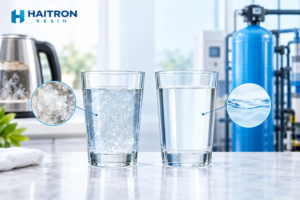
Can You Drink Distilled Water?
Yes, you can drink distilled water, and it is safe for a healthy adult eating a normal diet. The only real drawback is what is missing from it.
People usually ask can you drink distilled water because they have heard it is somehow dangerous. It is not. Distilled water has no calcium, no magnesium and no other minerals, so it gives you nothing extra, but it hydrates you just as well as tap water.
We make the ion exchange resins used to purify water for laboratories and factories, so we work with very pure water every day. Here is the plain version, with no scare stories.
What is distilled water?
Water is boiled until it turns to steam. The steam is collected and cooled back into liquid. Anything that cannot turn into steam is left behind.
That means minerals, salts, heavy metals, most chemicals and bacteria all stay in the pot. What you collect is close to pure water.
How pure? Tap water usually carries 100 to 400 parts per million of dissolved solids. Distilled water carries around 1 to 5.
Why does distilled water taste flat?
Taste in water comes from the minerals in it and from dissolved carbon dioxide. Take both away and there is nothing left to taste.
This matters more than it sounds. If you do not enjoy drinking something, you drink less of it. Being a bit dehydrated because your water is boring is a genuine problem.
Can you drink distilled water long term?
For most people, yes, provided you eat properly. But the research raises a few points worth knowing, and this is where the question of whether distilled water is safe to drink gets more interesting.
The World Health Organization published a report in 2005 on the health risks of drinking demineralized water. It flagged four things:
- The flat taste can put people off drinking enough
- It adds no calcium or magnesium to your daily intake
- It has a mild diuretic effect, so you pass a little more out
- Being very pure, it is aggressive toward pipes and containers and can pull material from them
A 2022 review of the research came to a similar conclusion. Drinking demineralized water long term was linked to poorer overall nutrient intake.
Read that carefully though. The concern applies to people who rely on water for a real share of their minerals and do not make it up in food. If you eat a varied diet, food gives you far more calcium and magnesium than water ever did.
If you have a health condition, ask your doctor rather than the internet.
Two myths worth clearing up
Myth one: distilled water dehydrates you.
It does not. Water is water. Your body absorbs distilled water exactly the same way it absorbs tap water. This myth comes from confusing hydration with electrolyte balance. They are two different things.
Myth two: it pulls minerals out of your bones.
Badly overstated. Pure water is called aggressive because it dissolves things readily, which is true inside a copper pipe. Inside your body the effect is tiny. One glass of milk gives you more calcium than you would lose across a whole gallon of distilled water.
Who should not drink distilled water?
Most people can drink it with no issue at all. A few should not use it as their only water:
- Babies and young children
- Endurance athletes losing a lot of salt through sweat
- Anyone losing fluids heavily through illness
- People already low on sodium, potassium, magnesium or calcium
What is the difference between distilled and deionized water?
These labels get mixed up constantly, and the answers online flatly contradict each other. Here is the honest version.
Boiled water has been heated to kill germs. All the minerals are still in it. It is not distilled.
Purified water only means the water met a purity standard. It says nothing about how.
Distilled water was turned to steam and back. The heat also kills bacteria, which is why it is sold to drink.
Deionized water is made a different way. It passes through beds of ion exchange resin that swap out the charged particles. Our mixed bed resin is built for exactly this job.
Now the part almost nobody explains properly.
Deionizing can reach far higher purity than distilling. Ultrapure deionized water is measured in resistivity and reaches 18.2 megohm centimeters.
But deionizing only removes particles carrying an electrical charge. Bacteria carry no charge. Neither do many organic compounds. So deionized water can be extremely pure by one measure and still not safe to drink.
That is the real answer to which is purer. They measure different things. Distilled water is cleaner biologically. Deionized water is cleaner ionically. Neither is simply better than the other.
Can you add the minerals back?
Yes, and it is easy.
Mineral drops made for drinking water work well. A small pinch of sea salt in a large jug adds trace elements. Some filter jugs have remineralizing cartridges built in.
Or just eat properly. Dairy, leafy greens, nuts and beans give you far more than water ever will.
What is distilled water used for?
Even if you never drink it, it earns its place:
- CPAP machines and humidifiers, where minerals leave crusty deposits
- Steam irons, which scale up fast on hard water
- Car batteries and cooling systems
- Fish tanks, once minerals are added back
- Laboratory work and washing glassware
In industry the job usually goes to deionized water instead, because you can produce it continuously without boiling anything. It is used for rinsing electronics, making medicines and in food and drink production. You can see the industries that depend on it on our applications page.
Common questions
Can you drink distilled water every day?
You can, but it is not the best everyday choice. Water with some minerals tastes better and adds to your intake.
Can you drink distilled water instead of tap water?
For a while, yes. Long term, tap water in most places gives you a better mineral balance and costs nothing.
Is distilled water the same as boiled water?
No. Boiling kills germs. Distilling separates the water from everything dissolved in it.
Can you drink deionized water?
Usually not. It is very low in minerals but can still contain bacteria, because deionizing does not remove them.
Does distilled water contain chlorine?
No. Distilling removes it along with almost everything else. If chlorine is your only concern, a carbon filter is far simpler, as our guide on whether a water softener removes chlorine explains.
Is distilled water good for babies?
Ask your doctor or health visitor. Infants have different needs and should not rely on mineral free water.
In short
So, can you drink distilled water? Yes, safely, for a healthy adult on a normal diet. It will not dehydrate you and it will not drain your bones. It just gives you nothing extra.
For everyday drinking, water with some minerals is the better choice. For machines, laboratories and factories, very pure water is exactly what you want.
If you need high purity water at industrial scale, take a look at our full range of ion exchange resins or talk to our team about your process.