
Salt Bridge in a Water Softener: How to Fix It the Easy Way
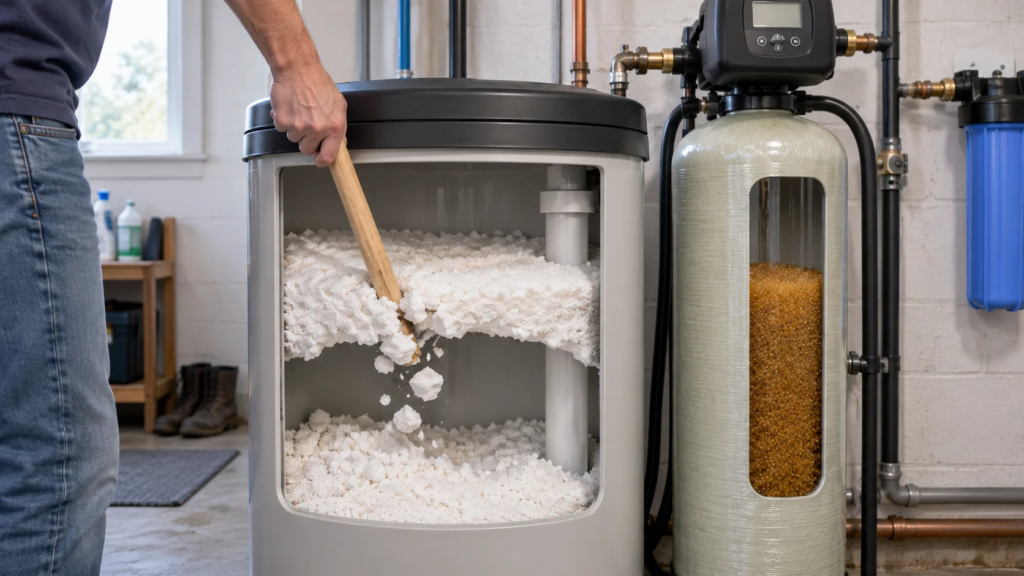
A salt bridge in a water softener trips up more homeowners than almost any other softener problem, and it is easy to see why. Picture a block of hard, fused salt sitting inside the brine tank, blocking water from reaching the loose salt underneath. That is a salt bridge in a water softener in a nutshell. Your tank can look completely full, yet the machine quietly stops making brine, and your water goes hard without any warning. If you are dealing with a salt bridge in a water softener right now, do not worry. Fixing one takes a few minutes, a broom handle, and nothing fancy at all.
What Is a Salt Bridge in a Water Softener?
So what is actually going on in there? Salt sits at the top of the brine tank, and it slowly dissolves whenever it touches humid air or standing water. Warm days speed that up. Cold nights slow it down. Somewhere in between, the surface layer dries out and fuses back together. Do that enough times and you end up with one solid slab of salt, with hollow space hiding underneath it. Nothing dissolves down there anymore. No brine gets made. And without brine, your softener cannot pull calcium and magnesium out of your water, no matter how full that tank looks.
Bridge or Mushing? They Are Not the Same Thing
Here is something most guides skip. A hard crust up top is not the only way a brine tank can fail. There is a second problem called salt mushing, and mixing the two up wastes your time.
A bridge sits near the top and feels hard, almost like concrete. Mushing sinks to the bottom and feels wet, closer to sludge than salt. You can break a bridge apart with a pole in a couple of minutes. Mushing will not budge no matter how hard you poke it, since it just settles right back down. The only real fix there is draining the tank, rinsing it out, and starting fresh.
Have you poked around with a broom handle a few times this month, and the softener still is not working? Check the bottom of the tank too. You might be dealing with mushing instead.
Signs of a Salt Bridge in a Water Softener
A few clues give it away almost every time.
Hard water symptoms creep back in: spotty dishes, stiff towels, and maybe scale around the faucets. The salt level barely moves, week after week, no matter how much the softener supposedly uses. Tap on the tank, and one spot sounds hollow, almost drum-like. The softener runs right on schedule, yet nothing about your water changes afterward.
Notice two or three of these at once? That is a pretty strong sign.
How to Check for a Salt Bridge
Grab a broom handle and give this a try.
- Turn off or bypass the softener first.
- Take the lid off the brine tank.
- Push the handle straight down into the salt.
- Smooth resistance all the way to the bottom means you are in the clear.
- A stop halfway down, or a sudden drop into empty space, means you have found your bridge.
How to Break a Salt Bridge Safely
Once you know it is there, breaking it apart is the easy part.
- Double-check the softener is off or bypassed.
- Pick something long and blunt, like that same broom handle. Skip anything sharp.
- Tap gently around the edges first, then work your way toward the middle.
- Still stuck? Pour in about a gallon of warm water and give it a few minutes to soften up.
- Scoop out whatever chunks are left floating around.
- Refill the tank to about half full. Do not pack it to the top.
- Run the softener so it can build fresh brine right away.
Two quick warnings. Skip the hot water, since warm water does the job without any risk of warping the tank. And put the hammer down, literally. Banging on the tank with metal tools is how people end up cracking the plastic.
What Causes a Salt Bridge in a Water Softener
A handful of things usually team up to cause this.
Warm, damp air sitting around the tank is the biggest one. Sudden temperature swings do not help either. Neither does filling the tank right to the brim, since that traps moisture with nowhere to go. Cheap salt, or the wrong type of water softener salt, tends to clump more than it should. And if your household barely uses water, the softener regenerates less often, so salt just sits there undisturbed, giving humidity plenty of time to work its way in.
How to Stop It Coming Back
A few small habits go a long way here.
Keep the salt around half full instead of stacked on the lid. Stick with good, high-purity salt built for softeners. That is really just part of solid water softener maintenance, and it ties straight into picking the right water softener salt types for your unit in the first place. If you can, keep the tank somewhere dry rather than a damp garage corner. Check it once a month with that same broom handle test. And once a year, give the whole tank a proper cleanout.
Does a Salt Bridge Hurt the Resin Inside?
Not really, as long as you catch it early. The resin sitting inside your softener, usually a strong acid cation resin, is what actually grabs the hardness minerals out of your water. A short bridge just means that resin skips a refresh for a little while. Clear the bridge, run a regeneration, and things go right back to normal.
Let a bridge sit for months without anyone noticing, though, and it slowly chips away at how well that resin performs. That is part of why it is worth glancing at your water softener hardness setting every so often too, instead of assuming a full-looking tank means everything is fine.
Quick Questions
What causes a salt bridge? Mostly warm, damp air combined with salt that sits still for too long.
How often should I check? Once a month works well, right when you are already checking your salt level.
Can I use hot water to break it up? Stick with warm. Hot water will not clear it any faster, and it can damage the tank.
Does it actually hurt my softener? Not from a single short bridge. It only turns into a real problem if it keeps happening without ever getting fixed.
In Short
A salt bridge in a water softener is just a hard block of salt sitting somewhere it should not be. Once you know what a salt bridge in a water softener looks like, spotting one and breaking it apart takes only a few minutes. Keep the salt level moderate, use decent salt, and check the tank monthly, and a salt bridge in a water softener should not give you much trouble ever again.