Anion Exchange Resin: The Complete Guide to Types, Uses, and Regeneration (2026)
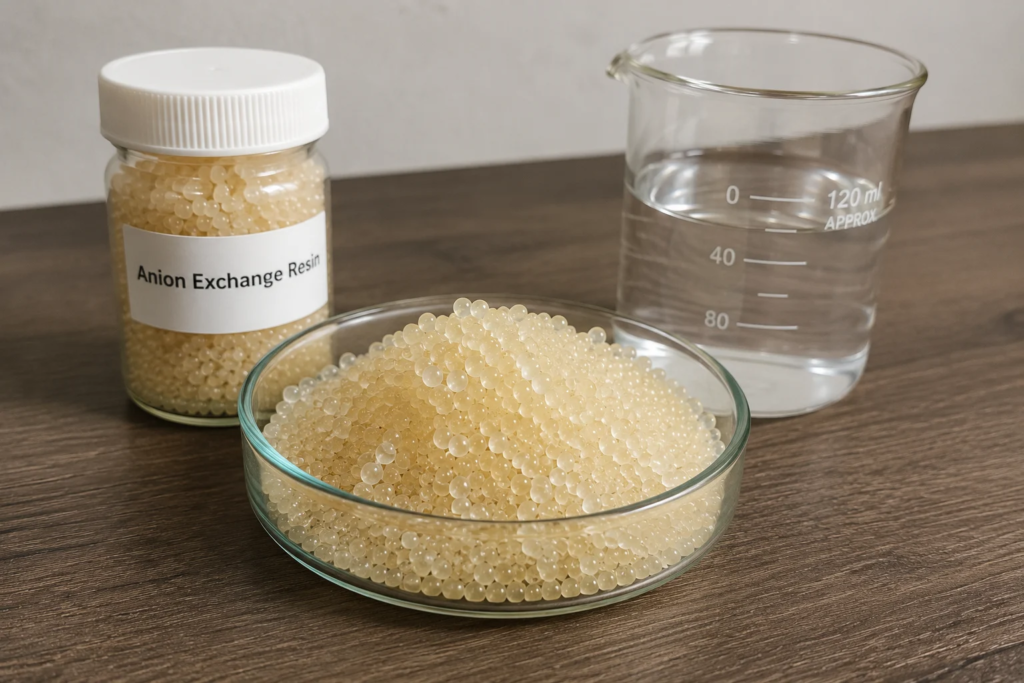
If your water has too much nitrate, sulfate, or silica in it, chances are someone will eventually tell you to “just use anion exchange resin.” That’s true, but only if you pick the right one.
Not all anion resins do the same job. Strong base, weak base, Type I, Type II, gel, macroporous, nitrate selective: each of these behaves differently depending on your water chemistry, your target contaminant, and how you plan to regenerate the bed. Pick the wrong one and you’ll get an early breakthrough, wasted chemicals, or water that still fails spec.
This guide walks through how anion exchange resin actually works, the main resin types and when to use each one, real world applications, regeneration methods, and a step by step process for choosing the right grade for your system.
What Is Anion Exchange Resin?
So what kind of anions are we talking about? A few show up again and again:
- Nitrate
- Sulfate
- Chloride
- Bicarbonate and carbonate
- Silica species
- Arsenate
- Dissolved organic acids
Now here’s the part that actually matters. As water moves through the resin bed, those problem anions don’t just vanish, they trade spots with chloride or hydroxide ions that were already sitting on the resin. That trade is really the whole idea behind the name “anion exchange.”
But nothing lasts forever. As more and more of those exchange sites get used up, the resin starts running out of room to work. Once it hits that point, you’re stuck with two choices: regenerate it, or swap it out for fresh resin.
Anion Resin vs. Cation Resin: What’s the Difference?
Anions and cations are basically opposites when it comes to charge. Anions, things like nitrate, sulfate, and chloride, carry a negative charge. Cations, on the other hand, carry a positive charge, and that group includes calcium, magnesium, sodium, and iron. Figuring out which one you’re trying to remove is really what tells you which resin you actually need.
| Feature | Anion Exchange Resin | Cation Exchange Resin |
| Resin charge | Positive functional sites | Negative functional sites |
| Captures | Negatively charged ions | Positively charged ions |
| Common targets | Nitrate, sulfate, silica, bicarbonate | Calcium, magnesium, iron, sodium |
| Common applications | Demineralization, nitrate removal | Water softening, demineralization |
| Typical regenerant | Salt or caustic | Salt or acid |
One thing worth mentioning right away: anion resin isn’t going to do anything about hardness. If calcium and magnesium are what you’re dealing with, that’s not an anion problem at all, you’ll need cation exchange resin instead.
How Anion Exchange Resin Actually Works
Break it down into six steps:
- Untreated water enters the vessel.
- It flows down through a packed bed of resin beads.
- Target anions migrate toward the resin’s positively charged sites.
- The resin grabs and holds those anions.
- Chloride or hydroxide ions get released back into the water in exchange.
- Eventually the resin exhausts itself and needs regenerating.
Which ions get released, chloride or hydroxide, depends entirely on the resin’s starting ionic form.
Chloride Form Anion Exchange
Chloride form resin swaps out chloride ions as it captures contaminants. It’s the workhorse for:
- Nitrate removal
- Sulfate removal
- Tannin reduction
- Arsenate removal
- General organic matter control
You regenerate it with sodium chloride brine, so in practice it behaves a lot like a household water softener, just targeting different ions.
A quick but important note on nitrate: sulfate competes with nitrate for the same resin sites. Load a standard strong base resin with too much sulfate, and it can actually release nitrate it had already captured, a phenomenon known as “nitrate dumping.” If your sulfate levels are high, a nitrate selective resin will hold up far better than a generic grade. The EPA caps nitrate in drinking water at 10 mg/L, measured as nitrogen, so this isn’t a detail to guess at. Test your water and size the system around real numbers.
Hydroxide Form Anion Exchange
Hydroxide form resin releases hydroxide ions as it works, and it’s the standard choice for:
- Demineralization and deionization
- Boiler feedwater treatment
- Condensate polishing
- Laboratory water systems
- Electronics and semiconductor grade water
- Mixed bed polishing
In a classic demineralization train, hydrogen form cation resin strips out the positive ions and releases hydrogen. Hydroxide from anion resin strips out the negative ions and releases hydroxide. The hydrogen and hydroxide then combine, and you get pure water as the byproduct.
Regeneration here runs on sodium hydroxide, or caustic soda. Exactly how much, how hot, and for how long depends on the specific resin grade and your system design.
Three Concepts That Determine Whether Your Resin Actually Works
Exchange Capacity
This is simply how many ions a given volume of resin can hold. The number on the data sheet is a ceiling, not a promise. Real world “operating capacity” is almost always lower once you factor in your feedwater, regenerant dose, flow rate, temperature, and whatever else is competing for those exchange sites.
Selectivity
Selectivity is the resin’s built in preference for one ion over another. A standard Anion Exchange Resin, for instance, will usually favor sulfate over nitrate, which is exactly why nitrate selective resins exist. Don’t size a system around the concentration of your target ion alone; look at the whole ionic profile.
Breakthrough
Breakthrough is basically the moment your target contaminant starts showing up again in treated water. It can happen for a bunch of reasons: the resin’s exhausted, the bed’s undersized, flow’s too fast, contact time’s too short, competing ions are winning out, or regeneration just didn’t fully finish. That’s why keeping an eye on things regularly matters, it catches the problem before it turns into a compliance headache.
The Main Types of Anion Exchange Resin
Resins split into two broad families: strong base and weak base.
Strong Base Anion (SBA) Resin
SBA resin uses permanently charged quaternary ammonium groups, which stay active across almost any pH. That makes it versatile enough to remove both strong acid and weak acid anions, nitrate and sulfate for sure, but also silica.
Typical uses: nitrate/sulfate removal, silica removal, dealkalization, demineralization, ultrapure water, condensate polishing, organic matter control.
SBA resin comes in two flavors, Type I and Type II, and picking between them matters more than most people expect.
Type I SBA Resin
Type I is the stronger of the two and does an excellent job removing weakly ionized substances like silica. It’s the go to for:
- High purity demineralized water
- Low silica leakage
- Mixed bed polishing
- Condensate treatment
- Electronics grade water
- Boiler feedwater prep
The trade off: Type I needs a more aggressive regeneration program than Type II. Most engineers accept that cost when final water quality is non negotiable, which is why Type I dominates in high purity separate bed and mixed bed systems.
Type II SBA Resin
Type II generally gives you higher operating capacity, easier regeneration, and lower caustic demand, but its silica removal is noticeably weaker than Type I’s.
It’s a solid fit when:
- Ultra low silica isn’t required
- Feedwater has a moderate weak acid load
- Operating efficiency matters more than perfection
- You’re producing general industrial demineralized water, not electronics grade water
Don’t swap Type II in for Type I in a high purity application just because it’s cheaper to run. Let the required spec make that call.
Weak Base Anion (WBA) Resin
WBA resin runs on tertiary amine functional groups. It’s built to strip strong mineral acids, typically right after a cation exchange stage, and it regenerates far more efficiently than SBA resin. You can often release the captured acids with a much lower chemical dose.
Common uses: strong acid removal, partial demineralization, dealkalization, organic scavenging, and pretreatment ahead of a strong base stage.
What it won’t do: remove silica, carbonate, or other weakly ionized species. Never use WBA resin as your final polishing stage if you need genuinely high purity water.
Type I vs. Type II vs. WBA: Quick Comparison
| Selection factor | Type I SBA | Type II SBA | WBA |
| Functional group | Type I quaternary ammonium | Type II quaternary ammonium | Tertiary amine |
| pH operating range | Broad | Broad | Limited |
| Strong acid removal | Excellent | Excellent | Excellent |
| Silica removal | Excellent | Moderate | Poor |
| Regeneration efficiency | Moderate | Good | Very high |
| Caustic requirement | Higher | Lower | Lower |
| Best for | High-purity water | General demineralization | Strong-acid removal |
| Suitable for final polishing? | Yes | Depends on application | No |
Gel vs. Macroporous: Does Bead Structure Matter?
Yes, and it’s easy to overlook.
Gel resin has a continuous polymer structure with no permanent large pores. It offers high capacity and cost effective performance, but it’s more vulnerable to fouling from large organic molecules. Use it when your feedwater is relatively clean, low in turbidity and organics, and your pretreatment is solid.
Macroporous resin has a more open structure, which gives it better access to larger organics, stronger resistance to fouling, and higher tolerance for osmotic stress. It’s the better choice for tannin removal, dissolved organic matter, industrial wastewater, food and beverage streams, and any process known for recurring fouling problems.
One caveat: macroporous doesn’t automatically mean higher capacity when it comes to Anion Exchange Resin. Its real advantage is durability under tough conditions, not raw exchange power.
What Does Anion Exchange Resin Actually Remove?
| Target contaminant | Common resin choice | Working form | Typical regeneration |
| Nitrate | Nitrate-selective SBA | Chloride | Sodium chloride |
| Sulfate | Strong base anion resin | Chloride | Sodium chloride |
| Silica | Type I SBA | Hydroxide | Sodium hydroxide |
| Bicarbonate | SBA or suitable WBA system | Chloride or hydroxide | Depends on design |
| Tannins | Macroporous SBA | Chloride | Sodium chloride |
| Dissolved organics | Macroporous SBA or WBA | Application-dependent | Application-dependent |
| Arsenate | Suitable SBA grade | Chloride | Application-dependent |
| Strong mineral acids | WBA | Free-base or hydroxide cycle | Alkali regenerant |
| General mineral salts | SBA in demineralization | Hydroxide | Sodium hydroxide |
It’s worth saying plainly: anion resin isn’t a cure all. It won’t replace sediment filtration, activated carbon, reverse osmosis, disinfection, cation exchange, or iron/manganese treatment. Most real systems combine several of these technologies to get the job done.
Where Anion Exchange Resin Gets Used
Nitrate removal from drinking water: Groundwater near farmland, septic systems, or manure storage often picks up nitrate. Chloride from SBA resin is the standard fix, but remember the sulfate competition issue above. Test for nitrate as nitrogen, check sulfate and TDS, and consider seasonal retesting if you’re on a well with variable water quality.
Industrial demineralization: A typical train runs strong acid cation resin, optional degassing, then weak or strong base anion resin, finishing with mixed bed polishing if you need very high purity. The right configuration depends on your alkalinity, CO₂, silica, and conductivity targets.
Boiler feedwater treatment: Silica, chloride, and sulfate can wreak havoc in high pressure steam systems. Type I SBA resin is the standard when silica leakage has to stay low.
Condensate polishing: Mixed beds of cation and anion resin protect boilers, steam generators, turbines, and heat transfer surfaces from returning contamination. Bead integrity matters as much as chemistry here.
Electronics and semiconductor water: Chip fabrication needs water with almost no ionic contamination. Type I SBA resin, often running after reverse osmosis, is the standard for deionization and mixed bed polishing.
Food and beverage processing: Deashing, decolorization, sugar purification, organic acid control, Anion Exchange Resin shows up throughout the industry, though food contact resin has to meet its own regulatory and documentation requirements.
Pharmaceutical and biomedical water: Ion exchange is one piece of a larger purified water process here, with validation, extractables control, and microbial management all part of the picture.
Hydrometallurgy and resource recovery: Specialty and selective resins can capture metal complexes and support brine purification or process water recycling, but this needs laboratory level chemistry work, not off the shelf selection.
Wastewater treatment: Anion exchange can recover or remove ionic contaminants from industrial wastewater, though performance leans heavily on suspended solids, oil and grease, and pretreatment quality.
How to Choose the Right Anion Exchange Resin: A 7 Step Process
Picking resin by product name alone is how systems end up with early breakthrough, wasted chemicals, or water that fails spec. Here’s a better process.
- Identify the Target Ion
Nitrate, sulfate, silica, bicarbonate, arsenate, tannin, strong mineral acids, dissolved organics, name it specifically. A general demineralization resin isn’t automatically your best option for, say, selective nitrate removal. - Test the Complete Feedwater
Not just the contaminant you’re worried about. A good analysis covers target contaminant concentration, competing ions, pH, conductivity, TDS, alkalinity, silica, organics, iron and manganese, free chlorine, suspended solids, and temperature. - Define the Required Treated Water Quality
Drinking water nitrate limits, general demineralized water, low conductivity process water, low silica boiler feed, high resistivity polishing, the target output shapes everything downstream. - Choose the Functional Type
Type I SBA for low silica leakage and high purity. Type II SBA when easier regeneration and higher capacity matter more than rock bottom silica. WBA for efficient strong acid removal or as a front end stage. A selective grade when you’re fighting strong competing ions. - Choose Gel or Macroporous Structure
Base this on how clean your feedwater is and how much organic fouling risk you’re dealing with. - Check the Hydraulics
Service flow, bed depth, contact time, pressure drop, backwash expansion, distribution, and freeboard all need to line up with your vessel and resin choice. - Review Regeneration Requirements
Chemical type, concentration, dose, contact time, rinse volumes, waste disposal, and operator safety all matter. A resin with impressive lab tested capacity can still be a bad economic choice if it demands excessive chemicals or constant regeneration.
Application-Based Starting Points
| Application | Common starting choice | Why |
| Nitrate removal | Nitrate-selective SBA | Better nitrate preference under sulfate competition |
| Sulfate removal | Chloride-form SBA | Effective, straightforward sulfate exchange |
| High-purity deionization | Type I SBA | Low silica leakage |
| General demineralization | Type II SBA | Good capacity, efficient regeneration |
| Strong-acid removal | WBA | High regeneration efficiency |
| Tannin removal | Macroporous SBA | Better access to organic molecules |
| Condensate polishing | High-purity Type I SBA | High treated-water quality |
| Mixed-bed polishing | Type I SBA with SAC | Low conductivity, high resistivity |
| Organic scavenging | Macroporous SBA or WBA | Fouling resistance |
Treat this table as a starting point, not the final word. Difficult streams usually justify pilot testing before you commit to full scale purchasing of Anion Exchange Resin.
Regeneration Methods, Explained
Salt-Brine Regeneration
This is standard for chloride form resins handling nitrate, sulfate, and some organic removal duties. The cycle typically runs: backwash, brine injection, slow displacement rinse, fast rinse, water quality check, then back to service. Brine dose depends on the resin, the contaminant load, and how much operating capacity you want back.
Caustic Regeneration
This is how hydroxide from SBA resin gets restored, using sodium hydroxide. Concentration, purity, temperature, contact time, flow distribution, and rinse quality all affect the outcome, and Type I and Type II resins often need different regeneration conditions from each other.
Weak Base Resin Regeneration
This tends to be the most forgiving, since WBA resin doesn’t hold strong acids as tightly. Depending on the application, you might regenerate with sodium hydroxide, soda ash, ammonia, or another approved alkaline solution, always per the manufacturer’s technical guidance.
What Kills Resin Performance
- Organic Fouling: Large organic molecules coat the beads or block exchange sites, showing up as reduced capacity, longer rinsing, discoloration, and early breakthrough. Carbon pretreatment or a dedicated scavenger often helps.
- Oxidation: Free chlorine and other oxidants attack the resin polymer over time, causing capacity loss, bead weakening, and more fines. Control oxidants upstream of the resin.
- Incomplete Regeneration: Low chemical concentration, short contact time, channeling, or poor flow distribution all mimic the symptoms of “dead” resin when the real problem is the regeneration cycle itself.
- Osmotic Shock: Sudden swings in ionic concentration make beads swell and shrink rapidly, which cracks them and creates fines over time. Gradual transitions help.
- Suspended Solids: Solids clog the spaces between beads and raise pressure drop. Good pretreatment and backwashing keep this in check.
Troubleshooting Quick Reference
| Problem | Likely cause | What to check |
| Early breakthrough | Undersized bed or high competing-ion load | Retest feedwater, review resin volume |
| High nitrate in treated water | Sulfate competition or exhausted resin | Consider nitrate-selective resin, check regeneration |
| High silica leakage | Wrong resin type or poor caustic regeneration | Review Type I resin and regeneration setup |
| Rising pressure drop | Solids, fines, or compacted bed | Backwash, inspect distributors, analyze resin |
| Reduced capacity | Fouling, oxidation, or incomplete regeneration | Test resin, review pretreatment |
| Long final rinse | Excess regenerant or hydraulic issue | Check chemical dose and rinse flow |
| Broken beads | Osmotic or mechanical stress | Review operating transitions and flow |
| Resin discoloration | Organic or iron fouling | Identify foulant, improve pretreatment |
| Poor mixed-bed separation | Bead damage or density change | Analyze resin condition and separation process |
How Long Does Anion Exchange Resin Last?
There’s no universal answer here, since service life depends on your water chemistry, resin type, regeneration frequency, oxidant exposure, fouling, mechanical stress, temperature, and pretreatment quality. That said, well run systems can keep resin in service for years, while chlorine exposure, iron, oils, or repeated physical stress can shorten that considerably.
So the better approach is judging resin by performance, not calendar age. Instead, watch for declining operating capacity, rising leakage, growing chemical consumption, excessive pressure drop, bead breakage, or poor rinse quality, and confirm with lab analysis when something looks off.
Maintenance Best Practices
- Remove suspended solids before water reaches the resin bed
- Keep free chlorine and other oxidants under control
- Monitor target ion breakthrough regularly
- Log service volume and regenerant use over time
- Maintain correct service and backwash flow rates
- Never let the resin dry out
- Protect it from freezing and excessive heat
- Test periodically for organic and iron fouling
- Pull resin samples for inspection now and then
- Follow the manufacturer’s data sheet
- Investigate performance changes early, not after they’ve become a real problem
Storage and Handling Basics
Anion exchange resin comes shipped as moist beads, and it’s got to stay that way. So keep the packaging sealed, steer clear of freezing temps and excessive heat, keep it away from oxidizing chemicals, and use clean tools whenever you’re loading it. Also, don’t skip the supplier’s shelf life guidance.
Here’s an important safety note: regeneration chemicals like sodium hydroxide can cause serious injury, so make sure you’re always wearing proper protective equipment and following the applicable safety data sheet.
Choosing a Resin Manufacturer
The cheapest resin per kilogram isn’t always the cheapest resin to operate. Therefore, before committing to a supplier, look at their range of resin types, technical data quality, batch to batch consistency, particle size distribution, mechanical strength, osmotic stability, quality control process, regulatory documentation, and how much application support they actually offer. In fact, a supplier worth working with will ask for your water analysis before recommending anything.
Anion Exchange Resin Solutions from Haitron
Haitron supplies a full range of ion exchange resins for water treatment, demineralization, purification, and resource recovery applications, including strong base anion resin, weak base anion resin, strong acid cation resin, weak acid cation resin, mixed bed resin, chelating resin, and food grade adsorption resin.
To get a grade recommendation that actually fits your system, share:
- A complete water analysis
- Your target contaminant
- Flow rate and daily operating volume
- Required treated water quality
- Your existing treatment process
- Preferred regeneration method
- Operating temperature
Frequently Asked Questions
What is Anion Exchange Resin?
Picture tiny beads, insoluble, carrying a permanent positive charge; that’s basically what this resin is. As water runs through it, the resin trades out anions it doesn’t want, things like nitrate or sulfate, for something harmless it’s already holding onto, usually chloride or hydroxide.
How Does Anion Exchange Work?
Each bead is covered in fixed positive spots, and those spots grab onto negatively charged ions as water moves through the bed. Nitrate, sulfate, whatever’s floating around gets pulled in and swapped for the ion loaded onto the resin during its last regeneration. Eventually every spot fills up, and at that point the resin just stops working until it’s regenerated again.
Why Is It Called Anion Exchange?
Pretty simple, really, it’s named for what it targets. Anions go in, get swapped out, done. Cation exchange resin does the opposite job, handling positively charged stuff like calcium and magnesium.
How Is Anion Exchange Resin Prepared?
It begins as a plain polymer bead, usually polystyrene cross linked with divinylbenzene. From there it gets treated with chemicals that attach functional groups onto the bead surface. Quaternary ammonium groups for strong base resin, tertiary amine for weak base. Those groups are really what make the whole exchange process possible.
Why Is Anion Exchange Important?
A huge chunk of the contaminants people worry about in water, nitrate, sulfate, silica, arsenate, various organic acids, happen to carry a negative charge. Take anion exchange out of the picture and there’s not much of a straightforward way left to deal with them at any real scale.
What Is the Cost of Anion Resin?
Honestly, it swings a lot depending on the type, the grade, and who you’re buying from. Type II SBA usually costs less than Type I, and WBA resin tends to run cheaper than SBA resin in general. Rather than guessing at a number that won’t mean much once you factor in your region or application, it’s worth just asking for a quote tied to your actual volume and use case.
Does Anion Resin Lower pH?
Hydroxide from strong base resin can push pH up a bit, as it lets go of hydroxide ions during exchange. In contrast, chloride form resin barely moves the needle by comparison. Overall, how much it actually shifts depends on your feedwater and which form of resin you’re using.
Is Ion Exchange Resin Plastic?
More or less. To start, the base is cross linked polystyrene, which sits in the same chemistry family as a lot of everyday plastics. However, it’s modified with added functional groups so it can do its ion exchange job.
Is Ion Exchange Resin Safe?
Yes, when it’s made properly and used the way it’s meant to be. In particular, resins built for food or pharmaceutical applications go through extra testing and certification to back that up. However, what isn’t automatically safe is the regeneration chemistry around it; for instance, sodium hydroxide and similar compounds are hazardous and call for proper protective gear when handled.
Final Thoughts
Anion exchange resin can handle a wide range of negatively charged contaminants, but only if the resin actually matches the water. Type I strong base resin earns its keep in high purity, low silica applications. Type II strikes a better balance for general demineralization. Weak base resin is the efficient choice for strong acid removal and multi stage pretreatment. Gel, macroporous, and selective grades each solve different problems.
Skip the guesswork. Test your complete water or process stream, define exactly what “treated” needs to mean for your application, and size the system around real numbers, not the resin with the best sounding name.
Finally, once you’re ready to get into the details, just send Haitron your water analysis, flow rate, target contaminant, and treatment goals, and we’ll recommend the resin grade that best fits your system.