Deionized Water: What It Is, How It’s Made, and How to Choose the Right Resin
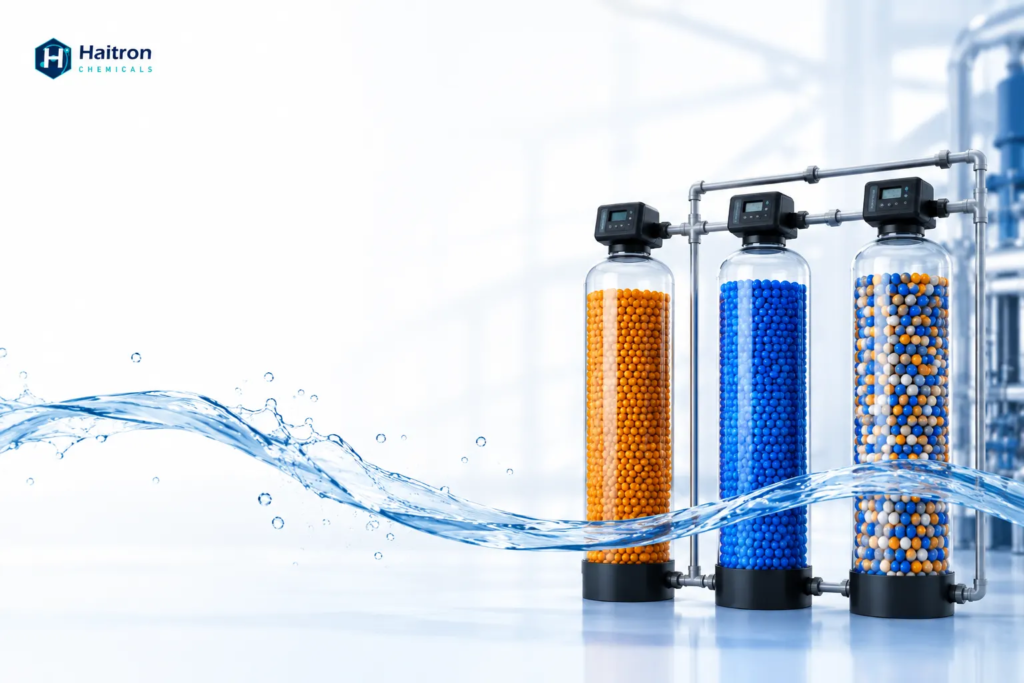
Ever wonder what actually makes deionized water different from tap water? It’s what’s missing. Tap water carries dissolved minerals like calcium, magnesium, sodium, chloride, and sulfate, and deionizing it means stripping nearly all of that out.
Here’s the interesting part: it’s not filtered like coffee grounds. The water passes through ion exchange resin, which swaps those mineral ions for hydrogen and hydroxide ions. Those two combine to form pure water.
You’ll find DI water working behind the scenes in places you might not expect: semiconductor plants, research labs, pharmaceutical production, power plants, metal finishing shops, even car washes. Anywhere a stray mineral could wreck a sensitive process or damage costly equipment, chances are DI water is doing the job instead of plain tap water.
So how does the process actually work? Which resins get the job done? How does it compare to distilled or reverse osmosis water? And what should you check before buying resin? Let’s get into it.
Key Takeaways
- Deionization removes ions, not everything: bacteria, viruses, dissolved gases, and non ionic organics stick around, so you’ll still need RO, UV, or carbon filtration to handle those.
- Two resins do the core work: strong acid cation (SAC) resin pulls out positive ions, while strong base anion (SBA) resin handles the negative ones.
- Mixed bed resin gives the highest purity: cation and anion beads sit blended together in one vessel, giving ions repeated contact, though it’s harder to regenerate on site.
- DI, distilled, and RO water aren’t the same thing: each relies on a different removal method and targets different contaminants (see the comparison tables below).
- Resin choice depends on your feed water: not just your application’s name. A full water analysis should be your starting point, not an afterthought.
Table of Contents
- What Is Deionized Water?
- How Is Deionized Water Made? (Step-by-Step)
- Which Ion Exchange Resins Produce DI Water?
- Mixed-Bed vs. Dual-Bed Deionization
- Deionized Water vs. Distilled Water
- Deionized Water vs. Reverse Osmosis Water
- Industrial Uses of Deionized Water
- What Deionization Does Not Remove
- How DI Water Quality Is Measured
- How to Select the Right Resin: A Checklist
- Frequently Asked Questions About Deionized Water
What Is Deionized Water?
Deionized water, or DI water, is water that has had most of its dissolved ionic content removed through a process called ion exchange. It’s sometimes called demineralized water too, since most of what gets removed comes from dissolved mineral salts.
Common cations (positive ions) removed:
- Calcium
- Magnesium
- Sodium
- Iron
- Copper
Common anions (negative ions) removed:
- Chloride
- Sulfate
- Nitrate
- Bicarbonate
- Silicate species
Ion exchange resin doesn’t trap these ions mechanically the way a sediment filter traps particles. Instead, the resin beads swap unwanted ions for hydrogen and hydroxide ions. Those released H⁺ and OH⁻ ions then recombine into water molecules, which is exactly why the process lowers both ionic content and electrical conductivity at the same time.
Final water quality always comes down to four things: system design, resin condition, feed water chemistry, and how well the system is operated and monitored day to day.
How Is Deionized Water Made?
Most industrial setups that produce deionized water rely on four stages, though not every system actually needs all of them. It really comes down to what’s in your incoming water and how pure you need the final output to be.
Step 1: Feed Water Pretreatment
Before water ever reaches the resin, it needs pretreatment. This step keeps suspended solids, oxidants, organic fouling, and other heavy contaminants from wearing the resin down early. You’ll typically see stages like:
- Sediment filtration
- Activated carbon
- Water softening
- Reverse osmosis
- Degasification
- pH adjustment
Figuring out which of these you actually need starts with a full feed water analysis. Skip that step, and you’re probably looking at underperforming resin down the road.
Step 2: Cation Exchange
Next, water flows through a strong acid cation (SAC) resin sitting in its hydrogen form. As positive ions like calcium, magnesium, and sodium get pulled out, the resin releases hydrogen ions (H⁺) in their place. The water at this point still carries acids from the leftover anions plus that released hydrogen, so it’s not done yet, it still needs to go through anion exchange.
Step 3: Anion Exchange
From there, water moves through a strong base anion (SBA) resin in its hydroxide form. This resin grabs negative ions, things like chloride, sulfate, nitrate, and silica related species, and releases hydroxide ions (OH⁻) in return. Those hydroxide ions then pair up with the hydrogen ions from Step 2, forming plain water.
As the Veolia Water Technologies ion exchange handbook points out, combining cation and anion exchange lets you strip out dissolved ions and produce genuinely high purity industrial water.
Step 4: Final Mixed Bed Polishing (Optional)
Some applications demand extremely low conductivity or very tight control over ionic leakage. For those cases, water passes through a mixed bed ion exchange resin, where cation and anion beads sit mixed together in one vessel. That close, repeated contact catches whatever ions slipped past the earlier stages.
Which Ion Exchange Resins Produce DI Water?
| Resin Type | Primary Function | Common Position in System |
| SAC resin (H⁺ form) | Removes positively charged ions | Primary cation exchange |
| WAC resin (H⁺ form) | Removes hardness tied to alkalinity | Selected demineralization systems |
| SBA resin (OH⁻ form) | Removes strong and weak acid anions | Primary anion exchange |
| WBA resin | Removes strong mineral acid anions | Positioned before SBA in select systems |
| Mixed-bed resin | Polishes remaining cations and anions | Final purification stage |
A weak base anion (WBA) resin can take some of the load off the SBA unit downstream, but it just doesn’t match the SBA’s broad removal range working on its own. The same goes for weak acid cation (WAC) resin, it performs well under the right alkalinity conditions, but it’s not a drop-in replacement for SAC resin across the board. At the end of the day, resin choice should come down to your actual feed water chemistry and output requirements, not just defaulting to whatever combination is considered “standard.”
Mixed-Bed vs. Dual-Bed Deionization
| Factor | Dual-Bed System | Mixed-Bed System |
| Resin arrangement | Separate cation and anion vessels | Cation and anion beads combined in one vessel |
| Best for | Larger volumes, continuous industrial treatment | Final polishing after RO or dual-bed treatment |
| Final purity | Good, but higher potential ionic leakage | Very high, low conductivity |
| Regeneration | Easier: resins are already separate. | Harder: beads must be separated first. |
| System footprint | Larger | More compact |
Bottom line: dual bed systems win on flexibility and easier on-site regeneration, while mixed bed systems win on maximum purity, though they often mean relying on cartridge replacement or off-site regeneration since separating the bead types is trickier.
See the full mixed-bed resin guide for operation and application details.
Deionized Water vs. Distilled Water
| Comparison | Deionized Water | Distilled Water |
| Process | Ion exchange | Evaporation and condensation |
| Primary target | Dissolved charged ions | Broad range of non-volatile impurities |
| Production speed | Supports continuous treatment | Limited by heating/condensing capacity |
| Energy use | Mainly pumping and regeneration | Substantial thermal energy |
| Microorganism control | Not guaranteed by deionization alone | Depends on production, collection, storage |
| Typical use | Industrial processes, labs | Labs, manufacturing, specialty uses |
nope, they’re not the same. Deionization only strips out the charged ions, doing it through resin exchange. Distillation takes it further, using evaporation and condensation to remove a much wider range of impurities. And here’s the thing, neither term on its own tells you the full water quality picture. That really comes down to how the system’s built and how well it’s being monitored.
Deionized Water vs. Reverse Osmosis Water
RO membranes are good at separating water from a wide range of dissolved salts, particles, and other contaminants, but some dissolved ions still manage to slip through into the permeate. That’s where deionized water production comes in: the resin exchange sites strip out whatever ionic content remains, which is exactly why DI is so often paired with RO as a final polishing step.
A typical high-purity treatment train:
- Feed water filtration
- Activated carbon or chemical pretreatment
- Reverse osmosis
- Cation/anion exchange or mixed bed polishing
- Final filtration, UV, or other application specific treatment
Running RO ahead of the resin cuts down on the ionic load hitting the resin bed, which in turn can stretch out the time between regenerations or replacements. That said, the right sequence for your setup still comes down to your feed water analysis and what spec you’re targeting.
Industrial Uses of Deionized Water
- Semiconductor and electronics manufacturing: Even trace ionic contamination can throw off sensitive components, so DI water shows up throughout wafer processing, cleaning, and rinsing.
- Laboratories: Reagent prep, glassware rinsing, and routine testing all lean on it, but sensitive lab work often needs extra control over organics, particles, and microbes on top of that.
- Pharmaceutical manufacturing: From cleaning to formulation to the manufacturing process itself, DI water is a constant, though how it’s treated and monitored shifts depending on which quality standard is in play.
- Power generation: Boiler feedwater and steam cycle systems use it to keep deposit buildup and corrosion in check, and condensate polishing often brings ion exchange resin into the mix as well.
- Metal finishing: Surface prep, plating, coating, and final rinsing all depend on it to keep unwanted mineral deposits from forming on the metal.
- Automotive and spot-free rinsing: Vehicles, glass, and equipment stay free of mineral spotting thanks to DI water, though how much resin capacity you need really tracks with your incoming ionic load.
- Cosmetics manufacturing: Formulations stay clear of unwanted minerals with DI water in the mix, though keeping microbes and organics out usually takes an extra purification step or two.
What Deionization Does Not Remove
A common misconception is that “deionized” automatically means “contaminant-free.” It doesn’t. Standard ion exchange deionized water production targets charged ions specifically, and it may not reliably remove:
- Bacteria and viruses
- Suspended particles
- Many non-ionic organic compounds
- Dissolved gases
- Oil and grease
- Uncharged molecules
That’s exactly why industrial systems often pair deionization with activated carbon, RO membranes, particle filters, ultrafiltration, UV treatment, or degasification. Which combination makes sense really depends on what contaminants are actually showing up in your feed water.
How Is DI Water Quality Measured?
Total dissolved solids (TDS) alone usually isn’t enough for high-purity applications. Key measurements include:
| Measurement | What It Tells You |
| Conductivity | How easily water carries current; rising conductivity can signal ionic leakage or exhausted resin |
| Resistivity | Inverse of conductivity; higher resistivity generally means lower ionic contamination |
| Silica leakage | Important for power generation, electronics, and other high-purity uses; depends on pH, resin type, and operating conditions |
| Sodium leakage | Can flag cation exchanger performance issues or resin exhaustion |
| Total organic carbon (TOC) | Ion removal alone doesn’t confirm low organic content, so TOC needs separate monitoring |
Use calibrated instruments with temperature compensation when you’re comparing readings over time, and build your monitoring plan around your specific application rather than leaning on just one metric.
How to Select the Right Resin: A Checklist
Picking resin based on the product name alone is a pretty reliable way to end up with poor performance or wasted operating cost. Before you even ask for a recommendation, gather:
- Full feed water analysis
- Required output conductivity or resistivity
- Silica and sodium limits (if applicable)
- Hourly flow rate
- Daily treatment volume
- Operating temperature
- Existing pretreatment stages
- Vessel dimensions
- Regeneration method
- Available regenerant chemicals
A standard demineralization train usually pairs SAC and SBA resin together. If a system’s dealing with a high strong acid anion load, adding WBA resin ahead of the SBA stage often makes sense. And when purity requirements get stricter, mixed bed polishing typically follows the primary system.
A good ion exchange resin manufacturer will look at your complete operating conditions, not just the application you’re targeting, before ever recommending a resin grade.
Frequently Asked Questions About Deionized Water
Is deionized water pH neutral?
Right when it’s made, DI water sits pretty close to neutral. But it doesn’t hold that position for long. Since almost all its ions are gone, it’s got barely any buffering capacity left, so just being exposed to air is enough to nudge the pH off center as CO₂ starts dissolving into it.
Is deionized water 100% pure?
Nope, and people mix this up all the time. “Pure” here really just means low in dissolved ionic content, not free of absolutely everything. Water can test as highly deionized and still carry bacteria, dissolved gases, or non-ionic organics.
Can bacteria grow in deionized water?
It can, yeah. A low ionic load doesn’t make water sterile. Under the right conditions, especially if it’s just sitting around in storage, microbial growth can still take hold, which is why how you store and handle it matters just as much as the deionizing process itself.
Why is deionized water more expensive than regular water?
Mostly it’s the resin, the equipment, and all the regeneration or replacement cycles that go into stripping those ions out. Tap water skips that whole process, so of course it’s cheaper, but you’re also stuck with the mineral load DI water doesn’t have.
What’s the difference between deionized and demineralized water?
Honestly, barely any. People tend to use the terms interchangeably, since they both point to water that’s had its dissolved minerals or ions taken out. Different industries just tend to favor one word over the other, but the process behind it is basically the same.
Does boiling water make it deionized?
No. Boiling handles bacteria and can help with dissolved gases, but it doesn’t touch dissolved minerals or ions. Actually, boiling can end up concentrating whatever minerals are left as the water evaporates off.
Can I put deionized water in my car battery?
Usually, yeah, it’s often the recommended choice since it won’t leave mineral buildup behind the way tap water can. Still, worth double checking your battery manufacturer’s guidelines first, since some call for distilled water specifically.
How long does deionized water stay deionized?
Not forever. The second it’s exposed to air, it starts absorbing CO₂ and picking up whatever’s floating around, which slowly bumps its ionic content back up. That’s part of why it’s usually used right after it’s made instead of sitting in storage for high purity work.
Final Thoughts
Deionized water matters anywhere dissolved ions could damage equipment, throw off production, or compromise product quality, and ion exchange resin is what makes stripping those ions out possible in the first place. But just dropping resin into a vessel doesn’t give you a working system on its own. Feed water composition, pretreatment, resin type, flow rate, regeneration schedule, and purity targets all play a part in whether the setup actually performs the way it should.
SAC and SBA resin usually handle the primary demineralization work. WAC or WBA resin can improve efficiency when conditions are right for them. And mixed bed resin steps in for final polishing whenever ionic leakage needs to stay as close to zero as possible.
For an accurate resin recommendation, share your feed water analysis, required output quality, flow rate, and operating conditions with Haitron Chemicals.