Ion Exchange Resin Price 2026: Complete Cost Guide (Per Kg & Per Cubic Foot)
What Does Ion Exchange Resin Cost? (Quick Answer)
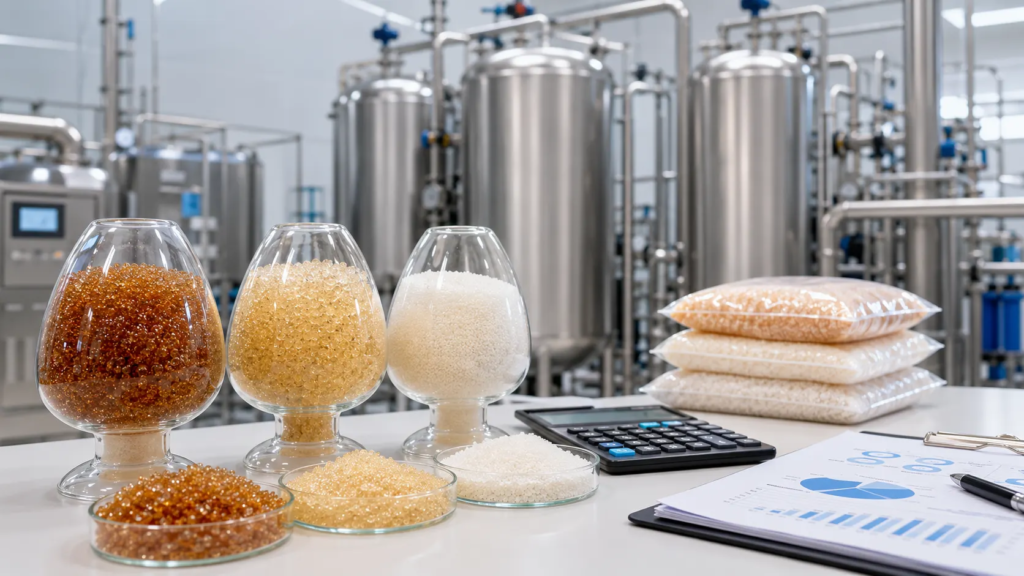
Ion exchange resin costs $3–$20 per kg depending on grade, or $40–$200 per cubic foot for standard industrial resin (SAC/WAC/SBA/WBA types) in the US market. Specialty and high-purity resins can run $500–$2,000+ per cubic foot.
- Standard grade (softening/deionization): $3–5/kg or $40–$200/cu ft
- High-purity grade (pharma, semiconductor, food-grade): $6–12/kg
- Specialty formulations: $10–20/kg, or $500–$2,000+/cu ft
- Bulk industrial pricing (1-ton+ orders): as low as $2.90–$3.00/kg
The rest of this guide breaks down pricing by resin type, what drives the cost, and how to buy smart.
How Much Does Each Resin Type Cost?
Price depends heavily on which resin you’re buying. Here’s the breakdown:
Cation Resin (SAC/WAC) Price
Strong Acid Cation (SAC) and Weak Acid Cation (WAC) resins remove positively charged ions (calcium, magnesium) and are the backbone of water softening. These typically run $40–$200 per cubic foot, or $3–8 per kg in bulk.
Anion Resin (SBA/WBA) Price
Strong Base Anion (SBA) and Weak Base Anion (WBA) resins remove negatively charged ions (chloride, sulfate, silica) and are essential in demineralization (DM) systems. These cost more to manufacture, running $130–$200 per cubic foot.
Mixed Bed Resin Price
A blend of cation and anion resin in one vessel, used for ultrapure water polishing (semiconductor fabs, pharmaceutical manufacturing, power plants). This is the most expensive category, often $10–20+ per kg given the purity requirements.
Specialty Resin Price
Chelating resins, selective ion resins, and custom formulations for niche industrial separation can cost $500 to $2,000+ per cubic foot, sometimes far more depending on the target contaminant and required selectivity.
Kg vs Cubic Foot: Why Pricing Units Trip People Up
Most US industrial suppliers quote resin per cubic foot, while global/import suppliers (especially from China) quote per kilogram. These units aren’t interchangeable without conversion, resin bulk density typically runs 40–45 lbs per cubic foot (roughly 18–20 kg/cu ft). If you’re comparing a domestic per-cubic-foot quote against an imported per-kg quote, convert both to the same unit first, or you’ll end up comparing apples to oranges and picking the “cheaper” option that isn’t actually cheaper.
What Drives Ion Exchange Resin Pricing?
Price isn’t just a brand markup, several concrete factors move the number:
- Resin type: cation resins are generally cheaper than anion or mixed bed resins to manufacture
- Purity grade: semiconductor/pharma-grade resin costs several times more than standard water-softening grade
- Brand: Dow (Dowex), Purolite, DuPont (Amberlite), and Lanxess command a premium over generic manufacturers
- Order volume bulk contracts (multi-ton) routinely bring 20 to 40% off list price
- Raw material costs: resin is polystyrene/divinylbenzene-based, so it tracks petrochemical feedstock prices
- Regeneration frequency needed: resin with higher exchange capacity costs more upfront but needs regenerating less often
- Import/tariff factors: a large share of global resin supply is manufactured overseas, so currency shifts and tariffs affect landed cost in the US
Cheap Resin vs Premium Resin: What’s the Real Difference?
Looking only at the sticker price is a common mistake. The number that actually matters is total cost of ownership:
- Cheap resin: Lower upfront cost, but it degrades faster, needs more frequent regeneration, and typically lasts 1 to 2 years before capacity drops off
- Premium branded resin: Higher upfront cost, but you get greater exchange capacity, longer service life (5 to 8 years with proper maintenance), and fewer regeneration cycles, which also means less regenerant chemical spend over time
If you’re running a demineralization or softening system continuously, factor in regeneration chemical costs, downtime, and disposal costs alongside the purchase price, not just the per-kg or per-cubic-foot number.
What Should You Check Before Buying Resin?
- Confirm the pricing unit, per kg, per cubic foot, or per liter, and don’t compare mismatched units
- Check the exchange capacity (measured in meq/mL or meq/g), not just the price, since a cheaper resin with lower capacity can actually cost more per unit of real performance
- Ask for a sample or spec sheet before committing to a bulk order
- Verify the supplier’s credentials, things like ISO certification, audited supplier status, or a solid industrial track record
- Factor in regeneration chemical costs (HCl, NaOH, NaCl), since these are recurring costs on top of the resin itself
- Ask about expected service life or warranty; many suppliers can tell you the expected years of service under certain operating conditions
- Look into off-site regeneration services if you’d rather skip the resin purchase and disposal cycle altogether; these usually run $40 to $100 per cubic foot as a service fee
FAQs
Q1. How much does ion exchange resin cost per kg?
Honestly it depends a lot on grades. If you’re buying in bulk, standard stuff is usually $3 to $5 a kg. Want something high purity? That’ll run you more, like $6 to $12. And specialty resins can climb even higher, sometimes $10 to $20 a kg or more.
Q2. How much does ion exchange resin cost per cubic foot?
SAC/WAC (that’s cation resin) usually goes for $40 to $200 a cubic foot. Anion resin, the SBA/WBA type, costs a bit more, somewhere around $130 to $200. And if you need something special, be ready to pay anywhere from $500 to well over $2,000 per cubic foot.
Q3. What’s the difference in price between cation and anion resin?
Cation resin’s the cheaper one, usually $40 to $200 a cubic foot. Anion resin costs more, around $130 to $200, mostly because it’s harder to make.
Q4. How long does ion exchange resin actually last?
Somewhere between 3 and 8 years, give or take. It really comes down to the water quality you’re dealing with and how often you’re regenerating it. Once it drops about 20 to 30% below what it started at, that’s usually your cue to replace it.
Q5. Does the resin price include regeneration chemicals?
Nope, that’s separate. Things like hydrochloric acid, sodium hydroxide, sodium chloride, you’ll be paying for those on an ongoing basis too.
Q6. Any discounts for buying in bulk?
Yeah, usually. If you’re ordering multi-ton or high volume, you can often knock 20 to 40% off the regular price.
Q7. What about off-site regeneration instead of buying new resin?
That’ll typically cost $40 to $100 per cubic foot, depending on how much water you’re running through it and how often it needs doing.