How to Remove Silica From Water: Ion Exchange, RO, and Lime Softening Compared
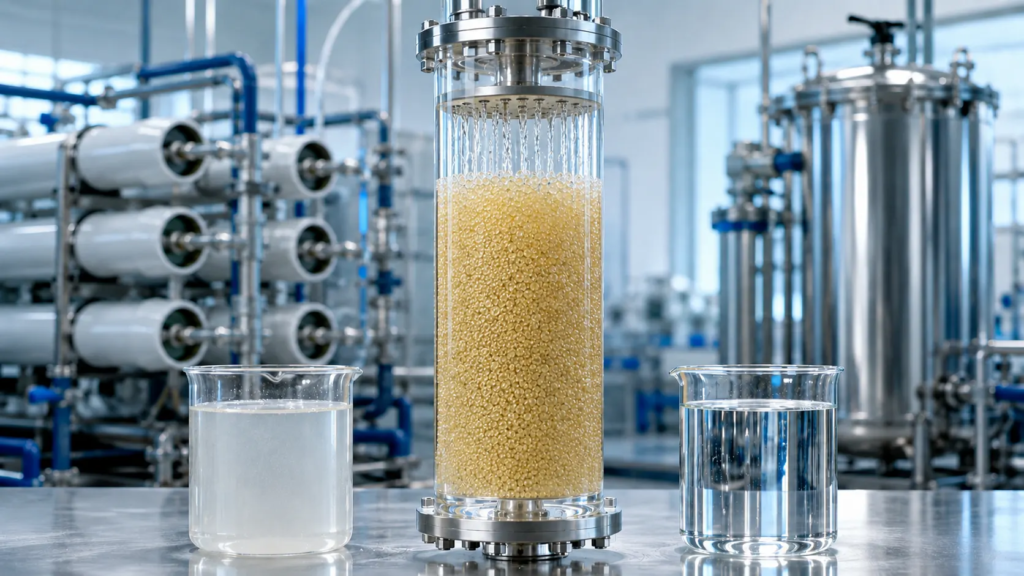
Removing silica from water means bringing dissolved and suspended silicon dioxide (SiO2) down to a target level. You’ve got a few tools for this: ion exchange, reverse osmosis, lime softening, or membrane filtration. Which one works depends on what form the silica is actually in. Reactive (dissolved) silica responds to ion exchange and RO. Colloidal (polymerized) silica doesn’t; it needs filtration or coagulation instead. This guide walks through what silica actually is, how low you need to go for your specific application, and how to pick between the main removal methods.
Key Takeaways
- Silica comes in two forms, and they don’t behave the same way. Reactive silica is dissolved and ionic. Colloidal silica is polymerized and carries almost no charge. Ion exchange only removes the reactive form.
- Strong base anion (SBA) resin in the hydroxide cycle handles reactive silica, often down to single-digit parts per billion, and it’s a standard stage in demineralization trains.
- Target levels swing wildly depending on the use. High-pressure boiler feedwater often needs silica below 0.02 mg/L (20 ppb). Some semiconductor rinse specs call for under 1 ppb.
- A water softener won’t touch silica, period. Softening resin exchanges hardness ions like calcium and magnesium. Silica isn’t part of that reaction.
- Most industrial systems don’t rely on just one method. Pretreatment, then RO, then ion exchange or mixed bed polishing, working together, is the norm.
What Silica Removal From Water Actually Means
Reactive Silica vs. Colloidal Silica
Silica in raw water shows up in two forms, and the difference matters a lot for how you treat it. Reactive silica, sometimes called monomeric silica, is dissolved and sits in equilibrium with the bisilicate ion. That gives it a weak ionic character. Because of that charge, strong base anion exchange resin running in the hydroxide cycle can pull it right out of solution. That’s according to technical literature published by resin manufacturers DuPont and Dowex.
Colloidal silica works differently. It’s made of long polymerized chains of silica units, and those chains carry essentially no ionic charge. Ion exchange resin has almost no capacity for it. The resin might trap a bit of colloidal material through basic filtration, but you can’t count on that as a real removal mechanism. Colloidal silica needs a physical or coagulation-based approach instead, like ultrafiltration or clarification.
Here’s why this matters before you buy anything: a standard silicomolybdate lab test only measures the reactive fraction. So a clean reading on that test doesn’t necessarily mean your colloidal silica is gone too.
Why Silica Removal Matters
Silica scale is one of the tougher deposits you’ll deal with in an industrial water system. Unlike calcium carbonate scale, it shrugs off most standard descaling chemistry once it’s formed, and it’s abrasive enough to wear down pumps and piping over time. In boilers, silica can carry over with steam at high pressure and deposit on turbine blades, which cuts efficiency and forces shutdowns for mechanical cleaning. In membrane systems, it fouls reverse osmosis and ultrafiltration units and puts a hard ceiling on how far you can concentrate a reject stream before scaling takes over.
For high-purity applications, the concern isn’t scaling so much as product quality. In semiconductor and electronics rinse water, even trace silica left behind after a rinse cycle can cause a device to fail. That’s exactly why specs for that water are written in single-digit parts per billion.
How Much Silica Is Too Much? Typical Targets by Application
There’s no single legal limit for silica in water. The U.S. EPA hasn’t set a primary or secondary drinking water standard for it specifically, so residential targets come down to taste, staining, and protecting your appliances rather than a federal number. Industrial targets are different: they’re set by whatever equipment or process the water is feeding.
| Application | Typical silica target | Why |
| High-pressure boiler feedwater | Roughly 10 to 20 ppb (as low as 0.02 mg/L) | Prevents volatile carryover and turbine deposits |
| Cooling tower / lower-pressure boiler makeup | Roughly 10 to 100 ppb, depending on the application | Limits scale on heat transfer surfaces |
| Semiconductor / electronics rinse water | Often below 1 to 5 ppb, sometimes under 1 ppb | Trace silica can cause device failure |
| General industrial process/RO feed | Managed to avoid exceeding silica’s solubility limit, not a fixed number | Protects membranes and downstream equipment |
These figures are general industry ranges pulled from manufacturer and treatment-industry technical publications, not a regulatory requirement. Always confirm the actual spec for your equipment against your boiler OEM’s manual, your facility’s water quality target, or your customer’s purchase spec.
The Main Methods for Removing Silica From Water
Ion Exchange With Strong Base Anion Resin
Strong base anion resin, regenerated with caustic soda (sodium hydroxide) and run in the hydroxide cycle, exchanges reactive silica right along with other anions like chloride, sulfate, and bicarbonate. This is the standard approach in demineralization systems, usually paired with strong acid cation resin ahead of it, with mixed bed resin as an optional final polishing stage when you need very low, consistent silica leakage. Ion exchange generally gets residual reactive silica lower than reverse osmosis can on its own, which is why it’s commonly used as a polishing step after RO rather than a full replacement for it.
Here’s a practical wrinkle worth knowing: silica has a lower affinity for SBA resin than sulfate or chloride does. That means as a resin bed nears exhaustion, or if regeneration doesn’t use enough excess caustic, silica is often the first thing to leak through. Build that into your monitoring plan instead of finding out the hard way.
Reverse Osmosis
RO membranes reject a large share of reactive silica, commonly cited in the 96 to 99% range, and they’re also effective against colloidal silica, which ion exchange simply can’t touch. Because silica concentrates in the reject stream, you have to set system recovery with its solubility limit in mind, or scaling will form on the membrane before you hit your target recovery rate. RO is frequently used ahead of ion exchange since it cuts down the ionic load the resin has to handle and stretches out time between regenerations.
Lime Softening
Lime softening adds calcium hydroxide to raise pH and precipitate hardness minerals out of the water. As those flocs form, they absorb silica particles right along with calcium and magnesium, and the combined floc gets removed by settling or filtration. It’s a long-established pretreatment for cooling tower and boiler makeup water carrying both hardness and silica. The tradeoff is real capital investment, ongoing chemical dosing, and sludge handling, and the dosing has to track changes in incoming silica concentration over time.
Ultrafiltration and Coagulation for Colloidal Silica
Since colloidal silica isn’t ionic, ultrafiltration (physically sieving out fine particles) and coagulation or flocculation methods are used specifically for that fraction. These usually get paired with RO or ion exchange rather than run alone, since raw water almost always carries both reactive and colloidal silica together.
Comparing the Methods
| Method | Removes reactive silica | Removes colloidal silica | Typical role |
| Ion exchange (SBA / mixed bed) | Yes, down to very low ppb levels | No, minimal effect | Primary demineralization or final polishing |
| Reverse osmosis | Yes, 96 to 99% typical | Yes | Bulk reduction and colloidal removal, often ahead of ion exchange |
| Lime softening | Partial, through co-precipitation | Partial | Pretreatment for high-silica, high-hardness feeds |
| Ultrafiltration / coagulation | No direct effect | Yes | Colloidal silica pretreatment |
How to Choose the Right Silica Removal Method
- Test for both reactive and total silica. A silicomolybdate test alone won’t tell you if colloidal silica is present too.
- Confirm the target level your application actually requires. That might be a boiler OEM spec, an electronics water spec, or just a general scaling-prevention target for cooling water.
- Check your existing pretreatment. High hardness or high TDS ahead of an ion exchange system changes resin sizing and how often you’ll regenerate.
- Match the method to the silica form that’s actually present. Reactive-dominant, low-volume, high-purity needs generally point to ion exchange, sometimes after RO. Colloidal-dominant or very high-silica raw water usually needs UF, coagulation, or lime softening first.
- Share your feed water analysis, flow rate, and target quality with a resin supplier before assuming which resin family or model fits. The right answer comes from your numbers, not from your application’s name alone.
Common Mistakes in Silica Removal Projects
- Assuming a water softener handles silica. Softening resin only exchanges hardness ions. It has zero effect on silica.
- Sizing regeneration around capacity alone. Since silica has lower resin affinity than sulfate or chloride, under-dosed caustic regeneration can let silica leak through before other anions do.
- Treating one silicomolybdate reading as the full picture. It measures reactive silica only, not the colloidal fraction.
- Skipping a feed water analysis before ordering resin or membranes. Silica behavior varies enough between sources that guesswork usually just means retesting and reordering later.
FAQs
Does a water softener remove silica?
No. A water softener exchanges hardness ions like calcium and magnesium for sodium. It has no meaningful effect on either reactive or colloidal silica.
Does reverse osmosis remove silica from water?
Yes. RO typically rejects around 96 to 99% of reactive silica and is also effective against colloidal silica. System recovery still needs to be set carefully, since silica concentrates in the reject stream and can scale the membrane if you push past its solubility limit.
What’s the difference between reactive and colloidal silica?
Reactive silica is dissolved and carries a weak ionic charge, so ion exchange can remove it. Colloidal silica is polymerized into larger, uncharged chains, so it needs filtration or coagulation-based methods instead.
Is silica in drinking water a health concern?
The U.S. EPA hasn’t set a primary or secondary drinking water standard for silica, and it isn’t generally treated as a health-based contaminant at typical natural water concentrations. Most silica removal in drinking water contexts is done for staining, taste, or protecting appliances, not because of a regulatory requirement.
How low can ion exchange get silica levels?
Strong base anion resin operating in the hydroxide cycle can bring reactive silica down to very low parts-per-billion levels under proper operating conditions. That’s why it’s commonly used for boiler feedwater and high-purity polishing applications.
What’s the cheapest way to remove silica from water?
There isn’t one cheapest method across the board. It depends on your raw water silica level, volume, and target quality. As a general rule, lime softening tends to fit high-volume, high-hardness feeds where a lower silica target is acceptable, while ion exchange and RO fit lower-volume, high-purity requirements better. Get a treatability assessment based on your actual feed water before assuming which option is most economical for your site.
Getting the Right Resin for Your System
Picking a silica removal method starts with knowing what’s actually in your feed water, not just what application you’re treating. Haitron manufactures strong base anion resin for demineralization and silica reduction, along with mixed bed resin for final polishing when you need very low silica leakage.
Share your feed water analysis, target silica level, flow rate, and regeneration setup, and Haitron’s technical team can confirm the right resin family and model for your project. Request a quote.