Electroplating Wastewater Treatment: Process, Standards, and Where Ion Exchange Fits
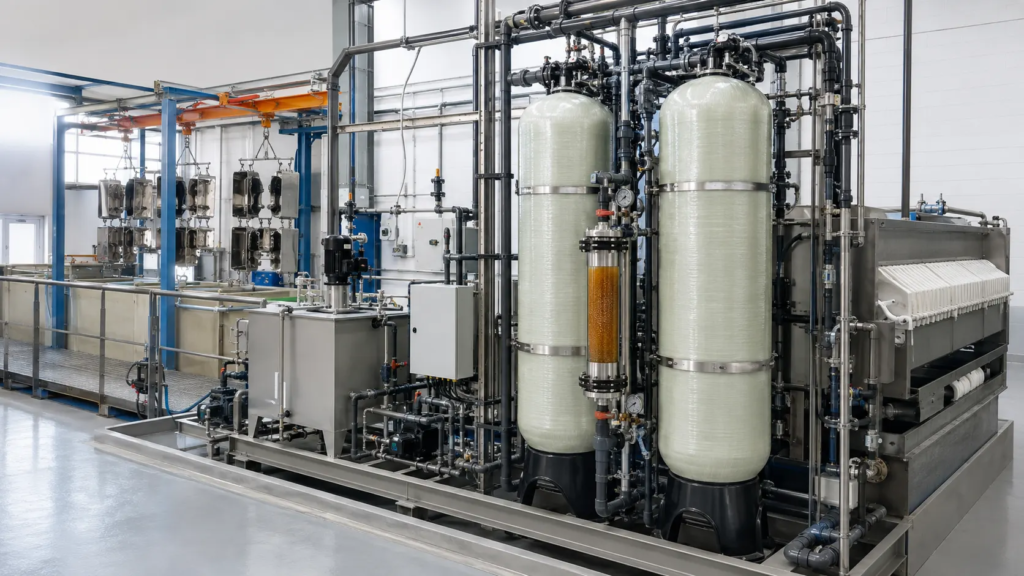
Cleaning up electroplating wastewater rarely happens in one move. It usually takes a few methods working together, chemical, physical, and ion exchange, to strip away plating and rinse water contaminants before that water heads out or gets reused.
The process starts with pretreatment, which handles cyanide and knocks hexavalent chromium down to safer levels. Then comes chemical precipitation, pulling out most of what’s still dissolved in the water. After that, a polishing step (often ion exchange) gets things down to strict discharge limits, and sometimes even recovers metal worth keeping.
That’s the core of what this guide walks through: what’s in the water, what rules apply, and how electroplating wastewater treatment actually comes together step by step.
What Is in Electroplating Wastewater
Electroplating and metal-finishing operations don’t produce just one type of wastewater, they produce several, and treating any of it properly starts with knowing what’s actually in each stream. A full-scale plant study published in Environmental Advances breaks electroplating effluent down into a few main categories: acidic and alkaline rinse water, organic-heavy wastewater left over from degreasing and de-waxing, cyanide-bearing wastewater from cyanide-based plating baths, chromium-bearing wastewater, and general heavy-metal wastewater carrying dissolved nickel, copper, zinc, and similar ions.
Plants usually keep these streams separate right from the source. There’s a good reason for that. Mix cyanide wastewater with an acid stream, and you risk generating toxic hydrogen cyanide gas. Mix chromium wastewater with reducing agents meant for a different line, and you’ve just wasted chemicals for nothing. So a facility running cyanide zinc plating, chromium plating, and copper plating lines side by side will typically send each stream to its own holding tank before any treatment even begins.
Global Discharge Standards at a Glance
There’s no single global standard here, discharge limits shift from country to country, and sometimes even from region to region within the same country. That’s part of what trips up teams sourcing treatment equipment or resin for operations spread across multiple sites.
| Region | Standard | Example limits |
| United States | 40 CFR Part 433 (EPA Metal Finishing Effluent Guidelines) | Facility-specific limits set under best-practicable and best-available-technology criteria; the EPA is also developing PFAS-specific limits for chromium electroplating discharges |
| European Union | Industrial Emissions Directive 2010/75/EU | Limits are set at member-state and permit level; general industry guidance figures cluster around 0.5 mg/L for chromium and nickel |
| China | GB 21900-2008 | Sets numeric limits by pollutant, including strict caps on nickel and hexavalent chromium in sensitive areas |
Rules vary by country, and within China, by whether a facility sits in a sensitive region, so treat these figures as general guidance, not a permit substitute. The US EPA is revising metal-finishing guidelines to target PFAS from chromium plating, likely reshaping electroplating wastewater treatment rules by 2026.
How Electroplating Wastewater Is Treated: The Typical Process Train
Step 1: Segregation and Pretreatment
Cyanide gets dealt with first. An alkaline chlorination step oxidizes it, breaking it down before it can reach later stages of treatment. Chromium follows a different path entirely. A reduction step converts hexavalent chromium, the toxic and highly soluble form, into trivalent chromium. That form settles out of the water far more easily.
Step 2: Chemical Precipitation
Once cyanide is destroyed and chromium is reduced, lime or another alkali gets added to raise the pH. This turns dissolved metals into solid hydroxide particles. A flocculant is added next, pulling those fine particles into larger clumps. The clumps settle out and get pressed into sludge. A study of a Shenzhen plant found precipitation usually running near pH 3.5, with oxidation-reduction potential sitting around 300 to 450 mV. COD removal ranged from 24% to 79%, which shows just how much results can shift depending on what’s flowing in that day.
Precipitation does most of the work here because it’s affordable and dependable. Still, it has real limits. It rarely brings metal levels down far enough by itself, and it keeps generating sludge that has to be disposed of separately.
Step 3: Ion Exchange Polishing and Metal Recovery
This is where resin comes in. It doesn’t replace precipitation, it picks up where precipitation leaves off. Once most metals are already removed, the remaining trace ions pass through a resin bed. Chelating resins target specific metals selectively, even when other ions are present, pushing concentrations down to very low levels.
Research backs this up. One 2024 study found resin removing hexavalent chromium stayed above 97% effective even after 30 regeneration cycles. Other tests on real plant effluent showed strong results in the same pH range precipitation already runs in, which is why resin polishing fits naturally as the next step. It also makes metal recovery possible, since the metal sticks to the resin instead of ending up in the sludge.
Chemical Precipitation vs. Ion Exchange: Which Do You Need?
Most plants don’t pick one over the other, they use both. Chemical precipitation is usually the better choice for handling large, unpredictable metal loads at a lower cost, which is why it works as the first stage almost everywhere. Ion exchange, on the other hand, tends to shine at the final polishing step, especially when discharge limits are strict, when recovering metal actually pays off, or when sludge disposal costs are already becoming a headache the operator wants to cut down.
A plant sending wastewater into a loosely regulated sewer with a fairly light metal load can often get by with precipitation alone. But a plant operating in a sensitive region under GB 21900-2008, or one looking to recover nickel or copper instead of sending it to a landfill as sludge, will usually need that extra polishing stage. In most cases, this two-step approach is simply how electroplating wastewater treatment gets done right.
What Resin Family Fits Which Electroplating Stream
- Chelating resin: usually the best starting point for selective heavy metal capture, things like chromium, nickel, copper, and zinc, especially once precipitation has already done its part. It’s also the go to option when resource recovery is a real goal rather than an afterthought.
- Strong acid cation (SAC) resin: a solid choice for bulk cation removal ahead of a chelating polish stage, or in situations where overall cation load matters more than targeting specific metals.
- Weak base anion (WBA) resin: comes into play when the process also has to handle acid or mixed ion streams, particularly where keeping regenerant demand low is a priority.
That said, none of this replaces an actual feed analysis. The right resin choice still depends on your specific water chemistry, the outlet quality you’re aiming for, what regenerants are available, and your flow rate. Treat this list as a starting shortlist, not a final specification.
Common Mistakes in Electroplating Wastewater Treatment
- Skipping pretreatment before precipitation means Cr⁶⁺ and cyanide bound metals never get handled properly, since precipitation alone can’t touch them.
- Trusting precipitation alone to hit strict limits is risky, because performance swings with influent variability, and that’s exactly where a polishing stage adds consistency.
- Guessing the resin before confirming feed composition is a common slip, since the same wastewater label can hide very different ion mixes plant to plant.
- Ignoring recovery value and treating sludge disposal as a fixed cost overlooks how ion exchange can shrink disposal volume and sometimes recover sellable metal.
Frequently Asked Questions
What chemicals are typically in electroplating wastewater?
Mostly heavy metals like chromium, nickel, copper, and zinc, plus cyanide from plating baths and organic residue from degreasing. The mix changes depending on what a facility actually plates.
Can heavy metals be recovered instead of just removed?
Yes. Ion exchange resin captures metal ions and lets you strip them back out during regeneration, instead of losing them to sludge. Whether it’s worth it depends on the metal and its scrap value.
How often does ion exchange resin need regeneration?
It depends on flow rate and how much metal is coming in, not a set schedule. Testing has shown chelating resins holding above 97% efficiency after 30 regeneration cycles, but your own feed water will decide the real number.
Does ion exchange replace chemical precipitation?
No, they work together. Precipitation handles the bulk metal load cheaply, and ion exchange comes in after to polish the water down to strict limits or recover value.
What data should we send before requesting a resin recommendation?
Your feed composition, pH, flow rate, target outlet quality, available regenerants, and temperature. That’s what a supplier actually needs to recommend a resin.
Does Haitron Resin help with electroplating wastewater treatment?
Yes, that’s what we do. Send over your feed data and target outlet quality, and we’ll help you find the right resin. More at haitronresin.com.
Next Step: Get a Resin Recommendation for Your Feed Water
If your plant is looking into a polishing or metal recovery stage for electroplating wastewater treatment, the fastest way forward is to share your feed analysis, target outlet quality, and flow rate. From there, Haitron’s technical team can tell you whether chelating, SAC, or WBA resin actually fits your process.
You can request a quote directly, or take a look at the chelating resin specifications first if you want model level detail before reaching out.