How to Remove Calcium From Water: 5 Methods Compared
Wondering how to remove calcium from water? The answer depends on where you want it gone. For your whole house, use a water softener. For drinking water, use reverse osmosis, which usually removes 96 to 98% of calcium.
Boiling only removes part of it. And “salt free softeners” don’t remove calcium at all. This guide explains what really works, so you can pick the right fix.
Should you remove calcium at all?
Calcium in water isn’t a health problem. The World Health Organization (WHO) sets no health limit for calcium or water hardness. Most people only start to taste it somewhere between 100 and 300 mg/L.
The real reasons to remove it are everyday hassles. Hard water leaves scale in kettles and water heaters, spots on dishes, and soap that won’t lather.
There’s also a reason not to overdo it. WHO warns that very soft water can eat away at pipes and pick up metals like lead and copper if it isn’t treated properly.
Step 1: Test your water first
Before you buy anything, find two numbers: total hardness and alkalinity. Your city’s water quality report usually lists both. Well owners can use a test kit or a lab.
These two numbers show what kind of calcium you have:
- Temporary hardness is calcium joined with bicarbonate. Heat turns it into a chalky white scale, which is why your kettle gets crusty. Boiling can remove this part.
- Permanent hardness is calcium joined with sulfate or chloride. Boiling does nothing to it.
Here’s a simple way to work it out. Your temporary hardness equals your alkalinity or your total hardness, whichever number is smaller. The rest is permanent.
For example, say your water has 250 mg/L total hardness and 180 mg/L alkalinity. About 180 mg/L is temporary, and 70 mg/L is permanent. Boiling could help with most of it, but not all.
How to remove calcium from water: methods compared
| Method | Removes calcium? | Best for | Main downside |
| Water softener | Yes, nearly all | Whole house | Adds sodium or potassium, uses salt |
| Reverse osmosis (RO) | Yes, about 96 to 98% | Drinking and cooking water | Slow, sends some water to the drain |
| Distillation | Yes, nearly all | Small batches | Slow and uses lots of electricity |
| Boiling | Only temporary hardness | A kettle’s worth | Leaves permanent hardness behind |
| Weak acid cation resin | Only temporary hardness | Commercial and industrial water | Needs acid to recharge, not for homes |
Water softener
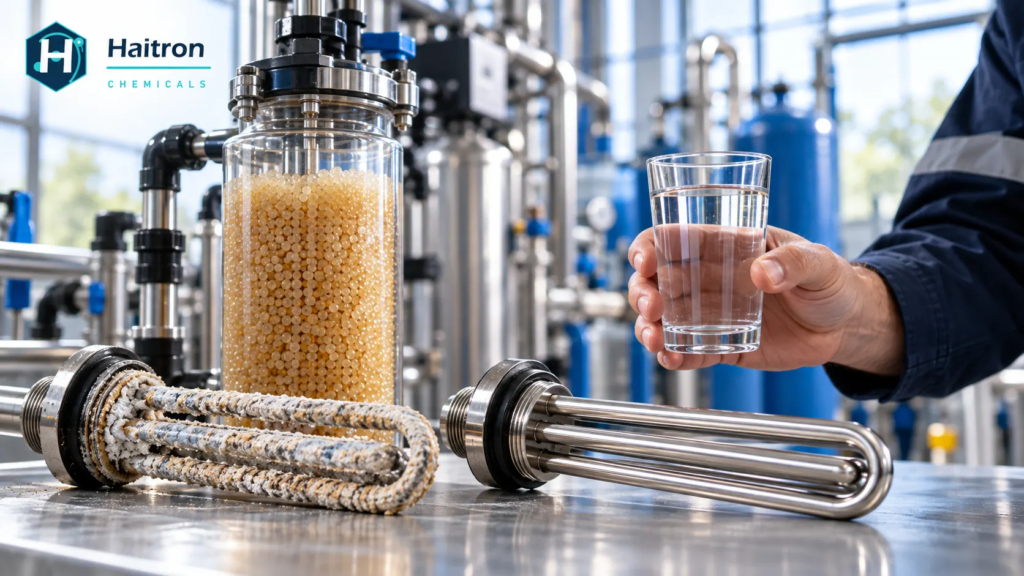
A water softener is a tank full of tiny resin beads. Think of each bead as a magnet for calcium. As water flows past, the beads grab calcium and magnesium and let go of sodium instead.
When the beads fill up, the softener rinses them with salty water and starts over. This is called regeneration. If you want less sodium, you can use potassium chloride instead of salt.
This is the only common method that softens all the water in your home. Our guide on how often a water softener should regenerate helps you get the settings right.
Reverse osmosis
Reverse osmosis pushes water through a very fine membrane. It’s like a sieve so tight that dissolved minerals can’t get through.
Typical membranes block about 96 to 98% of calcium and magnesium. Results change a little with water pressure, temperature, and your water’s makeup.
Most people put an RO system under the kitchen sink for drinking and cooking. If your water is very hard, a softener before the RO unit helps the membrane last longer.
Distillation
A countertop distiller boils water and catches the steam, leaving calcium behind in the pot. It’s slow, so it suits small needs like steam irons, humidifiers, and CPAP machines.
Boiling
Boiling turns calcium bicarbonate into solid chalk that sinks or sticks to the pot. But it does nothing for calcium sulfate or calcium chloride.
So boiling only helps if most of your hardness is temporary. You’ll also need to pour the water off the white sediment.
Weak acid cation resin (for businesses)
Factories use the same chemistry as boiling, but with a special resin instead of heat. Weak acid cation resin removes the calcium joined with bicarbonate, which is the temporary part. It also lowers alkalinity at the same time.
Our D113 weak acid cation resin has a high capacity (at least 4.5 mmol/mL), which suits cooling water and process water with lots of alkalinity. It isn’t the right choice when most hardness is permanent. In that case, strong acid cation resin, the kind inside home softeners, removes all of it.
Methods that don’t remove calcium (but may still help)
Some products change how calcium behaves instead of taking it out.
| Method | What it actually does | Is it worth it? |
| Salt free conditioner (TAC) | Turns calcium into tiny crystals that stick less. Hardness stays the same. | Can cut scale. Independent testing found about 88 to 99% less scale for the technology. |
| Scale inhibitor cartridge | Stops scale forming in one machine | Good for a coffee maker or boiler |
| Magnetic descaler | Claims to change how scale forms | Evidence is unclear |
| Fridge or pitcher filter | Improves taste, doesn’t hold dissolved calcium | Not for calcium |
| Vinegar | Dissolves scale that’s already there | Great for cleaning, not for treating water |
Salt free conditioners also work less well with iron, very hot water, or extremely hard water. If you’re not sure whether you need a softener or a filter, our guide on water softener vs water filter matches your problem to the right system.
Which method fits your goal?
The best answer to how to remove calcium from water depends on what you want to fix.
| Your goal | Best choice | Also think about |
| Soft water in every tap and shower | Water softener | RO at the kitchen sink for low sodium drinking water |
| Calcium free drinking water only | Under sink RO | A countertop distiller for small amounts |
| Less scale, no salt | Certified TAC conditioner | Remove iron first |
| Protect one machine | Scale inhibitor cartridge | Softened or RO water |
| Business water with high alkalinity | Weak acid cation resin, often followed by strong acid cation resin | Share your water test with a resin supplier |
How to remove calcium deposits you already have
Treating your water stops the new scale, but it won’t clean old buildup. For that, you need a mild acid.
Soak shower heads and faucet tips in white vinegar. Descale kettles with vinegar or citric acid. Flush your water heater the way the maker suggests. For cloudy cups and dishes, see our tips on hard water stains from glassware.
FAQs
Does boiling water remove calcium?
Only part of it. Boiling removes temporary hardness, but calcium joined with sulfate or chloride stays in the water.
Is calcium in water bad for you?
No. WHO sets no health limit for calcium in drinking water. The problems are scale, spots, and wasted soap.
Is softened water okay to drink?
For most people, yes. It has a little extra sodium. If you’re watching your sodium, use potassium chloride or drink RO water.
How do I remove calcium from well water?
The same way as city water. Test first, then use a softener for the whole house or RO for drinking. Test for iron too, because it can clog salt free systems.
Can Haitron help with calcium removal for my business?
Yes. Send us your water test results, and our team will suggest the right softening or dealkalization resin for your system.
Final Thoughts
Now you know how to remove calcium from water: test first, use a softener for the whole house, and use reverse osmosis for drinking water. Skip boiling unless most of your hardness is temporary, and remember that salt free systems reduce scale without removing calcium.