Does a Water Softener Remove Iron? Here’s the Honest Answer
Yes, but only a little. If you are wondering, does a water softener remove iron, it can remove a small amount of dissolved iron that remains invisible in the water. If your tap water looks clear but leaves orange stains later, a softener may help. However, if the water is already orange or brown when it comes from the faucet, a water softener alone will not solve the problem.
Let’s go through this slowly, in plain words, without any confusing science.
What You’ll Learn Here
By the end of this page, you’ll know whether your softener can handle the iron in your water, how much iron is too much, and what to do if it isn’t enough. No guesswork, just a clear answer.
Two Kinds of Iron, and Why That Matters
Most people talk about iron in water like it’s one thing. It isn’t. There are two kinds, and they behave in completely different ways.
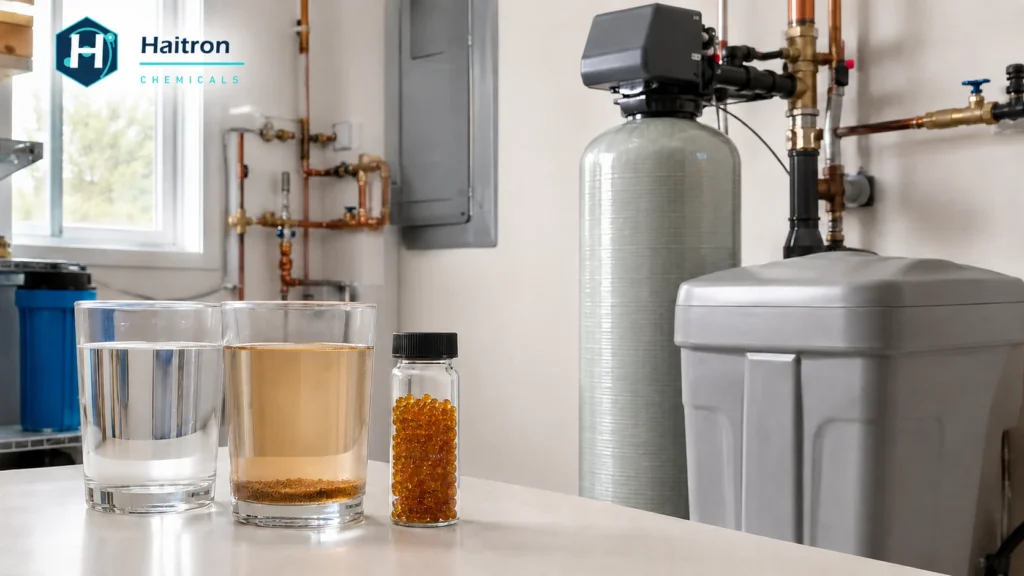
Hidden iron (ferrous iron). This kind is dissolved in the water. You can’t see it. Pour a glass straight from the tap and it looks totally clear. Leave that same glass sitting out for a while, though, and it slowly turns orange as the iron reacts with air. This is the type a water softener can actually help with.
Visible iron (ferric iron). This kind has already reacted and turned into tiny rust particles. The water looks orange, brown, or cloudy right from the tap. It’s the kind that stains sinks, tubs, and laundry. A water softener cannot remove this type, no matter how new or well maintained it is. That job belongs to an iron filter.
So How Does a Water Softener Remove Iron in the First Place?
Picture the inside of a softener tank filled with thousands of tiny resin beads. Their job is to grab hold of calcium and magnesium (the minerals that make water “hard”) and trade them for sodium. That’s the whole trick behind softened water.
Dissolved iron happens to behave a lot like calcium and magnesium chemically, so those same beads will grab a small amount of it too. This is exactly how a water softener removes iron. It’s really just a side effect of the softening process, not something the machine was built to do.
Here’s where it gets tricky. During the softener’s cleaning cycle (called regeneration), the water flowing through picks up oxygen from the air. If dissolved iron is released at that moment, the oxygen turns it into rust right there inside the tank. That rust doesn’t rinse away easily. Over time it can coat the resin beads and slow the whole system down, hurting its ability to soften water at all, not just remove iron.
How Much Iron Can a Softener Actually Handle?
There’s no single magic number here because every resin and every softener model is a little different. Still, most water treatment professionals work within a fairly consistent range, and it looks something like this:
| Iron Level in Your Water | Can a Softener Handle It? |
|---|---|
| Under 1 ppm, hidden iron | Usually, yes |
| 1 to 3 ppm, hidden iron | Sometimes, if the softener is in good shape |
| Above 3 ppm, or any visible rust colored iron | No, you’ll need a separate iron filter |
One number worth knowing: the U.S. EPA says water starts to stain and smell once iron passes about 0.3 ppm. So even amounts that sound tiny can still cause real problems around the house.
Signs Your Softener Is Losing the Fight Against Iron
How do you know if your softener is struggling? Watch for these:
- Rust stains keep showing up again, even right after the softener has run
- The water tastes or smells faintly metallic
- You notice orange or reddish buildup inside the salt tank
- Softened water doesn’t feel as soft as it used to
- You’re using more salt but getting weaker results
Any one of these on its own isn’t a big deal. A few of them together usually means the iron level is higher than your softener can comfortably manage.
How to Find Out What’s Really in Your Water
Guessing isn’t a great plan when it comes to your home’s water. Here’s a simple way to check.
Start with a water test. A basic iron test will tell you the exact amount, in parts per million, so you’re working with real numbers instead of a hunch. Next, just look at the water. If it’s clear from the tap but turns orange after sitting for a while, that points to hidden iron. If it’s already colored the moment it comes out, that’s visible iron. Finally, give it a sniff. A rotten egg or swampy smell often points to iron bacteria, which needs its own treatment and isn’t something a softener or even a basic iron filter will solve on its own.
What to Do If Your Iron Levels Are High
If your test comes back low, on the hidden iron side, a good water softener may genuinely be all you need. If the number is a bit higher, adding an iron filter ahead of the softener protects the resin and keeps your results consistent. And if there’s any visible rust or bacterial smell at all, an iron filter needs to come first, full stop. There’s no version of a softener alone that fixes that.
A lot of well water households end up running both systems together: an iron filter first, then the softener right after it. That way the softener only ever has to deal with calcium and magnesium, which is what it was actually designed for, and it tends to last a lot longer as a result.
Mistakes Worth Avoiding
A few things trip people up again and again. Buying a softener before ever testing the water is probably the most common one. Right behind it is assuming any softener can handle any amount of iron, which simply isn’t true. Some people also ignore the early warning signs for months until the softener basically stops working, when a quick check earlier could have caught it. And iron bacteria gets treated the same as regular dissolved iron more often than it should, even though the fix for one won’t touch the other.
Frequently Asked Questions
Does a water softener remove rust from water?
No. Rust is a solid, not something dissolved in the water, so a softener’s resin beads have nothing to grab onto. You’d need an iron filter to deal with rust.
Can too much iron damage a water softener?
It can. Iron that oxidizes inside the tank coats the resin beads over time, and that makes the softener weaker and shortens how long the resin lasts.
Is a water softener enough if my well water has iron bacteria?
No. Iron bacteria form a slimy buildup that a softener isn’t built to remove. That usually calls for a dedicated cleaning treatment, separate from any iron or hardness fix.
Why does my softened water still smell like iron?
Most likely the iron level is above what your softener can realistically handle, or the resin bed already has rust built up on it from past regeneration cycles.
Final Verdict
So, does a water softener remove iron? A little, yes, and only the hidden kind. It was never built to strip out rust, sediment, or bacteria, and expecting it to do so usually ends in disappointment (and stained laundry). If iron is a real problem in your home, pairing a softener with a proper iron filter is the setup that actually works, and it protects your equipment for the long run too.
If you’re looking into resin built for tougher water conditions, including hardness combined with iron, you can look through Haitron’s Strong Acid Cation Resin options, or read about how Chelating Resin is used to capture metals like iron in more demanding systems. Their blog also has more on water softener maintenance and salt free softeners, if you want to go deeper.