Does a Water Softener Remove Chlorine? Here’s the Real Answer
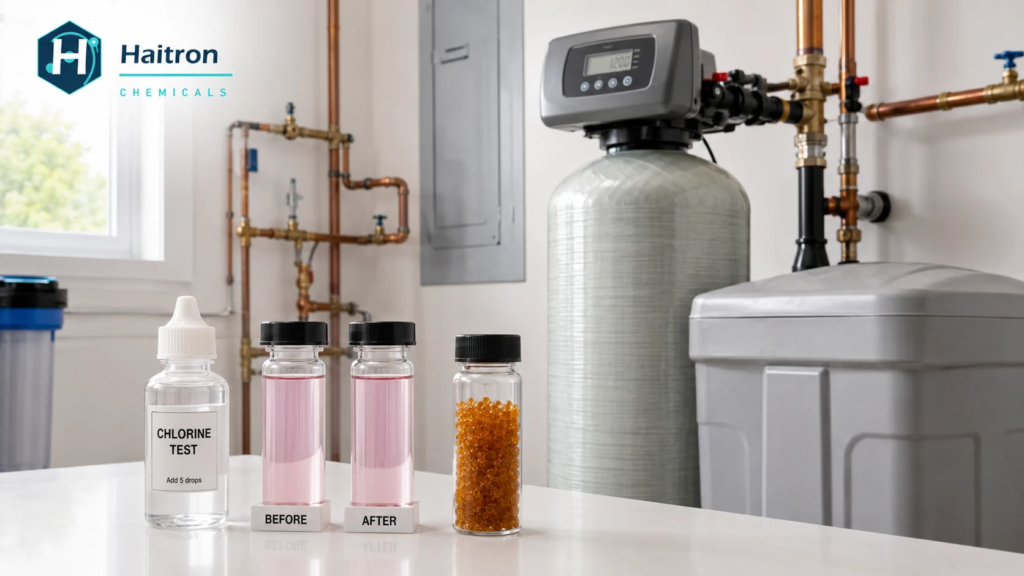
Does a water softener remove chlorine? No. A softener removes hardness. The resin inside swaps calcium and magnesium for sodium, and chlorine is not a hardness ion, so it passes straight through the tank and out to your taps. The more useful question is what chlorine does on the way through, because it slowly damages the resin you paid for. This page covers what passes, what breaks, and what to install instead.
Key Takeaways
- A softener reduces hardness only. Chlorine reduction is a separate job, and activated carbon does it.
- Free chlorine attacks the resin polymer itself and shortens the life of the bed.
- Resin makers publish free chlorine limits of roughly 0.2 to 0.5 mg/L. Tap water often runs at or above that.
- Chloramine is not the same problem as chlorine. It needs catalytic carbon, not ordinary carbon.
What a Water Softener Is Built to Do
A softener is a tank of ion exchange resin beads held in the sodium form. Hard water flows through, calcium and magnesium stick to the beads, and sodium goes into the water in their place. When the beads fill up, a brine rinse strips the hardness off and reloads them. That is the whole job. NSF/ANSI 44, the standard written for home cation exchange softeners, treats them as hardness equipment. Chlorine, taste and odor claims sit under a separate standard, NSF/ANSI 42, and one does not come with the other.
Why the Chlorine Slips Straight Through
Free chlorine in water exists mainly as hypochlorous acid and hypochlorite ion. A sodium-form cation resin only trades positive ions. Hypochlorite carries a negative charge and hypochlorous acid carries none, so neither one gets exchanged. The chlorine leaves the tank at close to the level it went in at.
So if your softened water still smells faintly of a swimming pool, nothing is broken. That is the tank doing exactly what it was built to do.
What Chlorine Does to Softener Resin
Softening resin is polystyrene crosslinked with divinylbenzene, usually written as DVB, with sulfonic acid groups attached. Those DVB crosslinks hold each bead together.
Free chlorine attacks them. DuPont’s technical note on oxidation stability sets out the mechanism: oxidation de-crosslinks the copolymer matrix, water retention rises, the beads swell, mechanical strength falls, and wet volume capacity is lost.
Any small drop in chlorine measured across a softener is therefore not filtration. It is the oxidant spending itself on the polymer.
How Much Chlorine Softening Resin Can Take
These are the maximum oxidant levels DuPont recommends in feed water for cation resins, measured at 20 degrees C.
| Cation resin type | Max free chlorine (Cl2) | Max chlorine dioxide | Max ozone |
|---|---|---|---|
| Gel, 8% DVB | 0.2 mg/L | 0.1 mg/L | 0.2 mg/L |
| Gel, 10% DVB | 0.3 mg/L | 0.15 mg/L | 0.3 mg/L |
| Macroporous, 12% DVB | 0.4 mg/L | 0.2 mg/L | 0.35 mg/L |
| Macroporous, 20% DVB | 0.5 mg/L | 0.25 mg/L | 0.4 mg/L |
Now compare that with the water arriving at the house. WHO reports that most disinfected drinking water carries 0.2 to 1 mg/L of free chlorine, and the US EPA allows a maximum residual disinfectant level of 4.0 mg/L. A standard 8% DVB gel resin is rated for 0.2 mg/L. Ordinary tap water often sits at or above the limit of the resin it is flowing through.
DuPont puts a number on the cost. A standard gel cation resin treating water at 10 to 15 degrees C, with less than 0.2 mg/L of free chlorine, may last around ten years. Raise free chlorine five times, to 1 mg/L, and the expected life drops to under one year.
Read that as a direction of travel, not a countdown clock in your basement. Those limits describe non-stop industrial service at high throughput. A house draws water in short bursts, so the decline is slower. It still happens.
Heat and Iron Make It Worse
The published limits assume 20 degrees C. DuPont’s temperature correction is blunt. Resin rated for 0.2 mg/L at 20 degrees C should see no more than 0.1 mg/L at 30 degrees C, and above 40 degrees C the safe oxidant level is close to zero. Warm climates and hot water loops sit at the wrong end of that curve.
Iron and heavy metals speed the reaction up too, because they act as catalysts for oxidative attack. Iron and chlorine together are harder on a bed than either one alone, which is worth knowing before you assume one tank can cover both. Our guide to whether a water softener removes iron covers that side of it.
Chlorine or Chloramine? The Fix Is Not the Same
Roughly one in five people on US public water get a chloraminated supply, according to the Water Quality Association, and the two disinfectants behave differently in a carbon bed.
- Free chlorine. Activated carbon removes it quickly and reliably. This is the easy case.
- Chloramine. DuPont notes that activated carbon only partly removes chloramine, and that it still damages ion exchange resin. The Water Quality Association lists catalytic activated carbon as the point-of-entry method. Industrial plants that need a guarantee dose sodium bisulfite or dithionite instead.
Find out which one your utility uses before buying any media. It is stated in the annual water quality report.
Should the Carbon Filter Go Before or After the Softener?
On chlorinated city water, put the carbon first. Carbon upstream drops the chlorine before it ever touches the resin, which is the whole point of adding it. Carbon placed after the softener still improves taste and smell, but it leaves the resin exposed for its full service life.
Two caveats. Upstream carbon sees raw hard water, and carbon beds need regular backwashing to keep working. On a private well with no disinfectant residual there is no chlorine to remove at all, so sediment or iron treatment takes priority instead.
A Practical Order of Operations
- Read your utility’s water quality report and note which disinfectant is used.
- Test free chlorine and total chlorine at the tap. Total minus free points to chloramine.
- Record the feed water temperature, especially in a warm region.
- Match the media to the disinfectant. Granular activated carbon for free chlorine, catalytic carbon and longer contact time for chloramine.
- Fit the carbon stage ahead of the softener, then retest before you commission or recharge the resin.
Mistakes That Quietly Cost You a Resin Bed
- Assuming any unit sold as a whole house system includes carbon. Some do. Plenty do not.
- Buying resin on grain capacity alone and never asking for the crosslink percentage.
- Running standard carbon against chloramine, then wondering why the smell survived.
- Ignoring feed temperature in a hot climate, where the safe level is a fraction of the published figure.
- Skipping the chlorine test and guessing. Good water softener maintenance will not save a bed that is oxidized every day.
What to Ask a Resin Supplier
Before buying replacement media, ask for the DVB crosslink percentage rather than just a model name, the structure (gel or macroporous), the published oxidant limit at your real operating temperature, the uniformity coefficient and particle size range, and a confirmed technical data sheet instead of a marketing page.
Higher crosslink and macroporous structures take more oxidant, which is why the grade matters on chlorinated feed. Haitron’s strong acid cation resin range lists crosslink density per grade for that reason.
In demineralization trains the tolerance is tighter again. DuPont advises avoiding non-stop exposure of anion resins above 0.05 mg/L of free chlorine, because oxidants attack the amine group directly and cause capacity loss and rinse problems. That applies to any strong base anion resin sitting downstream of a chlorinated source.
Frequently Asked Questions
Does a water softener remove chlorine taste and smell?
No. A cation exchange softener does not reduce free chlorine, so the taste and smell carry through to the tap. Some softeners ship with a built-in carbon stage, and that carbon does the work, not the resin. Check whether the unit holds an NSF/ANSI 42 claim for chlorine reduction.
Can chlorine damage a water softener?
Yes. Free chlorine oxidizes the divinylbenzene crosslinks in the resin, so the beads swell, hold more water, and lose capacity. The damage is gradual and mostly invisible until softening performance drops off. Chlorine also ages valve seals and pistons over time.
How much chlorine is too much for softener resin?
DuPont recommends a maximum of 0.2 mg/L of free chlorine for gel resin at 8% DVB, rising to 0.5 mg/L for macroporous resin at 20% DVB, both at 20 degrees C. Above 30 degrees C those limits roughly halve. Tap water at 1 mg/L is above every one of them.
Does a salt-free water conditioner remove chlorine?
No. A salt-free water softener changes how hardness minerals behave so they do not form scale. It is a conditioner, not a filter, and it has no way to reduce chlorine. Chlorine still needs a carbon stage.
Will a carbon filter soften my water?
No. Activated carbon adsorbs chlorine, taste and odor compounds, and some organics. It does not exchange calcium or magnesium, so hardness passes through untouched. Carbon and softening are two jobs and usually need two vessels.
Does reverse osmosis remove chlorine?
An RO system reduces chlorine at its carbon pre-filter, not at the membrane, and that pre-filter is not optional. Free chlorine damages thin-film composite membranes. For what the membrane itself handles, see does reverse osmosis remove fluoride.
The Short Version
A softener removes hardness and nothing else worth counting. Chlorine passes through it, and while it passes it slowly takes the resin apart. If your supply is chlorinated, the fix is a correctly sized carbon stage upstream plus a resin grade chosen with the oxidant load in mind.
Specifying or replacing resin for a chlorinated feed? Send your free chlorine and total chlorine figures, feed temperature, flow rate, and target outlet hardness when you request a quote. Haitron can then confirm the crosslink density and particle cut that suit the duty, rather than guessing from a model number.