Salt-Free Water Softener: What It Is, How It Works, and Whether It’s Right for You
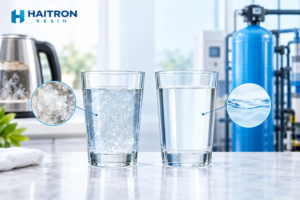
A salt free water softener doesn’t actually remove hardness minerals from your water, it’s more accurately called a water conditioner. Instead of stripping out calcium and magnesium the way a traditional salt based softener does, most salt free systems use a process called Template Assisted Crystallization (TAC) to change the shape of those minerals so they can’t stick to pipes, water heaters, or fixtures as limescale. Your water’s hardness reading stays the same, what changes is scale formation.
That distinction matters more than most product pages admit, and it’s the first thing to understand before deciding whether a salt free system fits your home.
How Does a Salt-Free Water Softener Work?
Template Assisted Crystallization (TAC)
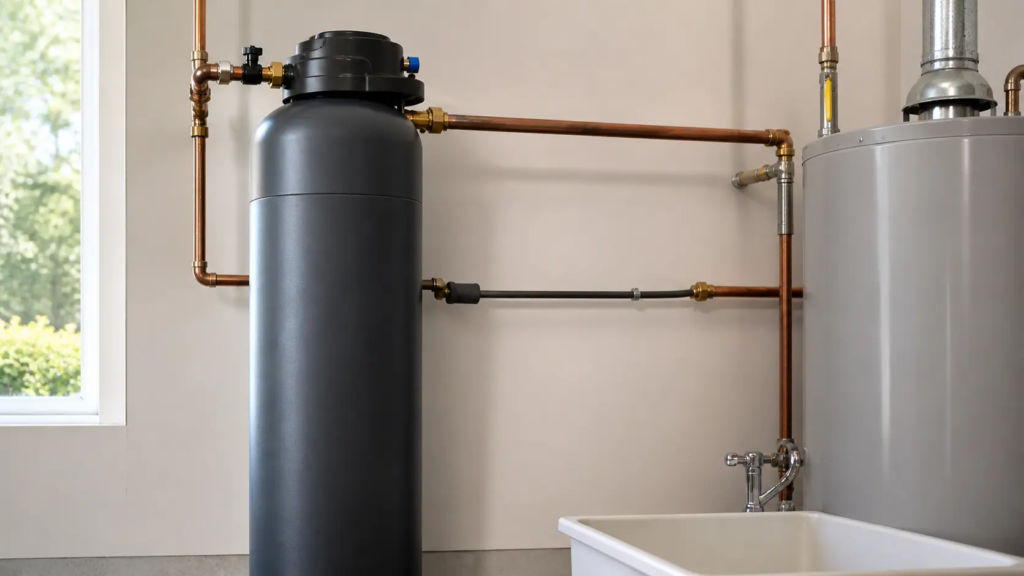
TAC is the dominant salt free technology on the market today. Water flows through a tank filled with polymer media beads. Each bead has microscopic nucleation sites that act as a “template,” encouraging dissolved calcium and magnesium (carbonate hardness) to crystallize into stable, microscopic calcite particles instead of staying as dissolved ions. Those crystals are too small and too stable to bond to surfaces, so they simply flow through your plumbing and appliances without forming scale.
Because nothing is added to or stripped from the water, TAC systems need no electricity, no drain line, no brine tank, and no regeneration cycle, which is why they’re marketed as low maintenance. Media typically lasts several years before replacement.
Other salt-free methods
Electromagnetic or electronic descalers use a coil wrapped around the incoming pipe to alter mineral behavior with an electric field. They’re cheaper than TAC systems but generally seen, including by independent water testing reviewers, as less consistent and harder to verify than media based TAC units. Chelation based systems (using agents like EDTA or citric acid) exist too, but their reliance on added chemicals makes them a less common recommendation.
Salt-Free vs. Salt-Based (Ion Exchange) Softeners
| Factor | Salt-Free (TAC) Conditioner | Salt-Based (Ion Exchange) Softener |
| Removes hardness minerals | No , converts them to inert crystals | Yes , exchanges calcium/magnesium for sodium (or potassium) |
| Water feel | Unchanged | “Slippery,” classically soft |
| Wastewater/brine discharge | None | Yes, during regeneration |
| Sodium added to water | None | Some, depending on resin and regenerant |
| Effective hardness range | Best under roughly 10–12 GPG | Effective across a much wider hardness range |
| Maintenance | Media swap every several years | Periodic salt refills, regular regeneration |
| Certification | No dedicated softening-performance standard | NSF/ANSI 44 covers softening performance |
| Electricity/drain required | No | Usually yes (for regeneration) |
Pros and Cons of Salt-Free Water Softeners
Pros: no salt or brine to buy or store, no wastewater discharge, no added sodium, low maintenance, works well in areas where brine discharge is restricted, retains beneficial minerals in the water.
Cons: doesn’t lower your hardness reading, no “soft water feel,” performance drops off at higher hardness levels, no formal third-party performance certification equivalent to NSF/ANSI 44, generally a higher upfront cost per unit of scale protection than a comparable salt-based softener.
Does a Salt-Free Water Softener Actually Remove Hardness?
No. This is the single most misunderstood point in the category. A TAC conditioner changes how hardness minerals behave physically, preventing scale, but it does not exchange or remove calcium and magnesium ions the way true ion exchange softening does. If you test your water before and after a salt free water softener, the grains per gallon (GPG) reading won’t meaningfully change. If your goal is specifically to eliminate soap scum, get that “soft” skin and hair feel, or pass a strict hardness spec, a salt free conditioner will not deliver that outcome, only genuine ion exchange softening does.
When a Salt-Free System Makes Sense, and When It Doesn’t
It makes sense when your water hardness is moderate (commonly cited as under 10 to 12 GPG), you’re mainly trying to protect pipes and appliances from scale, you want to avoid sodium for health or dietary reasons, or your area restricts brine or salt discharge into wastewater.
It doesn’t make sense when your hardness is high (many well water and some municipal supplies run well above that range), you want your water to actually feel different, or you need a certified, verifiable hardness reduction spec. In those cases, a properly sized ion exchange softener is still the better fit.
What About Certification?
Salt based softeners can be certified to NSF/ANSI 44, the standard that specifically evaluates softening performance and capacity. Salt free conditioners don’t have an equivalent dedicated softening performance standard. Components of any water treatment system, salt free included, can still be certified to NSF/ANSI 61 for material safety, but that’s a different thing from a performance guarantee. When comparing products, it’s worth knowing which certification, if any, actually applies to the claim being made.
Where Ion Exchange Resin Fits In
True softening, whether in a home or an industrial plant, still relies on ion exchange resin. Traditional systems use strong acid cation resin to swap hardness ions for sodium.
For applications where sodium addition needs to be minimized, weak acid cation resin, typically operated in hydrogen form and regenerated with acid rather than salt, is one of the established industrial approaches to reducing hardness linked to alkalinity with a smaller sodium footprint.
This is a genuinely low salt alternative, distinct from TAC conditioning. Haitron manufactures both resin types for water treatment and industrial system builders working on these exact trade-offs.
Frequently Asked Questions
Does a salt free water softener actually soften water?
No. It stops scale from building up, but it doesn’t take hardness minerals out of the water or lower your GPG reading like a true softener would.
What’s the difference between a water softener and a water conditioner?
A softener (salt based, ion exchange) removes hardness minerals from the water. A conditioner (typically TAC based and marketed as salt free) leaves the minerals in the water but changes their form so they don’t create scale.
How long does salt free softener media last?
Most people get several years out of TAC media before it needs swapping out, though that really depends on the product and what’s in your water.
Can I install a salt free system myself?
Many TAC units are designed for simpler installation than salt based softeners since there’s no drain line, brine tank, or electrical connection needed, but local plumbing codes and manufacturer instructions should always guide installation.
Is a salt free softener enough for very hard water?
Generally no. Performance is best documented at moderate hardness levels; above roughly 10 to 12 GPG, a properly sized ion exchange softener is the more reliable, established solution.
Conclusion
A salt free water softener is really a scale prevention conditioner, not a true softener, and understanding that distinction is the difference between a satisfied buyer and a disappointed one. It’s a legitimate, low maintenance option for moderate hardness and sodium sensitive households, but it isn’t a drop in replacement for ion exchange softening where a genuine hardness reduction is required. For system builders and industrial users evaluating low sodium softening approaches rather than conditioning, Haitron’s technical team can help match the right resin, SAC, WAC, or another family, to your feed water and target quality.