Soft Water Loop: What It Is, How It Looks and Do You Need One?
A soft water loop is a short, pre-plumbed section of pipe that comes out of a wall, makes a U shape, and goes back in. It marks the spot where a water softener can connect to your home’s main line.
A soft water loop is a short, pre-plumbed section of pipe that comes out of a wall, makes a U shape, and goes back in. It marks the spot where a water softener can connect to your home’s main line. Builders add it so a softener is easy to install later.
If you’ve spotted a strange copper or PEX U on your garage wall, that’s probably it. This guide shows you how a soft water loop works, what it costs, and what to do if your home doesn’t have one.
What Is a Soft Water Loop?
A soft water loop, also called a water softener loop, is a dedicated plumbing connection made for a softener. One pipe carries hard water out of the wall, and the other carries soft water back in. Until you install a softener, the two pipes are joined, so water just flows through the U.
Think of it like a parking spot reserved for a softener. The space, the lines and often a nearby drain and outlet are ready. You just “park” the softener there.
The big benefit is separation. Builders branch outdoor faucets and irrigation off before the loop, so you don’t waste softened water on the lawn.
What Does a Water Softener Loop Look Like?
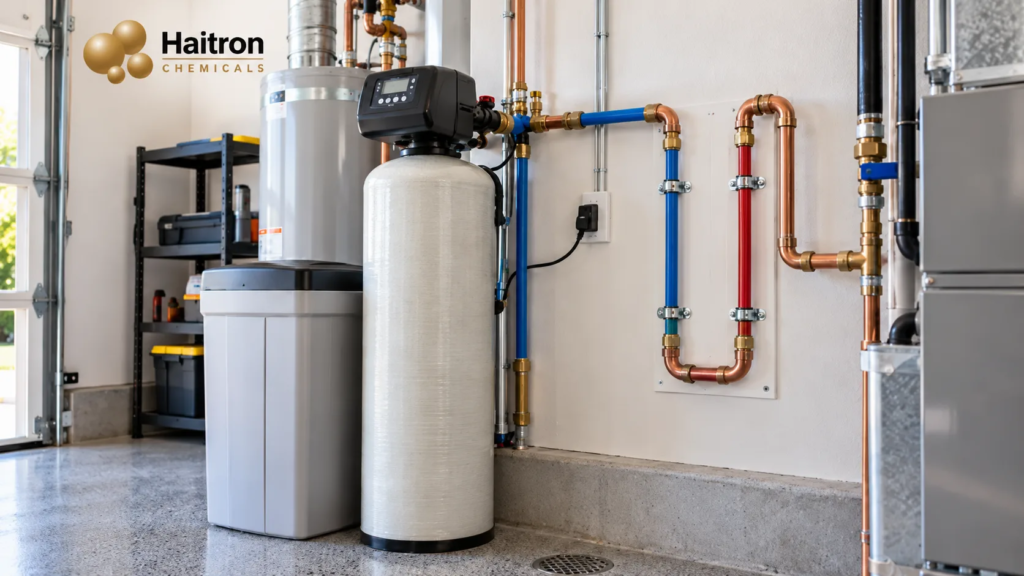
Look for two pipes coming out of a wall a few inches apart, joined by a U or a short bridge. It’s usually in the garage, near the water heater, or in a utility room. Many loops sit near a drain and an electrical outlet. Copper is common, and newer homes often use PEX.
Here’s the simple layout:
Main line → outdoor faucets branch off (hard water) → loop out of the wall → softener → loop back into the wall → water heater and house (soft water)
Loops are most common in slab homes with attached garages. In homes with basements, the softener usually just ties into the main line wherever it enters.
How Does a Soft Water Loop Work?
The loop simply decides which pipes get soft water. When a plumber connects a softener, they cut the U, attach the softener’s inlet and outlet, and add a bypass valve. Every line the builder routed through the loop now gets soft water. Lines branched off before it stayed hard.
Inside the softener, resin beads do the real work. Most home units use strong acid cation resin. It swaps calcium and magnesium for sodium, a bit like trading heavy coins for light ones.
Which Taps Does Your Loop Actually Feed?
This is the detail most guides skip. A loop doesn’t automatically soften the whole house. Crystal Quest (2026) points out that some builders run only hot water through it, and others leave the kitchen cold tap on a hard line.
Here are the common layouts you’ll find:
| Loop layout | What gets soft water | What stays hard | Good for |
|---|---|---|---|
| Whole house except outdoors | Showers, sinks, laundry, water heater | Hose bibs, irrigation | Most families |
| Whole house except kitchen cold | Everything indoors but one drinking tap | Kitchen cold tap, outdoors | People watching sodium intake |
| Hot water only | Water heater and hot taps | All cold taps | Protecting the heater only |
| No loop | Wherever the plumber connects | Depends on the new tie in | Older homes and basements |
Want to test your own layout? Shut off the loop’s valve, or have a plumber put the softener in bypass. Then open each tap. The taps that lose pressure are the ones the loop feeds.
How Much Does a Soft Water Loop Cost?
Angi (2026) puts the average cost of adding a water softener loop at $600 to $2,000. The final price depends on how far the loop sits from your main line and whether pipes need rerouting. If your home already has a loop, installation is usually simpler and cheaper.
The cost rises when:
- The main line is far from the garage or utility room.
- Pipes run inside finished walls.
- You also need a new drain or outlet.
- Local code requires a permit.
Always get a written quote that lists the drain, the outlet and the bypass valve separately.
Can You Install a Water Softener Without a Loop?
Yes. A loop makes the job easier, but it isn’t required. Without one, a plumber cuts into the main line where it enters the home and adds the softener there. The key is to connect after the outdoor branches, if possible, and before the water heater.
For a full walkthrough of that process, follow a step by step softener plumbing guide. It covers the bypass valve, the drain air gap and the flushing steps.
Common Mistakes to Avoid
These are the errors that cost homeowners the most:
- Assuming the loop includes a drain. Some builders install only the supply loop. Check for a drain line or standpipe nearby.
- Assuming it feeds the whole house. Test which taps it serves first.
- Forgetting freeze risk. Garage loops in cold climates need insulation or a heated space.
- Skipping the bypass valve. Without one, any softener repair shuts off your water.
- Expecting the softener to filter. It won’t remove lead, so use a certified lead filter for water for that. For chlorine taste, add a GAC water filter.
What Are the Limitations of a Soft Water Loop?
A loop only shows where a softener can go. It doesn’t guarantee a drain, power or freeze protection. Its location is fixed, so moving it later means new plumbing. And because outdoor lines usually bypass the loop, you won’t get soft water for washing your car unless you add a separate soft water line.
Final Thoughts
A soft water loop is a handy shortcut, not a must have. Find yours, test which taps it feeds, and confirm there’s a drain and an outlet nearby before you buy a softener. If you’re not sure what you’re looking at, a local plumber can check it in minutes.
Your next step is to look at your garage or utility room wall today. Curious how ion exchange is used beyond the home? Explore our water treatment applications.
FAQs
Can I put a whole house filter on the loop instead?
Yes. A loop works as a connection point for any whole house treatment. You can fit a filter, a softener, or both in a row, as long as the flow rates suit your home.
Can a plumber move my soft water loop?
Yes. A plumber can extend or relocate the lines. Cost depends on the distance and on whether walls need opening, so get a quote before you choose a new softener location.
Will soft water reach my outdoor hose?
Usually not, because builders branch outdoor lines off before the loop on purpose. If you want soft water for car washing, a plumber can add a separate soft water hose bib.
Is it a problem if my loop is PEX instead of copper?
No. Both work well. PEX connects with crimp or push fit fittings, while copper usually needs soldering or compression fittings. Match the softener fittings to your pipe type.
What does Haitron make?
Haitron manufactures ion exchange resins, including strong acid cation resin used in home water softeners. It also makes mixed bed, anion and chelating resins for water treatment.