Mixed Bed Resin Cartridge: Construction, Capacity and When to Replace It
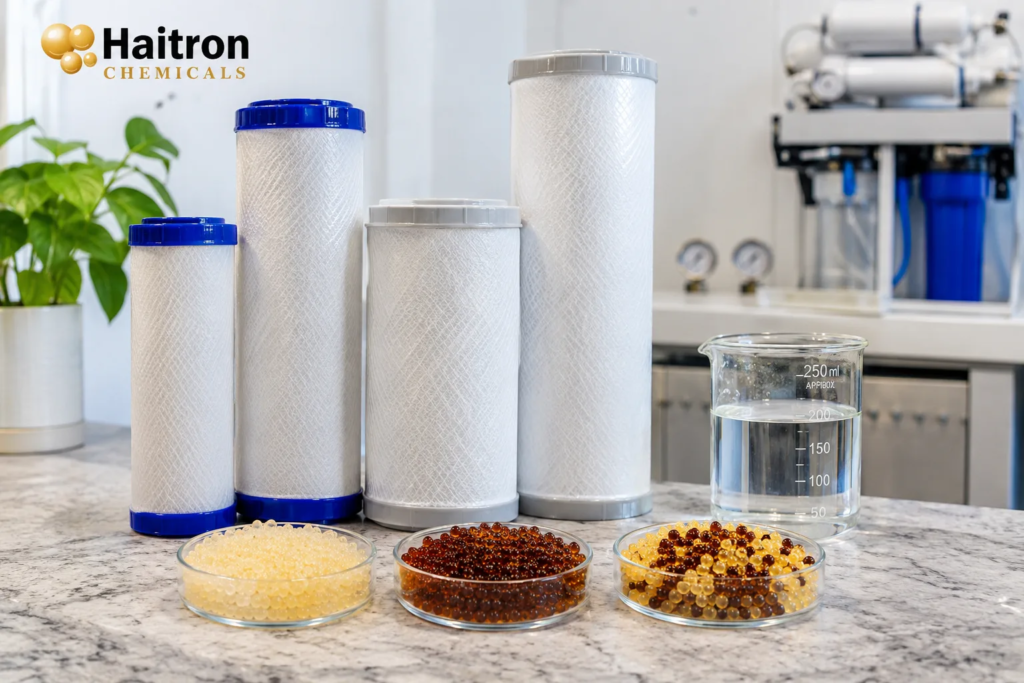
Spec sheets for the four most common cartridge sizes list capacities from about 450 to 2,350 grains. That’s a fivefold spread for parts that all look like the same white tube. A mixed bed resin cartridge is a filter shell packed with cation and anion exchange resin blended together. As water passes through the bed, dissolved ions are swapped for hydrogen and hydroxide, which recombine into water. The result is deionized water, often at 10 to 18 MΩ·cm resistivity when the feed has already been through reverse osmosis.
How long a cartridge lasts depends far more on the water you feed it than on the brand. This guide covers what’s inside, how to pick the resin, what capacity really means, and how to know when it’s done.
How does a mixed bed resin cartridge work?
Inside the shell are two kinds of beads. Strong acid cation resin in the hydrogen (H⁺) form grabs calcium, magnesium, sodium and other positive ions. Strong base anion resin in the hydroxide (OH⁻) form grabs chloride, sulfate, bicarbonate, silica and other negative ions. The H⁺ and OH⁻ they release join up as H₂O.
Because the two resins are mixed, water meets a cation bead, then an anion bead, then a cation bead again, over and over through the length of the bed. That behaves like a very long chain of separate cation and anion stages in series. It’s why a mixed bed ion exchange cartridge can push water close to the theoretical limit of 18.2 MΩ·cm, while separate beds usually can’t get that low on their own.
This is ion exchange filtration in its simplest packaged form. The cartridge removes dissolved ions only. It won’t take out chlorine, most organics, bacteria or particles, so it belongs after carbon and RO, not in front of them. Our deionized water guide covers what DI water is and where it gets used.
What’s inside the cartridge shell
Most deionization resin cartridges come in one of two standard diameters, each in two lengths. A deionization resin cartridge in the 2.5″ size drops into the same slim housing as an ordinary sediment or carbon filter.
| Size | Typical capacity | Typical max flow | Fits |
|---|---|---|---|
| 2.5″ x 10″ | About 450 to 500 grains | 0.3 to 0.4 gpm | Standard slim housings, most RO/DI units |
| 2.5″ x 20″ | About 900 grains | About 0.6 gpm | 20″ slim housings |
| 4.5″ x 10″ | About 1,050 grains | Varies by maker | 10″ Big Blue housings |
| 4.5″ x 20″ | About 2,100 to 2,350 grains | 0.5 to 1.5 gpm | 20″ Big Blue housings |
The parts around the resin matter more than they look. A typical sealed cartridge uses a polyester body, an ABS end cap, a polyester distribution pad at each end and an EPDM gasket, with the cap ultrasonically welded on. The pads spread water across the full bed and hold the beads in place, and the gasket keeps water from bypassing the resin through the housing.
Packing density is the hidden spec. If the shell isn’t filled tight, the bed can shift, the cation and anion beads start to separate, and the cartridge exhausts early. A loosely packed bed also lets water find fast paths through it, so part of the resin never does any work.
Operating limits are tighter than on a sediment filter. Published limits run around 100°F maximum for many 2.5″ cartridges (some 4.5″ models list 90°F) and about 125 psi. Hot water shortens anion resin life, so a DI cartridge never goes on a hot line.
Sealed or refillable DI resin cartridge?
Sealed cartridges arrive packed, wrapped and ready to drop in, just like any other mixed bed water filter cartridge. A refillable DI resin cartridge uses a twist-top shell you open and fill with loose resin. The shell is reusable, which suits users who go through a lot of resin, but the fill quality depends on whoever does the packing.
Choosing the resin: grade matters as much as size
The label “mixed bed” covers several quite different products.
Standard mixed bed
This is the general-purpose blend for RO/DI polishing, spot-free rinse and humidifiers.
Color-indicating mixed bed
This grade carries a pH indicator dye on the anion resin that shifts color as it exhausts, often blue to amber or tan. That makes the cartridge’s remaining life visible through a clear housing. It costs some capacity, though. In one cartridge maker’s own test, its color-indicating blend removed about 90% as much as its standard blend, so you trade a slice of capacity for the visual cue.
Semiconductor or low-TOC grade
This is resin washed and processed to cut total organic carbon leaching. It’s the choice for labs, electronics rinsing and anything measured with a TOC analyzer. See our guide on ultrapure water for what those specs involve.
Silica-focused blends
These add extra or specialized anion resin, because silica is weakly ionized and one of the first ions to slip through a tired bed. If you care about silica, our article on silica removal from water explains why it behaves differently.
Cation to anion balance
The ratio inside the blend matters too. Anion beads hold less capacity per liter than cation beads. On our own mixed bed ion exchange resin, the cation side is rated at 1.90 mmol/mL or more and the anion side at 1.05 mmol/mL or more. That’s why good blends carry extra anion volume, and why the anion side usually decides when the cartridge is finished.
How long does a mixed bed resin cartridge last?
Divide the cartridge’s grain capacity by the feed water’s ion load in grains per gallon. To get grains per gallon, divide TDS in ppm by 17.1 (our ppm to grains per gallon converter does the math).
Gallons ≈ capacity in grains ÷ (TDS in ppm ÷ 17.1)
Here’s what that gives for a 4.5″ x 20″ cartridge rated at 2,350 grains:
- On 300 ppm tap water: 300 ÷ 17.1 = 17.5 gpg, so about 134 gallons
- On RO permeate at 6 ppm (a membrane removing 98% of that tap water): about 6,700 gallons
That fiftyfold difference is the whole case for putting RO ahead of deionization. A mixed bed resin cartridge for RO/DI systems polishes the last few ppm. Fed raw tap water, it turns into a very expensive way to make a few buckets of DI water.
Real life comes in below the math, for two reasons:
- Carbon dioxide: CO₂ passes straight through RO membranes and loads the anion resin as bicarbonate, but it barely registers on a TDS meter. City water typically carries 5 to 50 ppm CO₂, so high-CO₂ water can eat a big share of the rated capacity.
- TDS creep: when an RO unit sits idle, the first minute or so of permeate after start-up carries higher TDS, and that slug goes straight into the DI stage. Systems that cycle on and off many times a day burn resin faster.
Flow rate matters too. Run a 2.5″ x 10″ cartridge well past its 0.3 to 0.4 gpm rating and ions get through before the resin has time to exchange them. Purity drops long before the capacity is used up.
Mixed bed resin cartridge vs separate bed resin
Separate bed setups use one cation stage and one anion stage, either as two cartridges or two tanks. They give more capacity per dollar on high-TDS water. Industrial systems can also regenerate them, because the two resins never need to be separated. But on their own they rarely reach the purity a mixed bed produces.
A mixed bed is the polisher. It’s best after RO or after a two-bed system, where the ion load is already low and the job is getting from a few ppm to near zero. Our mixed bed resin guide compares mixed, dual-bed and RO systems at plant scale.
For cartridges, the practical rule is simple. Low TDS feed and a need for high purity calls for a mixed bed. High TDS feed with modest purity targets calls for separate beds, or better still, RO first.
When and how to replace a mixed bed resin cartridge
Resin exhaustion doesn’t happen evenly. Weakly held ions such as silica and CO₂ leak first, while conductivity still looks fine. Then purity falls off quickly.
Watch the right signal for your use:
- Spot-free rinse, aquariums, humidifiers: Replace when an inline TDS meter after the DI stage reads 1 ppm or higher, or when a color-indicating bed has changed most of the way.
- Labs and electronics: Use a resistivity or water conductivity meter, not a TDS pen. Standard inline TDS meters read 0 ppm until resistivity drops to roughly 0.25 MΩ·cm, so a TDS reading of zero tells you very little about high purity water. Set a resistivity limit (for example 10 MΩ·cm) and change the cartridge when output falls below it.
- Critical silica or TOC specs: Change on a fixed volume schedule, before the meter shows a problem.
The swap itself takes a few minutes:
- Shut off the feed and open a downstream valve to relieve pressure.
- Unscrew the housing bowl and remove the old cartridge.
- Check the O-ring, clean the bowl and lubricate the O-ring with food-grade silicone.
- Fit the new cartridge in the flow direction marked on the label.
- Turn the water back on slowly, then flush to drain until your meter reads the target value.
Keep spare cartridges sealed until you need them. Resin left open to air absorbs CO₂, which uses up capacity before the cartridge ever goes into service.
Who should use which cartridge
If you run an RO/DI unit for a reef tank, car detailing or window cleaning, a standard or color-indicating 2.5″ x 10″ cartridge is usually enough. Track TDS after the DI stage and divert the start-up water away from the resin.
If you supply a lab, a print shop or an electronics line, choose a semiconductor-grade mixed bed. Size up to 4.5″ x 20″ so the flow stays well under the rating, and change on resistivity rather than TDS. To match resin grade and volume to your own feed water analysis, contact our team with your TDS, flow and purity target.
Quick questions
Can a mixed bed cartridge replace an RO system? Only for very small volumes or low-TDS feed. On normal tap water, a standard cartridge exhausts within a few hundred gallons at most, which makes RO first far cheaper over time.
Can you regenerate a mixed bed DI resin cartridge? Not practically at home. The cation and anion beads have to be separated and regenerated separately with acid and caustic, which takes specialized equipment, so most users replace the cartridge or the resin.
Do mixed bed cartridges remove chlorine? No, and chlorine damages resin over time. Put a carbon stage ahead of the DI cartridge.