DI Resin for Window Cleaning: Choosing It, Making It Last, Refilling It
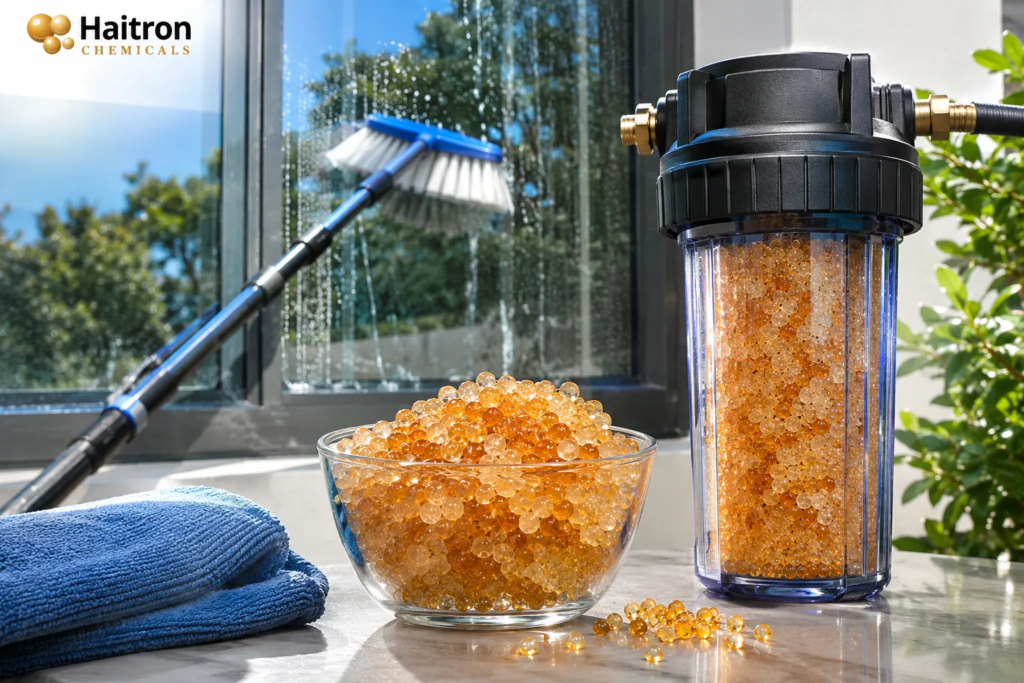
You have a water fed pole, a DI tank on the van, and tap water that tests somewhere between 50 and 400 ppm on your TDS meter. DI resin for window cleaning is a mixed bed of cation and anion exchange beads that strips those dissolved minerals out. The water leaving the brush reads 0 ppm and dries on glass without spots. No soap, no squeegee, no residue for dirt to cling to.
How long the resin lasts depends almost entirely on your tap water. On soft water, a half cubic foot tank can produce hundreds of gallons. On hard water, the same tank may give you about 100.
How pure water window cleaning works
Tap water leaves spots because it carries dissolved calcium, magnesium, sodium and other minerals. When a droplet evaporates, the water leaves and the minerals stay. That’s the white ring you see on glass dried in the sun.
Pure water has nothing left to leave behind. It also pulls dirt off the glass, because water with no dissolved solids readily picks up whatever it touches. You scrub with the brush, rinse with the same pure water, and walk away while it dries.
The DI resin does the purifying through ion exchange. Cation beads in the hydrogen form trade H⁺ for every calcium, magnesium or sodium ion they catch. Anion beads in the hydroxide form trade OH⁻ for chloride, sulfate and bicarbonate. The H⁺ and OH⁻ combine into plain water.
Mixed bed resin for window cleaning blends both bead types in one tank or cartridge. Water meets cation and anion beads over and over as it passes through, which is how a single vessel gets output all the way to 0 ppm. Our guide to deionized water explains the chemistry, and why any deionized water resin for window cleaning needs both bead types.
What TDS reading is good enough for spot free window cleaning?
Aim for 000 ppm at the brush. Readings up to about 10 ppm usually dry clean, but the margin shrinks on hot glass, hydrophobic coatings and windows in direct sun.
Most pros change resin when the output meter hits 10 ppm. Some swap at 5 ppm for high-end residential work. Don’t push past that point, because exhausted resin doesn’t fade out politely. When the beads are fully loaded, they can dump minerals in a burst, and output can jump from 0 to around 40 ppm, which is plenty to spot a whole elevation.
Test in two places:
- At the tank outlet, with an inline meter, so you see resin performance in real time
- At the brush head, with a handheld meter, because a contaminated hose can raise readings even when the tank reads 000
Run water for about 60 seconds before you read it, and rinse the meter cap with the water you’re testing. Conductivity readings shift about 2% per °C, so choose a meter with automatic temperature compensation.
How long does DI resin last for window cleaning?
Resin life depends on three things: your tap water’s TDS, how much resin you carry, and how many gallons you push through it each day.
Here’s one US supplier’s estimate of gallons to 0 ppm output for common cartridge sizes:
| Feed TDS | 2.5″ x 10″ (0.03 cu ft) | 4.5″ x 10″ (0.10 cu ft) | 4.5″ x 20″ (0.20 cu ft) |
|---|---|---|---|
| 15 ppm | About 277 gal | About 923 gal | About 1,847 gal |
| 40 ppm | About 104 gal | About 346 gal | About 693 gal |
| 200 ppm | About 21 gal | About 69 gal | About 139 gal |
For a typical half cubic foot DI tank, expect roughly 400 to 600 gallons when tap water tests under 100 ppm, and only about 100 gallons when it reads 250 ppm or more.
You can estimate your own numbers. Convert tap water TDS to grains per gallon by dividing ppm by 17.1 (our ppm to grains per gallon page does it for you). Then divide your resin’s rated grain capacity by that figure. A resin that delivers about 9,200 gallons per cubic foot on 15 ppm water will deliver closer to 700 on 200 ppm water.
Real resin life usually lands below the math. These habits shorten it:
- Running the pole faster than you need, which wastes pure water
- Channeling, where water cuts a fast path through a loose bed and leaves resin unused (shaking a standard vessel between jobs helps)
- Letting sediment or chlorine reach the resin without pre-filters
- Seasonal swings in tap water TDS, which can change resin life from one month to the next
A cheap flow control valve and a log of gallons used per refill tell you more than any chart. After two or three refills, you’ll know your real cost per gallon.
DI resin vs RO for window cleaning
If your tap water is soft, DI alone is simple. It needs no power or pump, it runs off a garden hose, and a half cubic foot tank weighs under 35 lb dry. It’s a good fit for solo operators and tight access jobs.
Hard water changes the math. Above about 150 ppm, DI-only resin use gets expensive fast, and most suppliers recommend an RO/DI system. If you’re not sure where your water falls, our guide to the difference between hard and soft water covers the ranges.
| DI only | RO/DI | |
|---|---|---|
| Best feed water | Under about 100 ppm | Above about 150 ppm |
| Upfront cost | Low | Higher |
| Resin use | All TDS hits the resin | RO removes 90 to 98% first |
| Waste water | None | About 1 to 2 gallons per gallon of pure water |
| Inlet pressure | Garden hose | About 40 to 60 psi, sometimes a booster pump |
| Setup | Minutes | About 5 minutes longer to manage the reject line |
The RO membrane removes most of the dissolved solids before the water reaches the resin. That can stretch resin life ten times or more, and some suppliers put the cut in DI consumption at up to 90%. One supplier estimates a cleaner in a 300 ppm area could spend about $2,000 a year more on resin with DI only than with RO/DI. It also says RO/DI pays back after roughly 5,000 to 7,000 gallons. Treat that as a ballpark from someone who sells both systems.
RO has its own costs. Membranes need replacing every year or two, pre-filters every few months, and the system needs flushing and winter protection. For a part-time cleaner on 60 ppm water working one or two days a week, those costs can outweigh the resin savings.
Choosing the best DI resin for window cleaning
Bags of window cleaning DI resin can look identical, but what’s inside varies a lot.
Virgin or regenerated resin
Virgin resin is new and has never been used. Regenerated resin has been used, then chemically stripped and recharged at a plant. Regen costs less, but its capacity and purity vary more from batch to batch.
Window cleaners argue about this constantly. Some say the difference doesn’t matter on glass, others won’t use anything but virgin. For a business where a spotted job means a free return visit, consistent virgin resin is the safer bet. If you buy regen, test each batch’s gallons per refill before trusting it on a big job.
Color-changing resin
Color-changing resin carries an indicator dye on the anion beads that shifts color as they exhaust. Through a clear housing you can see how far the spent zone has moved down the vessel. It’s handy for crews who forget to check the meter. Indicator dyes take up a little capacity, though, so it still pays to read TDS.
Bead quality and blend
Look for a mixed bed ion exchange resin made from a strong acid cation and a strong base anion, with uniform beads and a stated exchange capacity. Our mixed bed resin is a ready-to-use blend of strong acid cation and strong base anion resin, rated for product water above 18 MΩ·cm. That’s far purer than glass needs. Our mixed bed resin guide explains how the blend ratio affects performance.
Price per bag matters less than price per clean gallon. A cheaper resin that delivers 30% fewer gallons ends up costing more. For typical pricing factors, see our article on ion exchange resin price.
How to refill DI resin for window cleaning
Refill somewhere you can sweep up stray beads, because they get everywhere (and they’re very good at hiding in van carpet).
- Close the inlet and relieve pressure, then remove the vessel lid.
- Tip the spent resin into a bag or bucket, and check local rules for disposing of it.
- Rinse the vessel and check the riser tube and filter screens for cracks.
- Hold the riser tube centered and pour new resin through a funnel, filling to the level the vessel maker specifies. Keep resin out of the tube itself.
- Wipe the threads and O-ring, lubricate the O-ring with silicone grease, and close the lid.
- Run water to drain until the meter reads 000, then go to work.
Seal any leftover resin tightly. Opened bags exposed to air slowly lose capacity, so keep them in a cool, dry place out of the sun.
What about resin regeneration?
You can’t practically regenerate mixed bed resin yourself. The cation and anion beads have to be separated and treated with strong acid and caustic, which takes specialized equipment and safety gear. Large users sometimes send spent resin to a regeneration service, and most window cleaners simply replace it.
Quick questions
Can I use a water softener instead of DI resin? No. A softener swaps calcium and magnesium for sodium, so total dissolved solids stay about the same and the glass still spots.
Does DI resin remove chlorine? No, and chlorine shortens resin life. If you run DI only on city water, a carbon pre-filter ahead of the resin is a cheap way to protect it.
Why does my TDS read 000 at the tank but 5 at the brush? Check the hose and pole. Old hose, a dirty brush or a contaminated fitting can add dissolved solids after the resin.
Before your next refill
Test your tap water TDS today and note the gallons you use on your next three jobs. Then divide your resin’s capacity by those numbers. If the answer is fewer than about two weeks between refills, price an RO/DI system. If you’d like help matching resin grade and quantity to your water, contact our team with your TDS reading and weekly gallons.