DI Resin Refill: When, How and What to Buy
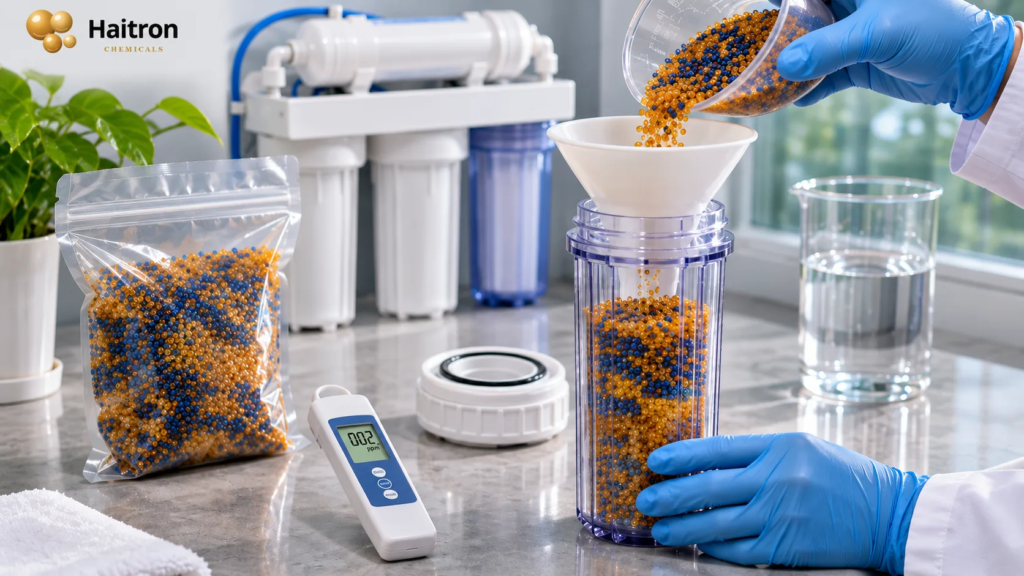
Your RO/DI meter has read 000 for months, and this morning it says 002. That’s the signal for a DI resin refill, and if your system uses a refillable DI resin cartridge, the whole job takes about fifteen minutes and costs a fraction of a new sealed cartridge.
This guide covers the three decisions that matter: when to change the resin, which resin to buy, and how to swap it without channeling, leaks or spilled beads all over the kitchen floor.
How often to do a DI resin refill
There’s no fixed calendar. Resin exhaustion depends on how much ion load passes through the bed, so the right interval comes from your water, not from the box. A reef keeper with 3 ppm RO water might refill once a year. A window cleaner running DI-only on 250 ppm tap water might refill every week.
Three signals tell you a DI resin refill is due, and they’re worth using together.
Outlet TDS
This is the one to trust. Mixed bed resin holds 000 for a long time and then climbs fast once the exchange sites run out. For aquariums and labs, change the resin when the outlet reads a steady 001 to 002. Water-fed pole cleaners often run until 10 to 20 ppm on glass, but solar panels need close to zero.
The color band
Color-indicating resin has a pH dye in the anion beads. On ResinTech’s MBD-30, for example, the anion beads shift from deep blue to amber as they exhaust. Bulk Reef Supply’s rule of thumb is to change the resin once the color line gets about an inch from the top of the cartridge. Treat color as an early warning and TDS as the final call, because the dye tracks the anion side and won’t always match the moment ions break through.
A gallon log
Write down the date and the gallons made at each refill. After two or three cycles you’ll know your real interval, which beats any calculator.
How long does DI resin last?
The rough math is capacity divided by feed TDS. Window Cleaning Resource publishes a table for its virgin mixed bed resin: a half cubic foot tank makes about 3,012 gallons at 50 ppm feed but only about 753 gallons at 200 ppm. Quadruple the TDS and you get a quarter of the water.
That’s why RO in front of DI changes everything. If your RO stage takes 250 ppm tap water down to 5 ppm, the DI stage only handles a tiny fraction of the original load. Resin that lasted a week on raw tap water can last months as a polisher in an RO DI water system.
Two things shorten resin life more than people expect. The first is dissolved CO2, which a TDS meter barely sees but the anion beads still have to remove. Private wells often carry a lot of it.
The second is frequent short runs. RO membranes push out higher TDS water for the first minute or two after startup, so making 2 gallons a day burns more resin per gallon than making 14 gallons once a week.
Best resin for DI filter refill
Most DI filter resin looks the same in the bag: small amber or blue beads. The differences hide in the spec sheet.
It must be mixed bed, in the H/OH form
A DI cartridge needs strong acid cation resin in the hydrogen form and strong base anion resin in the hydroxide form, blended together. You can see what each half does on our strong acid cation resin and strong base anion resin pages. Blends vary. ResinTech MBD-30 is a 50/50 mix by volume, while the XERO virgin resin for window cleaning is sold as 60/40 cation to anion.
Never refill a DI cartridge with water softener resin. Softener resin comes in the sodium form, so it trades calcium for sodium and your TDS barely moves. If a bag says “softener” or “salt regenerated,” it’s the wrong product. Our page on the soft water loop explains where softener resin does belong.
Virgin or regenerated
Virgin resin has never been used. Regenerated resin has been exhausted, stripped with acid and caustic, and remixed. Regenerated resin costs less, but its capacity depends on how thoroughly it was cleaned and separated, and that’s hard to check from the outside.
For a home RO/DI unit, where you use maybe a liter at a time, the price gap is small and virgin is the safer buy. For high-volume DI-only window cleaning, regenerated resin can make financial sense if your supplier publishes a tested capacity figure.
Grade matters for some uses
“Nuclear grade” and “semiconductor grade” labels point to resin with very low leachables and high purity output. That matters for reef tanks, labs and the electronics and high-purity applications where ions show up as defects. It matters less for rinsing a car.
Our mixed bed ion exchange resin (YHJ-18MH) is a gel SAC and SBA blend rated for product water above 18 megohm·cm, which puts it in the high-purity polishing class. If you need water for lab work, read our guide to what ultrapure water is to see where DI water stops and ultrapure begins.
Check the packaging
Moist anion resin slowly picks up CO2 from the air and loses capacity on the shelf. Buy resin in sealed foil or Mylar bags, and buy the size you’ll use in a few months rather than a drum that sits open in the garage for two years.
How to change DI resin in an RO DI filter
This is the routine for a mixed bed DI resin refill in a standard 10 inch refillable cartridge, the clear or blue canister on most RO/DI units.
- Close the feed valve and press the RO flush or open the tank valve to release pressure.
- Unscrew the DI housing with the filter wrench and lift out the cartridge. Keep a towel underneath, since the housing is full of water.
- Remove the cap and foam pad. Check the cartridge body for cracks.
- Tip the spent resin into a trash bag, then rinse the cartridge to wash out loose beads.
- Pour fresh resin through a funnel until the cartridge is about three quarters full. Tap it on the counter around ten times to settle the beads.
- Top it off until the resin sits level with the rim. Run a finger around the rim so no beads sit in the threads.
- Fit a new foam pad. Old pads compress and let beads escape into the outlet line.
- Screw on the cap, put the cartridge back with the flow arrow pointing the right way, check the O-ring, and refit the housing.
- Run the first few minutes of water to drain until the outlet TDS settles at zero.
Bulk Reef Supply’s step by step DI cartridge refill guide includes photos of the packing step, which is where most people go wrong. A loosely packed bed lets water find channels around the resin, and your TDS climbs even though most of the beads are still fresh.
Refilling a two-stage DI system
If your system has two DI stages, don’t refill both at once. Let the first cartridge run to full exhaustion while the second keeps the outlet at zero. Then refill the first, move it to the second position, and promote the old second cartridge to first. You use every bead before you throw it away, and each DI resin refill goes further.
Mistakes that waste a refill
Most “this resin is bad” complaints come from one of a handful of problems.
- Skipping carbon ahead of the resin. Chlorine attacks ion exchange resin. Keep the carbon block fresh, and if your city uses chloramine, see our notes on chloramine removal.
- Ignoring a tired RO membrane. If the water entering DI has crept from 3 ppm to 20 ppm, the resin is working seven times harder. Check the TDS before and after DI, not only at the outlet.
- Underfilling the cartridge. Gaps at the top of the cartridge let the bed shift and channel.
- Installing it with the flow arrow reversed. Some cartridges only seal properly in one direction.
Quick answers
Can I regenerate DI resin at home?
Technically yes, with hydrochloric acid and sodium hydroxide, but you have to separate the cation and anion beads first. The chemicals are hazardous and the results are uneven, so for home use, buying fresh resin is cheaper and safer.
Is a deionization resin refill the same for every cartridge?
Mostly. Standard 10 inch and 20 inch refillable housings take any loose mixed bed resin. Sealed cartridges and some branded window cleaning tanks use bags or fixed volumes, so check the volume before ordering.
Is DI water enough for lab use?
Sometimes. Our comparison of Milli Q water vs DI water covers when a lab needs Type 1 polishing on top of DI.
Start a gallon log at your next DI resin refill, and keep it taped to the RO unit. Note the date, the feed TDS and the gallons made. By the third refill you’ll know exactly how much resin to keep on the shelf. If you buy resin in volume for a cleaning business, an aquarium shop or an industrial line, browse our ion exchange resin range or send us your water analysis and we’ll match a grade and pack size.