Milli Q Water vs DI Water: Key Differences and Which One Your Lab Needs
The main difference in milli q water vs di water is purity. Milli Q water is Type 1 ultrapure water, while standard DI water usually sits at Type 2. DI water has most charged ions removed, and Milli Q water goes further by also removing organics, particles and bacteria.
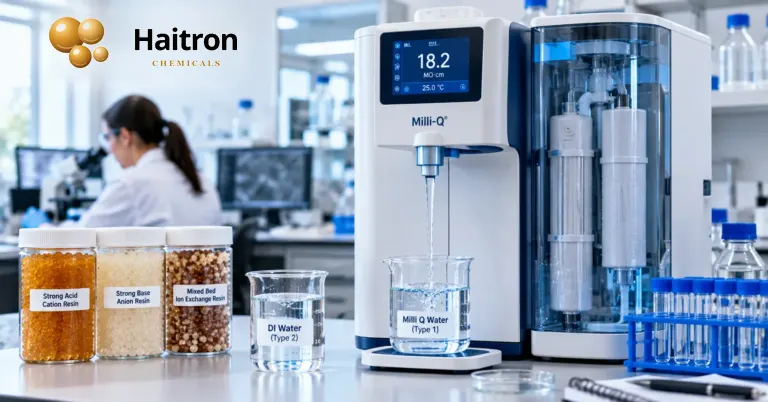
The main difference in milli q water vs di water is purity. Milli Q water is Type 1 ultrapure water, while standard DI water usually sits at Type 2. DI water has most charged ions removed, and Milli Q water goes further by also removing organics, particles and bacteria.
So for buffers and glassware rinsing, DI water is usually fine. For HPLC, ICP MS, PCR and cell culture, you’ll want Type 1 water.
What Is Milli Q Water?
Milli Q water is ultrapure water made by a Milli Q water purification system. Milli Q is a brand name, not a water grade. Lab staff say “milliq water” for any Type 1 water, the same way people say “Kleenex” for any tissue. It’s the purest grade most labs ever use.
Milli Q systems are made by Merck KGaA, sold as MilliporeSigma in the US and Canada. A typical system cleans tap water in stages: prefiltration, reverse osmosis, electrodeionization, UV light and a final filter.
The result is water with a resistivity of 18.2 MΩ·cm at 25 °C and total organic carbon (TOC) of 5 ppb or lower. Think of TOC as invisible “grease” in the water. You can’t see it, but it can ruin a sensitive test.
What Is DI Water?
DI water, or deionized water, is water that has passed through ion exchange resin. The resin swaps unwanted ions like calcium, sodium and chloride for hydrogen and hydroxide ions. Those two then join to form plain water.
Picture a magnet pulling iron filings out of sand. A strong acid cation resin grabs the positive ions, and an anion resin grabs the negative ones. Water flows through, much cleaner than it went in.
But DI water has limits. Resin removes ions very well, yet it does little against organic compounds, particles or bacteria. That’s why plain DI water usually lands in the Type 2 range, not Type 1.
Milli Q Water vs DI Water: What’s the Real Difference?
The difference is how many types of contaminants are removed. DI water targets ions only. Milli Q water removes ions, organics, particles and bacteria, reaching the highest purity water can have. In fact, Milli Q systems use deionization as one of their own steps, so DI is a stage, not a rival.
Most labs grade water using ASTM D1193, the reagent water standard updated by ASTM International in 2024. Type I water must reach at least 18 MΩ·cm resistivity. For Type II, only 1.0 MΩ·cm is needed. Sodium and chloride limits are also far tighter for Type I.
Why do Milli Q screens show 18.2? That’s the theoretical resistivity of perfectly pure water at 25 °C. You can’t go higher.
| Feature | Milli Q water (Type 1) | DI water (usually Type 2) |
|---|---|---|
| What it is | Ultrapure water from a multistage system | Water polished by ion exchange resin |
| Resistivity at 25 °C | 18.2 MΩ·cm | At least 1.0 MΩ·cm |
| Conductivity | 0.056 µS/cm | Up to 1.0 µS/cm |
| Organics (TOC) | 5 ppb or lower | Not reliably removed |
| Bacteria and particles | Removed by UV and final filter | Not removed by resin alone |
| Typical uses | HPLC, ICP MS, PCR, cell culture | Buffers, reagents, media, rinsing |
| Cost | Higher | Lower |
Milli Q Water vs DI Water: Which One Should You Use?
Match the water grade to your method, not to habit. Type 2 DI water works well for general lab tasks like buffers, reagents and culture media. When trace ions or organics could skew your results, choose Type 1 Milli-Q water. For washing and equipment feed, Type 3 RO water is enough.
Here’s how that looks in real lab work:
- Making a phosphate buffer for a teaching lab: DI water.
- Running trace metal analysis on ICP MS: Milli Q water.
- Preparing an HPLC mobile phase: Milli Q water.
- Setting up PCR or qPCR: molecular grade water, which is ultrapure water that’s also nuclease free.
- Filling a water bath or autoclave: RO or DI water is plenty.
Getting the milli q water vs di water choice right saves reagents, instrument time and repeat runs.
Is Distilled or Reverse Osmosis Water the Same as DI Water?
No. Distilled water is made by boiling water and collecting the steam. Reverse osmosis (RO) water is pushed through a very tight membrane. DI water passes through ion exchange resin. Each method removes different contaminants, so modern lab systems stack them together.
RO alone usually produces Type 3 water. It’s great as a first step, but not enough for analysis. To reach Type 1, systems add ion exchange polishing, UV oxidation and a final filter after RO.
In the distilled vs deionized water debate, distilled water has one weak spot. Some organic compounds boil along with the water and end up in the final product. In HPLC, that shows up as baseline noise and ghost peaks. Double distilled water helps, but most labs now reach Type 1 with RO, resin and UV instead.
How Does Ion Exchange Resin Make Both Waters Possible?
Resin is the heart of both. Even ultrapure systems rely on it for the final polish. ASTM has long described Type I water as being polished through a mixed bed of ion exchange materials followed by a 0.2 µm filter.
A mixed bed ion exchange resin blends cation and anion beads in one vessel. It catches the last trace ions in a single pass. Larger building DI systems often add a strong base anion resin stage first to pull out silica and carbon dioxide.
The same chemistry scales up to factories that need ultrapure water for electronics production, where one stray ion can ruin a microchip.
What Mistakes Should You Avoid?
The biggest mistake is assuming your water is purer than it is. Many labs trust a label or a meter without checking the outlet, the TOC or how long the water sat. Small slips like these cause big errors in sensitive tests.
- Assuming every tap gives Type 1. Many Milli Q units have one outlet for pure water and a separate one for ultrapure water.
- Storing ultrapure water for days. It absorbs carbon dioxide from the air, and its resistivity drops fast. Draw it fresh.
- Trusting resistivity alone. The meter can read 18.2 while TOC slowly rises because the UV lamp is aging.
- Skipping filter changes. A worn carbon prefilter lets chlorine through, which damages the RO membrane.
- Using DI water for trace work. Leftover organics can throw off HPLC and LC MS results.
Milli Q Water vs DI Water: What Are the Limitations of Each?
- Cost: Type 1 water costs more to produce and maintain than Type 2 or Type 3 water.
- Not automatically sterile: cell culture needs extra bacteria and endotoxin control, not just high resistivity.
- Resin runs out: once DI resin is exhausted, ions slip through and water quality falls.
- Not for drinking: neither water contains minerals, and neither offers any health benefit.
Conclusion: Milli Q Water vs DI Water
Both waters have a place in the lab. DI water is the affordable workhorse for buffers, rinsing and feed water. Milli Q water is the precision tool for trace analysis and molecular biology.
Your next step is simple. Check the water grade your method requires, then test resistivity and TOC at the outlet you actually use. Make the milli q water vs di water decision based on your application, and your results will be cleaner and easier to repeat.
FAQs
Can I use Milli Q water instead of DI water?
Yes. Milli Q water is purer, so it can replace DI water in almost any lab task. It just costs more per liter, so it’s wasteful for rinsing or water baths.
Is Type 2 water the same as DI water?
Not always. A well maintained DI system usually meets Type 2, but only a resistivity and TOC test against ASTM D1193 confirms it.
Does ultrapure water have a pH of 7?
In theory, yes, but it’s hard to measure. Ultrapure water has so few ions that pH meters give unstable readings, which is why ASTM doesn’t set pH limits for Type I water.
How long does Milli Q water stay ultrapure?
Only a short time once it meets air. For sensitive work, use it straight from the dispenser instead of storing it.
Does Haitron supply resin for DI and ultrapure water systems?
Yes. Haitron makes mixed bed, cation and anion ion exchange resins for demineralized and ultrapure water, with support from resin selection to commissioning.