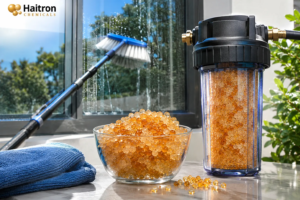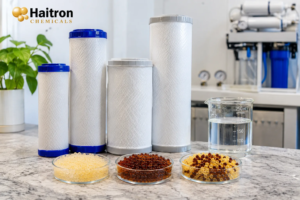
In-Line DI Resin Water Filter: Life, Setup and Refills
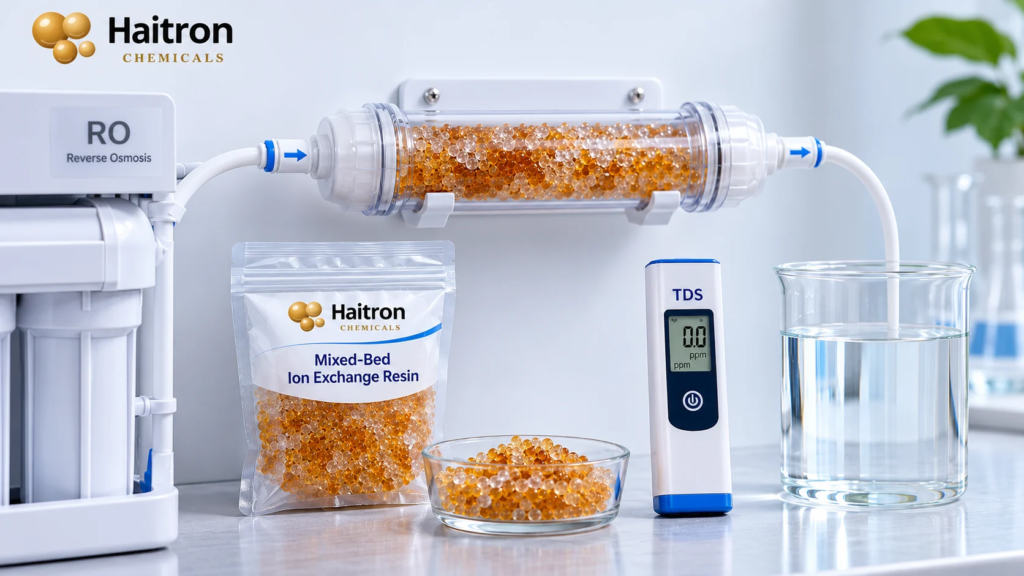
A standard 2.5 by 10 inch in-line DI resin water filter holds about 0.03 cubic feet of resin. Fed tap water at 200 ppm TDS, that small cartridge makes roughly 21 gallons of zero-TDS water before it’s spent. By contrast, fed RO water at 15 ppm, the same cartridge makes about 277 gallons.
That spread explains almost everything about these filters. An in-line DI resin water filter is a slim tube of mixed bed ion exchange resin that strips dissolved minerals out of water as it flows through. For that reason, it works beautifully for post-RO water polishing. Used alone on hard tap water, it turns into a resin subscription you never meant to sign up for.
Below: what happens inside the tube, how to work out its life before you buy, and how to refill one without wasting half the resin.
How does an in-line DI resin water filter work?
The tube is packed with two kinds of plastic beads, mixed together. First, cation beads (strong acid, sulfonic acid groups) swap calcium, magnesium, sodium and other positive ions for hydrogen. Meanwhile, anion beads (strong base, quaternary ammonium groups) swap chloride, sulfate, bicarbonate and silica for hydroxide. The hydrogen and hydroxide meet and form plain water.
Because both bead types sit side by side, water passes through thousands of tiny cation and anion stages in a few inches of bed. That’s why a mixed bed DI resin filter can push water to near 18 megohm·cm resistivity in a single pass, something separate cation and anion columns struggle to do. You can read the bead chemistry in more detail on our pages for strong acid cation resin and strong base anion resin.
There’s no regeneration in a cartridge this size. Once every exchange site is used, the resin is exhausted and the minerals pass straight through. Mixed bed resin also tends to fail suddenly rather than slowly, so your TDS reading can sit at 000 for weeks and then jump.
How long does in-line DI resin last?
The math is simple enough to do on a napkin: resin capacity divided by the TDS of the water going in. One RO retailer’s long-standing rule of thumb puts a typical in-line DI cartridge at about 3,400 ppm·gallons. Divide by your feed TDS and you get gallons of 0 ppm water.
| Feed water | What it usually means | Estimated gallons (3,400 ÷ TDS) |
|---|---|---|
| 200 ppm | Hard tap water, DI only | about 17 |
| 40 ppm | Tired RO membrane | about 85 |
| 10 ppm | Healthy RO membrane | about 340 |
| 2 ppm | Very good RO | about 1,700 |
J. Racenstein’s DI resin life table for pure water cleaning lands in the same zone: about 21 gallons at 200 ppm and about 104 gallons at 40 ppm for a 2.5 x 10 inch cartridge. Two sources using slightly different capacity assumptions, same conclusion. Feed TDS rules everything.
Why DI resin runs out sooner than the math says
Now the part the napkin misses. A TDS meter reads conductivity, and dissolved carbon dioxide barely registers. RO membranes let CO2 straight through, and the anion beads still have to grab it as bicarbonate. Silica behaves the same way. So your RO water might read 3 ppm while the resin is doing the work of something closer to 10 or 15 ppm.
That’s why reef keepers on forums report a common puzzle: they cut their RO output TDS by a factor of ten and did not get ten times the resin life. Their meters were right. The meters just weren’t measuring the whole load. If your real-world gallons come in at half the table above, CO2 is the first suspect, not bad resin.
How to make a DI resin cartridge last longer
A few habits stretch the life of any cartridge:
- Put the DI stage after RO, never before it. RO does the heavy TDS reduction; DI should only polish.
- Flush the RO to drain for a minute after startup. The first water out of a membrane carries higher TDS (often called TDS creep) and burns resin for nothing.
- Add a carbon stage ahead of everything. Omnipure, for example, lists free chlorine under 0.5 ppm as a feed limit for its in-line DI cartridges, because chlorine attacks the resin.
- Run at the rated flow. A 10 inch cartridge rated around 0.5 gpm won’t polish properly if you open the valve wide.
Do you need RO in front of it?
For most people, yes. If your tap water reads above roughly 150 to 200 ppm and you need more than a few gallons a week, RO/DI water filtration will cost less within a year than constant DI resin replacement in a DI-only unit.
There are fair exceptions. Soft municipal water at 40 to 60 ppm, a humidifier that needs a gallon a day, or a car detailer doing a final rinse once a week can all get away with an inline deionization filter on its own. The test is cost per gallon, so price a refill bag, run the formula above, and compare.
Inline DI resin filter for aquarium use
Reef tanks are the biggest home market for these filters, and for a good reason. Phosphate, silicate and nitrate in tap water feed nuisance algae, and corals react to trace metals that freshwater fish ignore. A reverse osmosis DI resin filter in the fourth stage of a standard four or five stage unit is the usual setup.
Mount a dual inline TDS meter with one probe before the DI cartridge and one after. When the outlet starts flicking between 000 and 001, order resin. Once it reads 002 or 003, swap it before your next water change.
For freshwater planted tanks, many keepers skip DI completely and remineralize RO water, since they would be adding minerals back anyway.
Inline DI resin filter for window cleaning
Water-fed pole cleaning depends on water with nothing left in it. Pure water dries on glass without spots, so there’s no squeegee and no soap. The trade standard is 000 ppm at the brush.
Where people disagree is the change point. Some suppliers tell window cleaners to swap resin once output passes 10 to 20 ppm, while solar panel work needs near zero.
In practice, pros in hard-water areas run RO/DI carts and treat the DI tank as a polisher, because DI-only at 300 ppm feed would mean changing resin before lunch. A small in-line DI resin water filter makes sense for homeowners doing their own windows twice a year, not for a daily route.
How to refill an inline DI resin cartridge
Refillable housings cost a bit more up front and pay back quickly, since bulk resin is far cheaper per liter than sealed cartridges. Here’s the routine:
- Shut off the feed, release pressure, and unscrew one end cap.
- Pour the spent resin into a bag and dispose of it according to local rules.
- Rinse the housing and check the foam or mesh pads at each end. Replace them if they’ve compressed.
- Fill with fresh mixed bed resin using a funnel. Tap the housing as you go so the beads settle, and leave about a centimeter of space at the top.
- Refit the pad and cap, then run water slowly through it to drain for a few minutes until the outlet TDS settles at zero.
Two mistakes come up again and again. The first is filling the cartridge with water softener resin. Softener resin runs in the sodium form and swaps calcium for sodium, so your TDS barely moves. DI resin needs to be in the hydrogen and hydroxide forms.
The second is leaving the bag of resin open. Moist resin slowly pulls CO2 from the air and loses capacity on the shelf, so seal the bag tightly between refills.
If you’re buying resin by the bag or the drum, our mixed bed ion exchange resin (YHJ-18MH) is a gel SAC and SBA blend rated for product water above 18 megohm·cm, the same grade used for final polishing in high-purity loops.
Where an in-line filter stops being the right tool
A cartridge is a polisher. Our own product notes say the same about mixed bed resin in general: it’s the wrong choice for bulk demineralization, which belongs in separate cation and anion vessels sized to the job.
If you’re feeding a lab, a boiler or a production line, look at a proper column and work out the resin volume from your flow and water analysis. Start with our ion exchange resin product range to see which families fit. Our guide to ion exchange column design walks through the sizing.
The same goes for purity targets. A good in-line cartridge after RO makes excellent deionized water. If you need Type 1 for HPLC or cell culture, read our comparison of Milli Q water vs DI water and our explainer on what ultrapure water is before you spend money on bigger cartridges that won’t get you there.
Quick answers
Does color-changing resin replace a TDS meter?
Not reliably. Indicator resin shows how far exhaustion has travelled through the bed, but the color front and the TDS breakthrough don’t always line up. Use both if you can.
Will DI resin remove chlorine or chloramine?
No, and chlorine damages it. Put carbon first. Chloramine needs catalytic carbon, which we cover in our chloramine removal guide.
Can I use an in-line DI filter just to remove hardness?
You can, but it’s an expensive way to do it. A softener or RO handles hardness far more cheaply. See our comparison of methods to remove calcium from water.
Before you buy anything, measure your tap water TDS, divide 3,400 by it, and look at the answer. Under 50 gallons means you need RO in front. Over 300 means a DI-only cartridge may be all you need. If you’re refilling cartridges in volume or supplying them to customers, send us your feed water numbers and we’ll suggest a resin grade and pack size.