Bulk DI Resin: What Industrial Buyers Should Check Before Ordering
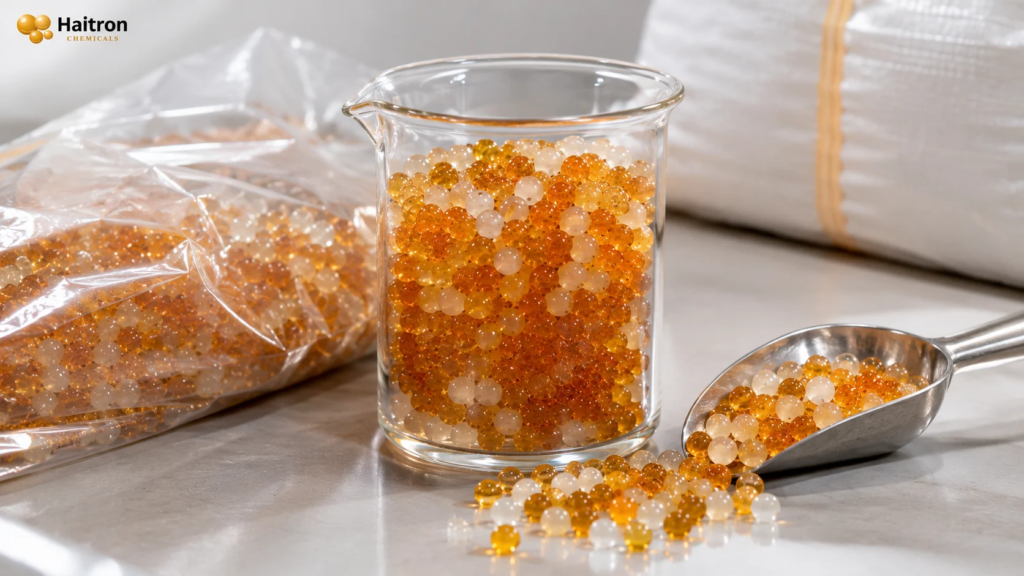
Search for bulk DI resin and most of page one belongs to reef aquarium shops. Their idea of bulk is a resealable bag of 1.25 to 7.5 lb that refills a few 10 inch cartridges. If you run a plant, a lab water loop or a spot-free rinse line, bulk means 25 L bags, cubic-foot sacks, drums or whole pallets, bought against a data sheet instead of a star rating.
This guide is for the second buyer. It covers which spec sheet numbers matter, when a mixed bed is the wrong resin to buy in volume, and how to stop a pallet from losing capacity before anyone opens it.
What bulk looks like once you leave the hobby aisle
The price ladder explains why people search for wholesale DI resin. One retailer lists a 7.5 lb bag of Bulk Reef Supply color-changing resin at $69.99. Serv-A-Pure lists a 40 cubic foot skid of mixed bed DI resin at $7,100, which works out to about $177 per cubic foot, with a lower price per skid at five or more.
But unit price is the smallest change. At industrial volume you stop buying a product and start buying a specification.
Most bulk deionization resin for industrial use is a gel type styrene DVB blend. It’s a strong acid cation resin in hydrogen form mixed with a strong base anion resin in hydroxide form, shipped ready to load. Two suppliers can sell bags that look identical and perform very differently in your vessel.
How to choose bulk DI resin from the spec sheet
Read the data sheet in this order. The first two lines decide your cost per cubic meter of treated water. The rest decide whether the resin behaves in your equipment.
Total capacity, per component
A mixed bed sheet lists capacity separately for the cation and anion halves. Haitron’s mixed bed ion exchange resin (YHJ-18MH) lists at least 1.90 mmol/mL for the cation component and at least 1.05 mmol/mL for the anion.
Lanxess lists 2.4 and 1.2 eq/L for Lewatit MonoPlus SM 1015 KR. AppliChem’s MBH 100 lists 1.7 and 1.0 eq/L. (mmol/mL and eq/L are the same unit, so you can compare them directly.)
Notice the pattern. In every sheet the anion side holds roughly half of what the cation side holds per liter. On a 1:1 blend by volume, that makes anion resin capacity the number to watch, because it usually limits the run.
Operating capacity to an endpoint
Total capacity is a lab figure. What you get in a column is lower, and good suppliers say how much lower. Lewatit SM 1015 KR and J.T. Baker’s NM-60 both quote a column capacity of at least 0.55 eq/L to a 0.02 MOhm·cm endpoint. AppliChem puts the typical working capacity of MBH 100 at 0.70 eq/L.
Here’s why that matters when you buy bulk DI resin for water treatment. Take 1 m³ of resin at 0.55 eq/L, which gives 550 equivalents. Feed it RO permeate carrying 0.5 meq/L of ions (about 25 mg/L as CaCO₃) and it treats roughly 1,100 m³ before it hits the endpoint.
Double the ionic load and you halve the run. Dissolved carbon dioxide and silica count toward that load, and they hit the anion half.
If a supplier only gives you total capacity, ask for an operating figure or a test endpoint. Without one, you can’t compare two quotes on cost per cubic meter.
Polishing quality
This tells you how clean the water gets, not how long the resin lasts. Haitron’s YHJ-18MH data sheet lists product water above 18 MOhm·cm. Lewatit SM 1015 KR is specified at a minimum of 18 MOhm·cm in its NaCl test, and NM-60 at 16 or better.
If you need Type 1 lab water, compare that number with what your instruments actually require. The gap between Milli Q water and DI water comes down to exactly this.
Bead size, uniformity and temperature
Haitron’s sheet puts at least 95% of beads between 0.315 and 1.25 mm, with a uniformity coefficient of 1.60 or lower. Monodisperse grades go tighter; Lewatit MonoPlus M 800 lists a maximum of 1.1.
Tighter beads mean a more even pressure drop, and Lanxess notes that a narrow distribution makes it easier to separate a mixed bed for regeneration. Check the temperature limit too. Haitron and Windows101 both list 60 °C maximum for their mixed beds.
When bulk mixed bed DI resin is the wrong buy
Mixed beds polish. They don’t do the heavy lifting well. Haitron’s own product page flags bulk demineralization as a job better handled by separate cation and anion trains, and that matches the capacity math above. Push high TDS water straight into a mixed bed and you’ll be replacing resin far more often than the price per cubic foot suggested.
So if your feed hasn’t been through RO or a two-bed system, buy strong acid cation resin and strong base anion resin for the primary train. Keep bulk ion exchange resin of the mixed bed type for the last stage.
Even reef retailers make a version of this point. Bulk Reef Supply tells customers to let carbon dioxide gas off RO water before it reaches the DI stage, because CO₂ eats resin.
The other fork is regenerable versus throwaway. Windows101 sells its MB 1:1 as virgin, non-regenerable industrial grade, which suits exchange tanks and cartridges. Haitron lists its mixed bed for either use, regenerated with acid and caustic or run once. If you regenerate on site, bead uniformity matters more, since you have to separate the two resins cleanly every cycle.
Storage is where bulk orders lose capacity
A big order only saves money if the resin still works when you load it. The anion half degrades first. One industry storage guide puts sealed shelf life at 3 to 5 years for strong acid cation resin and 1 to 2 years for strong base anion.
Nordic Filtration guarantees its Ecolite mixed bed for 2 years in original packaging, and Lanxess says packaging stability on its UltraPure grades runs about 24 months.
Keep it sealed, cool and moist, and away from bare steel drums, which can foul resin with iron. Don’t let it freeze or dry out. Bulk Reef Supply packs resin in foil-lined Mylar because exposure to air starts depleting it, and an industrial pallet left half open in a warehouse faces the same problem at a much larger scale.
If resin has sat for a long time, test a sample first. The same storage guide treats a capacity loss above 15% as a sign of real degradation.
In practice, order what you will load within about a year and schedule the rest as releases. A good per-cubic-foot price does nothing for resin that expired in the stockroom.
Where to buy bulk DI resin, and what to send first
Look for a bulk mixed bed DI resin supplier that publishes model-level data sheets and quotes operating capacity. It should also tell you the ionic form and packaging date of the lot you are buying. Ask how the resin ships (lined bags or drums) and whether the cation and anion ratio is fixed or adjustable.
A supplier can only match a resin properly if you give it your water. Haitron’s inquiry form asks for flow rate, inlet composition, target outlet quality, regenerant availability and temperature. If you’re also sizing new vessels, the ion exchange column design guide shows how bed depth and resin volume follow from those same numbers.
Quick answers
Is “nuclear grade” better?
In the hobby market it’s mostly a label. For industrial buying, ask for the capacity, resistivity and bead size figures instead; they tell you more than the name.
Is color-changing resin worth it in bulk?
It helps in clear cartridges where you can see the bed. In an opaque steel or FRP vessel nobody sees the color change, so a conductivity or resistivity monitor does the job better.
Before you request a quote, pull your latest water analysis and write down four numbers: flow rate, conductivity after RO, silica, and target resistivity. Then send them to Haitron and ask for the matching mixed bed or two-bed recommendation with the data sheet attached.