Ion Exchange Column Design: How to Size a Resin Column the Right Way
Ion exchange column design is the job of choosing the resin, resin volume, bed depth, vessel size and flow rate so a column removes the target ions reliably until its next regeneration. You start with a balanced water analysis. Then you size the resin from the ionic load and check the flow per bed volume.
Ion exchange column design is the job of choosing the resin, resin volume, bed depth, vessel size and flow rate so a column removes the target ions reliably until its next regeneration. You start with a balanced water analysis. Then you size the resin from the ionic load and check the flow per bed volume.
Get those three things right and most problems never show up. This guide covers industrial water treatment columns and lab ion exchange chromatography columns, because people mix them up all the time.
How Does an Ion Exchange Column Work?
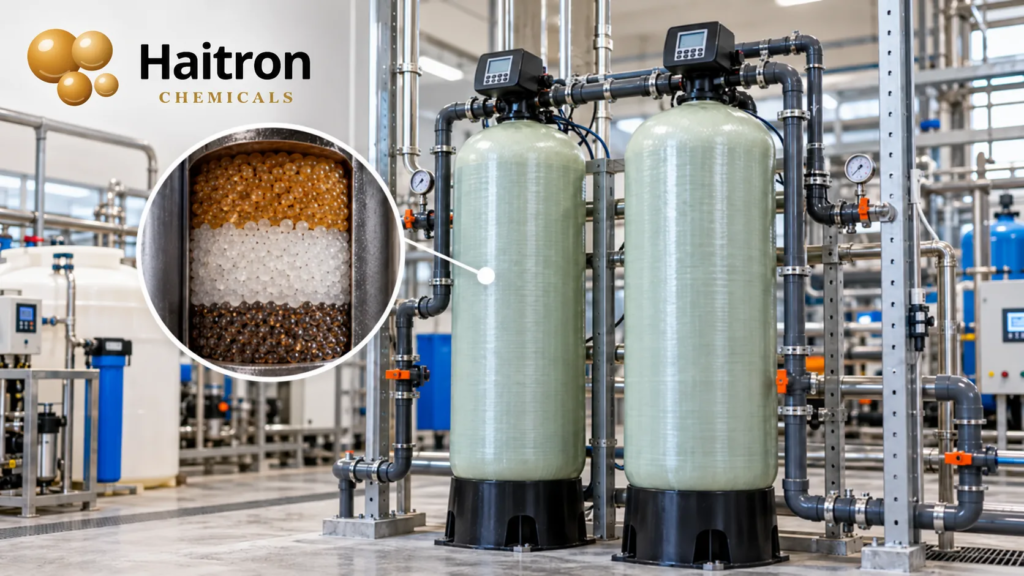
An ion exchange column is a vessel packed with resin beads that carry fixed electric charges. As liquid flows through, the beads swap their loosely held ions for the ions you want removed. When the beads are full, you regenerate them with acid, caustic or brine and start again.
Think of each bead as a tiny parking lot. Calcium drives in, hydrogen drives out. A cation exchange column uses negatively charged resin to grab positive ions like calcium and sodium. An anion exchange column uses positively charged resin to grab negative ions like chloride and sulfate.
Every industrial cycle has four stages: service, backwash, regeneration and rinse. Your design has to work for all four, not just the service run.
What Are the Key Steps in Ion Exchange Column Design?
Good design follows seven inputs: feed water analysis, flow rate, run time, target water quality, regeneration method, vessel size and resin type. Get the water analysis right first, because every later number depends on it. Then size the resin, check the flow rate and fit the vessel.
Here’s the practical order most engineers follow:
- Get a reliable, balanced water analysis. If quality changes by season, don’t design on an average. Design on the most probable water, then check the best and worst cases.
- Choose a run time between regenerations. It should be at least as long as the regeneration itself.
- Work out the ionic load per cycle.
- Divide by the resin’s operating capacity to get resin volume.
- Check the specific flow rate in bed volumes per hour (BV/h).
- Pick the diameter, bed depth and freeboard, then check pressure drop.
How Do You Calculate Resin Volume for an Ion Exchange Column?
Multiply the ion concentration (meq/L) by the water treated per cycle (m³) to get equivalents. Divide that by the resin’s operating capacity (eq/L) to get litres of resin. Then confirm the flow per bed volume sits inside the resin maker’s range, usually 5 to 50 BV/h.
Here’s a worked example based on the hand method in François de Dardel’s ion exchange design guide (updated 2022).
| Step | Value |
|---|---|
| Flow rate | 60 m³/h |
| Cation concentration | 4.8 meq/L |
| Run time | 12 hours |
| Water per cycle | 720 m³ |
| Cation load | 3,456 eq |
| SAC capacity (HCl regeneration) | about 1.0 eq/L |
| Resin needed | about 3,456 L |
| Specific flow rate | about 17 BV/h |
That 17 BV/h is fine. But cut the run to 8 hours and the resin drops to about 2,304 L at 26 BV/h. The plant gets smaller and cheaper. Compact plants often land around 30 to 35 BV/h, which suits a strong acid cation resin column running in two alternating trains.
Now fit the vessel. A tall, narrow column is usually cheaper than a short, wide one holding the same resin, because the dished ends and nozzle plates drive the cost. The main height limit is pressure drop. Keep it under about 1 to 1.5 bar at peak flow with clean resin.
Finally, leave room to backwash. Resin data sheets, such as Lanxess’s Lewatit MonoPlus S 108, recommend a freeboard of 60 to 100 percent of the resin volume and a minimum bed depth of about 800 mm.
Which Resin Should Go in Your Resin Column?
| Resin type | Removes | Typical use | Design note |
|---|---|---|---|
| Strong acid cation (SAC) | All cations | Softening, demineralisation | Highest capacity with HCl |
| Weak acid cation (WAC) | Hardness tied to alkalinity | Dealkalisation | Low regenerant use |
| Strong base anion (SBA) | All anions, including silica | Demin water | Weak on silica above about 50 °C |
| Weak base anion (WBA) | Strong mineral acids | Before SBA | Cuts caustic use |
| Mixed bed | Final traces | Polishing, ultrapure water | Needs at least 12 to 15 BV/h |
| Chelating | Selected metals | Metal and brine recovery | Very selective |
Two details catch people out. Hot water hurts silica removal, so check temperature before you finalise a strong base anion resin column. And if your feed water is high in organics, acrylic anion resins usually hold up better than styrenic ones.
Polishing units have their own rule. A mixed bed ion exchange resin column that’s oversized for its flow often performs worse, not better, because slow flow spreads unevenly through the bed.
How Are Industrial Columns Different From Ion Exchange Chromatography Columns?
Industrial columns remove ions from large volumes of water and are regenerated in place. Ion exchange chromatography columns are small, precise columns that separate molecules like proteins by charge and are eluted with a salt or pH gradient. The principle is the same. The scale and goal are not.
| Feature | Industrial resin column | Ion exchange chromatography column |
|---|---|---|
| Goal | Remove ions from water | Separate molecules by charge |
| Size | Litres to cubic metres | Millilitres, often pre packed |
| Cycle | Service, backwash, regenerate, rinse | Equilibrate, load, wash, elute |
| Example | Boiler feed demineraliser | Protein purification, ion exchange HPLC column |
In chromatography, a strong cation exchange column usually carries sulfonic acid groups, while a weak cation exchange column carries carboxylic acid groups. On the anion side, quaternary ammonium (Q) is a strong anion exchanger and DEAE is a weak anion exchanger. So if you’re buying lab columns, pick by charge first, then by strength.
What Common Mistakes Ruin a Resin Column?
Most failures trace back to a handful of design shortcuts:
- Designing on average water instead of the realistic worst case.
- Running too slowly. Brian Windsor of Purolite (2012) warns that many columns can’t handle very low flows, and poor distribution then causes channeling.
- Building short and wide when tall and narrow costs less.
- Skipping backwash freeboard, so beads wash out with the backwash water.
- Forgetting dilution and rinse water, which can add 2 to 10 percent to the ionic load.
- Using co flow regeneration on large plants. Counter flow regeneration gives better water quality and lower chemical use.
Pro Tips for Better Performance
- Use two trains that alternate. One serves while the other regenerates, so supply never stops.
- Choose uniform bead resins for packed bed designs. They pack evenly and rinse faster.
- Add a degasifier when bicarbonate is high. It strips carbon dioxide cheaply and shrinks the anion column.
- Avoid stopping a column halfway through a run. Water quality can dip when it restarts.
What Are the Limits of a Hand Calculation?
A hand calculation is a sanity check, not a final design. It’s roughly 20 percent accurate because real capacity shifts with temperature, regenerant dose and endpoint. Resin pairs like WAC with SAC need software. Always confirm the numbers with your resin maker’s data.
Conclusion
Good ion exchange column design comes down to honest water data, correct resin volume and a flow rate inside the resin’s comfort zone. Size tall rather than wide, leave space to backwash and plan for the worst water, not the average. If you’d like a second opinion, send us your water analysis and our team will match the right resin to your ion exchange column design.
FAQs
What is a bed volume?
One bed volume equals the volume of resin in the column. A 1 m³ bed running at 20 m³/h is working at 20 BV/h.
How deep should a resin bed be?
It depends on the resin and design. Many data sheets set a minimum around 600 to 800 mm to avoid poor flow distribution.
Can one column remove both cations and anions?
Yes. A mixed bed column holds both resins together and is usually used for final polishing.
Is ion chromatography the same as ion exchange chromatography?
The terms are often used interchangeably, though ion chromatography usually refers to analytical ion testing.
Does Haitron supply resin for existing columns?
Yes. Haitron makes SAC, WAC, SBA, WBA, chelating and mixed bed resins and can match a grade to your current system.