Chelating Resin: How It Works and Where It’s Used
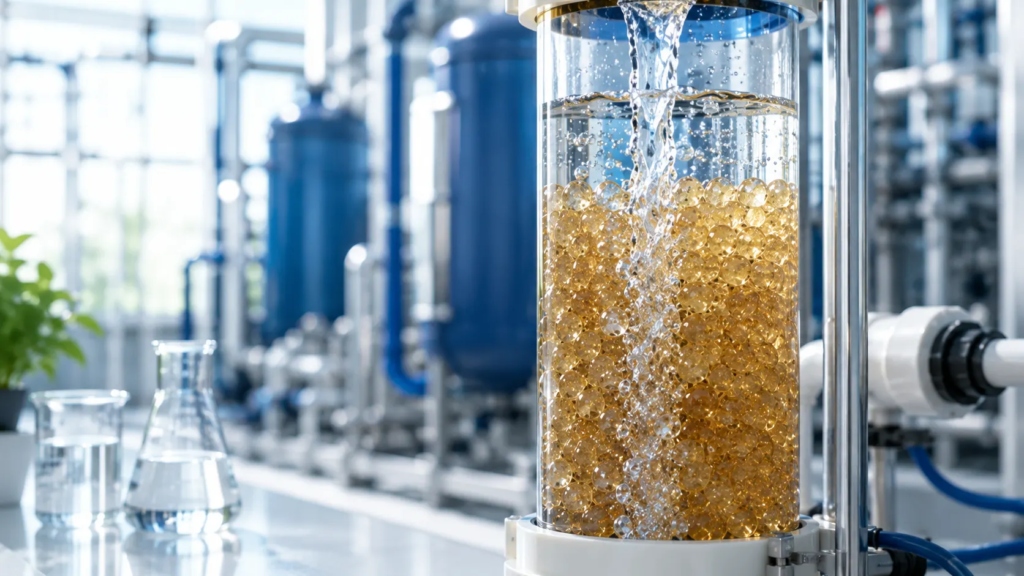
Chelating resin is a specialized ion exchange resin built to grab specific metal ions out of a solution, even when other ions are floating around in much bigger amounts. Standard resin isn’t picky. It’ll pull in almost anything with the right charge, competing ions and all. Chelating resin is different. It’s built for selectivity, which is exactly why you’ll find it doing the heavy lifting in heavy metal removal, precious metal recovery, boron removal, and brine purification: jobs where ordinary resin either can’t tell ions apart well enough or just gets swamped by everything else in the mix.
If you’ve ever stared at a plant that’s loaded with standard cation resin and still can’t hit a trace metal spec, selectivity is almost always the culprit. This guide walks through what chelating resin actually is, how it works, where it fits into real operations, and how to steer clear of the mistakes that end up wasting money on the wrong grade.
What Is Chelating Resin?
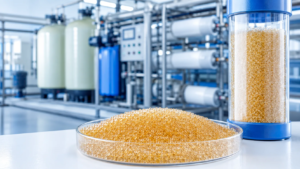
A chelating resin is a polymer bead, similar in size and shape to standard ion exchange resin, with chelating functional groups attached to its surface. Instead of a simple charged site, each group has multiple donor atoms, usually nitrogen, oxygen, or sulfur, that wrap around a metal ion and hold it with several bonds at once.
A chelating resin consists of a polymer matrix in which chelating ligands are attached by covalent bonds, and these resins differ from standard ion exchange resins by offering higher selectivity and stronger bonding, generally at a lower total capacity. That trade-off, less raw capacity for far better selectivity, is the whole point of the technology.
Chelating resin generally consists of two parts: a polymer matrix and a chelating group, and various ligands with nitrogen, oxygen, or sulfur donor atoms are immobilized on that matrix to capture metal ions.
How Chelating Resin Works
Here’s the basic sequence, broken down step by step:
- Solution flows through a bed of chelating resin beads.
- Target metal ions make their way to the chelating groups on the bead surface.
- Multiple donor atoms on each group wrap around the metal ion, locking it into a stable, ring-shaped bond called a chelate.
- Non-target ions, such as sodium, calcium, and other common cations, mostly just flow right through.
- Once the resin’s sites are full, the bed gets regenerated or swapped out.
None of this happens by accident, though. It comes down to how the resin gets built in the first place. Most of these resins start out as styrene-divinylbenzene copolymers, with iminodiacetate groups tacked on. And before the resin ever goes to work, it gets rinsed with acid. That rinse matters more than it sounds like it should, since it puts the functional groups into the right shape to actually latch onto the target metal.
That’s really the payoff here. Chelating resins with iminodiacetic acid functionality zero in on heavy metal cations so precisely that they hold up fine even in solutions loaded with sodium or other common ions, the exact conditions where standard cation resin usually starts to fall apart.
Chelating Resin vs. Standard Ion Exchange Resin
| Factor | Chelating Resin | Standard Cation Resin |
| Selectivity | Very high for specific metals | Low, targets any cation of the right charge |
| Exchange capacity | Generally lower | Generally higher |
| Best for | Trace metals, selective recovery | Bulk softening, general demineralization |
| Works in high-competing-ion water | Yes | Often not effective |
| Typical regeneration | Acid strip, application-dependent | Salt or acid, more standardized |
| Cost per unit capacity | Higher | Lower |
If your job is removing bulk hardness or general dissolved solids, a strong acid cation resin is almost always going to be the more economical choice. Chelating resin earns its keep when the problem you’re actually solving is selectivity, not raw capacity.
Main Chelating Groups and What They Target
Not every chelating resin behaves the same way. The functional group determines what it actually captures.
| Chelating group | Donor atoms | Typical targets |
| Iminodiacetic acid (IDA) | N, O | Copper, nickel, zinc, most transition metals |
| Aminomethylphosphonic acid (AMPA) | N, O | Indium, rare earth elements, uranium, thorium |
| Thiourea / thiol types | S | Silver, mercury, copper, lead |
| Glucamine | N, O | Boron and borate ions |
Iminodiacetic acid is the most common chelating group. Aminomethyl phosphonic acid, using nitrogen and oxygen, targets indium, rare earths, uranium, and thorium. Sulfur-based groups like thiol, thiourea, and thiouronium go after silver, mercury, copper, and lead. Glucamine-type resins are the ones built for boron, used to pull it from brine and seawater.
What Chelating Resin Is Used For
Chelating resin earns its place in processes where selectivity, not bulk capacity, is what decides whether the system actually works.
- Heavy metal removal: copper, nickel, zinc, mercury, and lead capture from process water or wastewater
- Brine decalcification: removing trace calcium, magnesium, strontium, and barium from chlor-alkali brine before electrolysis.
- Boron removal: pulling borate out of potable water or industrial process streams
- Precious metal recovery: capturing gold, platinum, and palladium from dilute process solutions
- Resource and metal recovery: selective recovery of valuable ions like potassium from desalinated seawater or brine
- Trace metal analysis: pre concentrating metals from dilute samples before laboratory testing
Other common applications include resin in pulp base metal capture for copper, nickel, cobalt, and zinc, along with removing hexavalent chromium from potable water.
Haitron’s own chelating resin family covers several of these jobs directly. YQ1 520H is built for multi ion heavy metal capture, while BYCLE 80CK is designed specifically for potassium recovery from desalinated seawater, a good example of how a single chelating group can be fine tuned to go after one particular target ion.
Regeneration and pH: Why Chelating Resin Behaves Differently
pH matters more with chelating resin than it does with almost any other resin family out there. Conventional chelating resins pick up heavy metals from aqueous solutions once pH climbs above roughly 4. Drop below that, though, and their functional groups become protonated, which causes selectivity for heavy metals to fall off fast.
That one detail explains most of the operating headaches people run into:
- Run the feed too acidic, and capacity drops even though the resin still looks “exhausted”
- Regenerating with strong acid strips the metal back off, and that’s exactly how the resin gets put back into service
- Metal recovery, not just removal, is often the real goal here, since the stripped solution can be concentrated and reclaimed afterward
In practice, this selectivity edge is what lets chelating resin hold up in solutions that would overwhelm a standard cation resin. Ordinary resins naturally favor common ions like sodium, while chelating resin stays locked onto the trace metals or complexed ions it’s actually meant to target.
Choosing the Right Chelating Resin
Picking a chelating resin based on product name alone is one of the easiest ways to end up with poor capacity and a system that never quite hits spec. A better approach looks like this:
- Identify the exact target ion. Copper removal and boron removal call for completely different chelating groups; “heavy metals” alone isn’t specific enough to go on.
- Test the full feed chemistry. pH, competing ion concentration, temperature, and target metal level all play a role in shaping which resin makes sense.
- Confirm the operating pH range. If your process runs below pH 4, ask your supplier directly whether that grade can still hold selectivity at those conditions.
- Match the functional group to the target. IDA works well for general transition metals, AMPA suits rare earths and uranium group elements, thiourea types are built for mercury and silver, and glucamine is the one for boron.
- Review your regeneration and recovery needs. If metal recovery matters just as much as removal, plan the regeneration and stripping stage from the start, not as something bolted on later.
Common Mistakes to Avoid
- Bulk softening: Using chelating resin for bulk softening is the wrong tool; standard cation resin is far cheaper for that job.
- Ignoring pH: Selectivity can quietly fall apart below pH 4 without giving any obvious warning sign.
- Wrong assumption: Assuming one chelating resin fits every metal is a mistake; the functional group, not the word “chelating,” is what actually determines what gets captured.
- Skipping analysis: Skipping a feed water or feed solution analysis leaves you with little to go on, since selectivity claims mean nothing without real data on competing ions.
Final Thoughts
Chelating Resin solves a specific problem: pulling out a target metal ion when standard ion exchange resin either isn’t selective enough or gets overwhelmed by competing ions. The functional group you choose, along with the pH you run at, is what decides whether that selectivity actually shows up once the system is running.
If you’re weighing chelating resin against a standard cation grade, the right place to start is your actual feed analysis and target ion, not a product name. Send Haitron your feed data and target output, and the technical team can confirm whether a grade like YQ1 520H or BYCLE 80CK fits your process.
Request a quote View Chelating Resin models
FAQs
Is chelating resin the same as a chelating agent?
No. A chelating agent is usually a dissolved chemical, like EDTA, that binds metal in solution, while chelating resin is an insoluble bead with similar binding groups attached to a solid polymer, so it can be filtered out and reused.
Can chelating resin remove hardness like a water softener?
It can bind calcium and magnesium, but it’s not the economical choice for that job; standard cation resin handles bulk hardness at a much lower cost per unit of capacity.
Does chelating resin need special regeneration chemicals?
Usually just an acid strip, since lowering pH releases the bound metal, though the exact acid, concentration, and contact time depend on the resin and target metal.
Why does chelating resin have lower capacity than standard resin?
The multi point bonding that gives it selectivity also takes up more physical space on the bead, which naturally limits total capacity compared with a standard exchanger.
Can chelating resin recover valuable metals instead of just removing them?
Yes, since the metal can be stripped off during regeneration, the recovered solution can often be concentrated and reclaimed, which is common in precious metal and resource recovery work.
What’s the difference between IDA and AMPA chelating groups?
IDA is the go to general purpose group for transition metals, while AMPA works through similar coordination but performs better for indium, rare earths, uranium, and thorium.
Is chelating resin used in drinking water treatment?
Yes, particularly for boron and hexavalent chromium removal from potable water, alongside broader industrial and process water uses.
How do I know if I need chelating resin or standard ion exchange resin?
If you’re after bulk removal of common ions like calcium or sodium, standard resin is usually more economical; if you need to selectively pull one metal out from a sea of other ions, chelating resin is built for that.