Hard Water Symptoms: Signs in Your Home, Skin and Hair
The most common hard water symptoms are white crust on taps, spotty glasses, soap that won’t lather, stiff laundry, and dry skin or dull hair after a shower. They come from calcium and magnesium dissolved in your water. A simple test confirms it.
The most common hard water symptoms are white crust on taps, spotty glasses, soap that won’t lather, stiff laundry, and dry skin or dull hair after a shower. They come from calcium and magnesium dissolved in your water. A simple test confirms it.
This guide shows you what each sign looks like and how to check your water at home. It also covers what the science really says about skin and hair, and how to fix hard water in your house.
What Is Hard Water?
Hard water is water with a high level of dissolved calcium and magnesium. It picks up these minerals as it moves through rock like limestone. The USGS calls water hard at 121 to 180 mg/L as calcium carbonate, and very hard above 180 mg/L.
Think of a kettle. The white crust inside it is the same mineral that builds up in your pipes and on your shower door.
What Are the Most Common Hard Water Symptoms in Your Home?
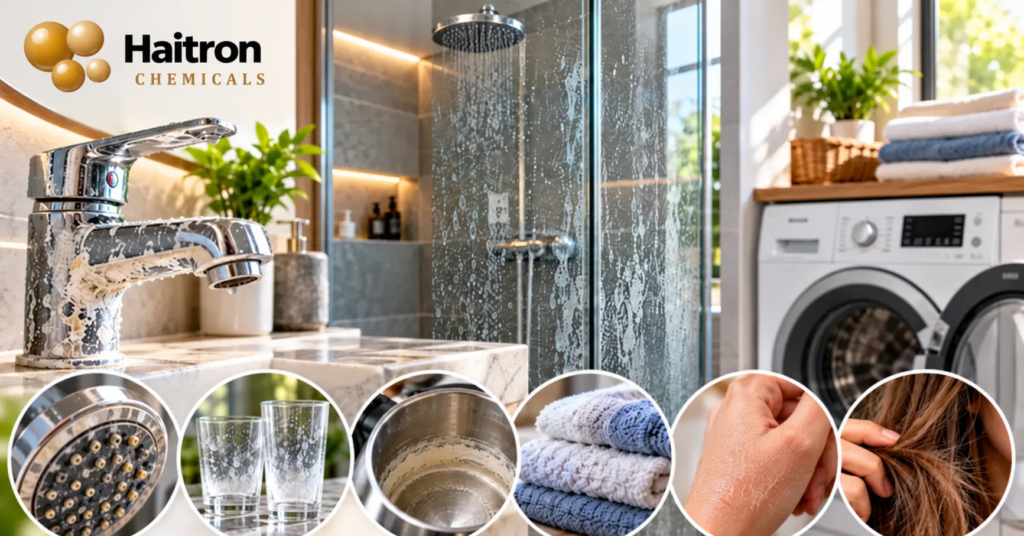
The clearest hard water symptoms are mineral deposits you can see and touch. Look for white or chalky crust on faucets, cloudy spots on glasses, and soap scum that comes back fast. Over time, showerheads clog and water flow drops.
Here are the hard water signs to check, room by room:
- In the kitchen: cloudy glasses, a crusty kettle, and white rings around the faucet base.
- In the shower: hard water stains on glass doors, scum on tiles, and clogged spray holes.
- In the laundry: clothes that feel stiff or scratchy, and colors that fade sooner.
- With your appliances: a water heater that rumbles or pops, which can mean scale has settled on the bottom.
Why does soap struggle? Calcium and magnesium react with soap to form a sticky curd. It’s the gray ring you see in a bathtub. That’s why you need more soap to get suds.
What Do Hard Water Stains Look Like?
Hard water stains are white, chalky or slightly cloudy. They often form rings where droplets dry. They feel rough, and they don’t wipe off easily with plain water.
Other colors usually point to something else. This table helps you tell them apart.
| What you see | Likely cause | Is it hard water? |
|---|---|---|
| White, chalky crust on taps | Calcium and magnesium scale | Yes |
| Cloudy spots on glasses | Mineral film left after drying | Usually yes |
| Gray soap ring in the tub | Soap reacting with hardness minerals | Yes |
| Orange or reddish brown stains | Iron or manganese in the water | No, test for iron |
| Blue or green stains in sinks | Copper pipes corroding | No, often the opposite problem |
| Pink slime near drains | Airborne bacteria growing in damp spots | No |
| Rotten egg smell | Hydrogen sulfide or bacteria | No |
This matters because a water softener fixes hardness, not iron, corrosion or odor. A test tells you which problem you actually have.
What Are the Hard Water Symptoms on Skin?
Hard water may leave skin feeling tight, dry or itchy after a shower. Researchers at the University of Sheffield and King’s College London (2017) found that hard water damaged the skin barrier and made skin more sensitive to soaps. People with eczema were more sensitive than people with healthy skin.
There’s an important detail. Harvey Water Softeners funded that study. Its lab findings are useful, but they don’t prove that hard water causes eczema in daily life.
So treat skin signs as a clue, not a diagnosis. If you have a lasting rash or itch, see a doctor. It could be something other than your water.
What Are the Hard Water Symptoms on Hair?
Hair washed in hard water can feel dry, dull, tangled or coated. Minerals and soap residue cling to the strands. The research is mixed, though. A 2018 study in the International Journal of Trichology found hair treated with hard water was about 8% weaker, while a 2013 study found no significant difference.
What neither study showed is hair falling out from the root. If you’re losing hair, a doctor or dermatologist is the right first stop.
How Can You Tell If You Have Hard Water at Home?
You can check for hard water at home in three simple ways:
- The soap bottle test. Fill a clear bottle one third with tap water, add a few drops of pure liquid soap, and shake. Few suds and cloudy water suggest hardness.
- Test strips. These are cheap strips that change color to show hardness in grains per gallon (gpg). One gpg equals about 17.1 mg/L.
- Your water report. City suppliers publish yearly water quality reports that list hardness.
On a private well, a certified lab test is the most reliable choice. It can check iron and other minerals at the same time.
How Do You Fix Hard Water in Your House?
The proven fix for whole house hard water is an ion exchange water softener. Inside, small resin beads swap calcium and magnesium for sodium. It works like a magnet that grabs the hard minerals before they reach your taps. The beads are usually strong acid cation resin.
For existing scales, white vinegar works well. Soak a showerhead in vinegar, or wipe vinegar onto taps and then rinse. The mild acid loosens the mineral crust.
Remember what a softener can’t do. It won’t remove lead, so you’d need a certified lead filter for water for that. It won’t fix chlorine taste either. A GAC water filter handles that job.
Common Mistakes to Avoid
These are the errors people make most often:
- Buying equipment before testing the water.
- Blaming hard water for orange or blue stains.
- Scrubbing glass with abrasive pads, which can scratch it permanently.
- Assuming every shower filter softens water. Many target chlorine, not hardness, so check the label.
- Treating skin or hair problems as proof without seeing a doctor.
What Are the Limits of These Signs?
Symptoms suggest a problem, but only testing confirms it. Dry skin can come from hot showers, harsh soap or cold weather. Low water pressure can come from old pipes. And for drinking, the WHO (2003) found no convincing evidence that hardness harms health.
Final Thoughts
The most reliable hard water symptoms are the ones you can see: white crust, spotty glasses and soap that won’t lather. Skin and hair signs are real for many people, but the science is still mixed.
Your next step is to test your water, so you know exactly what you’re dealing with before you spend money. If you notice several hard water symptoms, start with a strip test this week. Want to see how ion exchange is used beyond the home? Explore our water treatment applications.
FAQs
Can hard water damage my dishwasher?
Yes. Scale can build up on heating parts and spray arms over time. Using rinse aid and the dishwasher’s built in softener setting, if it has one, can help.
Is boiled hard water still hard?
Partly. Boiling removes some calcium as scale, which is the crust inside your kettle. Some hardness stays dissolved in the water.
Does bottled water count as hard or soft?
It varies by brand and source. Mineral waters can be quite hard, while purified waters are usually very soft. Check the label for the calcium and magnesium content.
Can hard water cause low water pressure?
It can. Scale narrows aerators, showerheads and old pipes over time. Clean the aerators first, because that often restores flow quickly.
What does Haitron make?
Haitron manufactures ion exchange resins, including strong acid cation resin used in water softeners. It also makes mixed bed, anion and chelating resins for water treatment.