Acid Neutralizer for Well Water: How It Works, Types and Sizing
An acid neutralizer is a tank filter that raises the pH of acidic water by passing it through a mineral, usually calcite, that slowly dissolves into it.
An acid neutralizer is a tank filter that raises the pH of acidic water by passing it through a mineral, usually calcite, that slowly dissolves into it. It turns corrosive well water into water that won’t eat copper pipes and fixtures. Most homes consider one when well water tests below pH 6.5.
Acidic water is common in private wells. It often looks clear and tastes fine, so the first sign is usually damage, not flavor.
What Is Acidic Water and Why Does It Matter?
Acidic water has a pH below 7. The US EPA recommends drinking water stay between pH 6.5 and 8.5. That range is a guideline, not an enforceable limit, and it exists mainly to prevent corrosion, metallic taste and staining. Below 6.5, water tends to pull metal out of pipes, solder and brass fittings.
The pH scale runs from 0 to 14, with 7 as neutral. Picture a seesaw. Below 7 tips toward acid, above 7 tips toward alkaline.
Common signs of low pH:
- Blue green stains in sinks and tubs from dissolved copper.
- A bitter or metallic taste.
- Pinhole leaks in copper pipes.
- Water heaters and fixtures that wear out early.
Virginia Cooperative Extension notes that low pH is more common than high pH in private water systems. If you have copper plumbing, test for lead and copper too.
How Does an Acid Neutralizer Work?
Acidic water flows through a tank filled with calcite, which is crushed calcium carbonate, much like limestone. The acid slowly dissolves the mineral, and that reaction raises both pH and alkalinity. Calcite is self limiting, so it tends to settle near neutral instead of overshooting. The media gets used up over time and needs topping up.
It works like an antacid tablet in your stomach. The tablet dissolves, cancels the acid, and is gone.
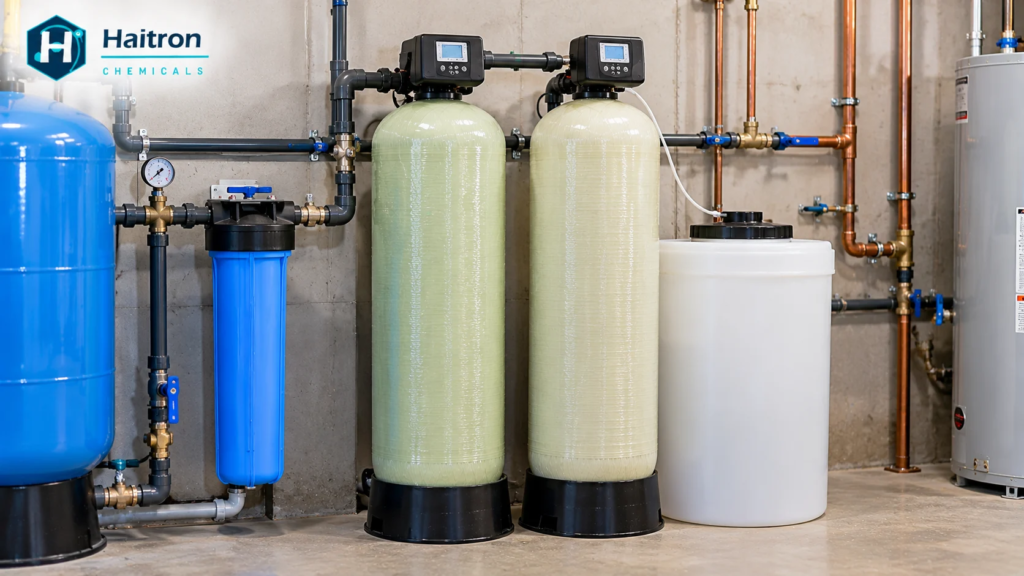
Most units treat all the water entering the house. A typical line runs: well pump, pressure tank, sediment filter, neutralizer, then softener. Most tanks backwash on a schedule to loosen the bed and flush out fine particles.
What Types of Water Neutralizer Systems Are There?
There are three main media choices plus one chemical option. Calcite treats mildly acidic water. Calcite blended with magnesium oxide, often sold as Corosex, treats more acidic water. Magnesium oxide alone works fast but can overshoot. A chemical feed pump that injects soda ash handles water too acidic for the media.
| Option | Typical pH range treated | Speed | Side effect | Upkeep |
|---|---|---|---|---|
| Calcite filter | About 6.0 to 6.9 | Slow, self limiting | Adds calcium hardness | Top up media, backwash |
| Calcite plus magnesium oxide | Down to about 5.3, depending on mix | Faster | Adds calcium and magnesium hardness | Top up media, watch for overcorrection |
| Magnesium oxide alone | About 4.5 to 6.0 | Fast | Can push pH too high at low flow; bed can cement | Frequent backwash |
| Soda ash feed pump | Very acidic water | Immediate, adjustable | Adds sodium, not hardness | Refill solution, service the pump |
Here’s a quotable fact from media maker Clack Corporation: magnesium oxide neutralizes about five times more acidity per pound than calcium carbonate. That’s why a small amount goes a long way, and why too much can overshoot.
For most homes, a calcite acid neutralizer is the safest place to start.
What Is the Best Acid Neutralizer for Well Water?
The best choice matches your lab results, not a brand name. For pH around 6.0 to 6.9, a calcite filter is usually best because it’s simple and self limiting. Below about 6.0, a calcite and magnesium oxide blend is common. For very acidic water, a soda ash feed system is often the better fit.
Two typical scenarios:
- A well tests at pH 6.4, the home has copper pipes, and the tub shows blue stains. A calcite filter is the standard fix.
- A well tests at pH 5.6. A calcite blend with a small share of magnesium oxide raises pH further, with a softener after it to handle the extra hardness.
How Do You Size a Calcite Water Filter?
Size for your peak flow rate, not your house size. Your pH and the backwash flow of your well pump can deliver matter too. A tank that’s too small lets water rush past the media without enough contact time, so pH barely moves. Lower pH water also uses up calcite faster.
- Test pH, alkalinity, hardness, iron, lead and copper at a certified lab.
- Find your peak flow in gallons per minute by counting fixtures that run at once.
- Check your well pump’s output. Backwashing tanks need steady flow to clean the bed.
- Pick a tank rated for that flow, then plan regular media top ups.
Good acid neutralizer water treatment depends on that match between tank, flow and pump.
What Is Acid Neutralizing Capacity and How Is It Calculated?
Acid neutralizing capacity (ANC) is the amount of acid water can absorb before its pH drops to a set point. In water treatment, it’s closely tied to alkalinity and is usually reported in mg/L as calcium carbonate. High ANC water resists pH swings. Low ANC water turns acidic easily and corrodes pipes faster.
You find ANC by titration. Add a strong acid of known strength to a sample until it reaches the endpoint, commonly pH 4.5.
ANC (meq/L) = (acid volume in mL × acid normality × 1000) ÷ sample volume in mL
Multiply by 50 to get mg/L as calcium carbonate.
Worked example: a 100 mL sample needs 5 mL of 0.02 N sulfuric acid. ANC = (5 × 0.02 × 1000) ÷ 100 = 1 meq/L, which equals 50 mg/L as calcium carbonate.
What Common Mistakes Should You Avoid?
Most problems come from guessing instead of testing, ignoring the hardness a neutralizer adds, and skipping maintenance. Each one either leaves water corrosive or creates a new scale problem. A lab test, the right media for your pH and a simple maintenance routine prevent nearly all of them.
- Guessing pH from stains instead of testing.
- Using magnesium oxide alone at low flow, which can overshoot pH.
- Placing the softener before the neutralizer.
- Letting the media run low. Check the bed level a few times a year.
- Never retesting lead and copper after treatment starts.
What Are the Limits of a Neutralizer?
A neutralizer fixes pH and corrosion, nothing more. Bacteria, nitrate and most other contaminants stay in the water. It also adds hardness. Since the unit sits after the well pump and pressure tank, it can’t protect them. Very acidic water may need a chemical feed system instead.
Where Do Ion Exchange Resins Fit In?
Acid neutralizers and softeners often work as a pair. Calcite adds calcium, so a softener downstream removes it. Softeners use strong acid cation resin to swap calcium and magnesium for sodium.
If your well also carries some iron, fine mesh resin is worth a look for softeners that handle iron. Facing the opposite problem, with too much alkalinity, a dealkalizer is the better tool. You can compare every resin family in Haitron’s product range.
Conclusion
Low pH water quietly damages pipes, heaters and fixtures. The fix is simple once you know your numbers: calcite for mild acidity, a blend for stronger acidity, and a feed pump for extreme cases.
Your next step: get a lab test, then choose the acid neutralizer that matches your pH, flow rate and hardness, and plan a softener if hardness climbs.
FAQs
Does an acid neutralizer make water safe to drink?
It reduces corrosion and the metals that leach from pipes. It doesn’t remove bacteria or other contaminants, so test for those separately.
How often do you add calcite?
It depends on your pH and water use. Check the bed a few times a year. Lower pH water uses calcite faster.
Do I need a neutralizer if I have plastic pipes?
Plastic pipes don’t corrode, but water heaters, pumps and fixtures still contain metal. Many owners treat for that reason.
Is low pH water harmful to drink?
The EPA pH range is set mainly for taste and corrosion. The bigger concern is lead and copper that acidic water can pull from plumbing.
Does Haitron make resin for softeners used after a neutralizer?
Yes. Haitron manufactures ion exchange resins, including strong acid cation resin for softening. You can request a quote through the contact page.