Dealkalizer: How It Works, Types, Sizing and When You Need One
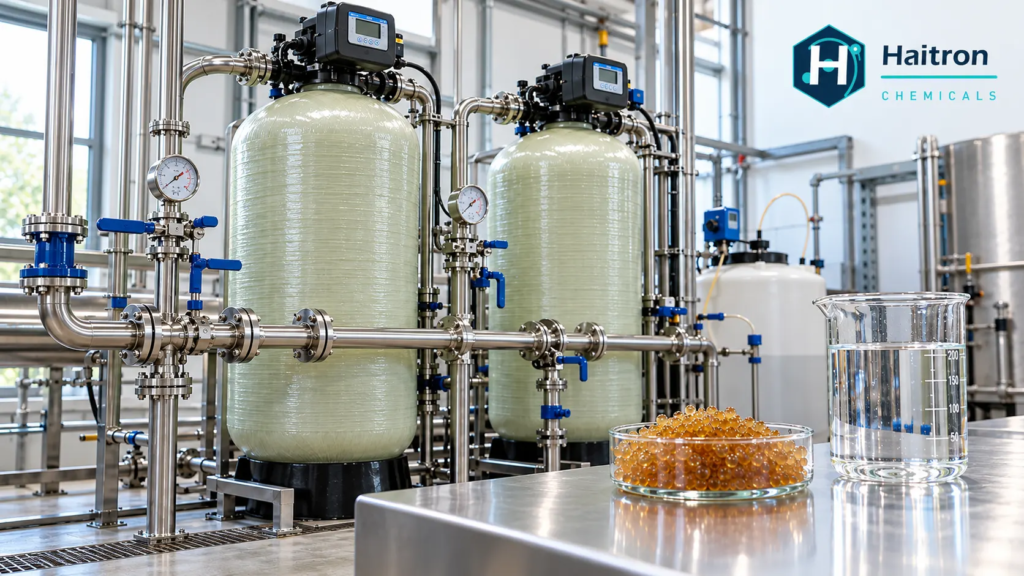
A dealkalizer is an ion exchange unit that removes alkalinity, mainly bicarbonate and carbonate, from water before it feeds a boiler or process. The most common type works like a water softener, but it uses anion resin and swaps alkalinity for chloride. Chem Aqua (2018) says a properly run unit cuts alkalinity by about 90%.
That one change can mean less boiler blowdown, less condensate corrosion and lower chemical costs. Here’s how it works and when it pays off.
What is alkalinity, and why remove it from boiler water?
Alkalinity is water’s ability to neutralize acid, a bit like an antacid tablet. Inside a boiler, heat breaks bicarbonate and carbonate into hydroxide and carbon dioxide. The carbon dioxide leaves with the steam and forms carbonic acid in the condensate. That acid eats return piping, while high boiler alkalinity causes foaming and carryover.
Cleaver Brooks calls carbon dioxide the major cause of condensate piping corrosion. To control high alkalinity, operators often raise blowdown, which means draining some boiler water to keep impurities down. Every gallon dumped wastes heated water, fuel and treatment chemicals.
How does a dealkalizer work?
A chloride cycle unit holds strong base anion resin charged with chloride. As softened water flows through, the resin grabs bicarbonate, carbonate and sulfate and releases chloride instead. When the resin fills up, a salt brine, often with a little caustic soda, recharges it. It’s the same idea as a softener, aimed at different ions.
Chem Aqua’s bulletin gives the key design numbers:
- Service flow: typically 2 to 3 gallons per minute per cubic foot of resin, since this exchange is slower than softening.
- Bed depth: at least 30 inches, versus 24 inches for a softener.
- Chloride: effluent chloride rises about 1 ppm for every ppm of alkalinity and sulfate removed.
- When to regenerate: once effluent alkalinity passes 10% of the raw water level.
Regeneration follows the same steps as a softener: backwash, brine draw, slow rinse and fast rinse. The normal salt dose is 5 to 7 pounds per cubic foot of resin.
Adding 0.25 to 0.50 pounds of caustic per cubic foot raises capacity a lot. It also turns free carbon dioxide into bicarbonate the resin can catch.
Wikipedia, citing an ion exchange text, notes Type II strong base anion resins give higher capacity than Type I in this service. Strong base anion resin is the core media either way.
What are the main types of dealkalization?
There are three main ion exchange methods. Chloride cycle units use anion resin and salt. Weak acid cation units use acid regenerated resin and a degasifier. Split stream systems blend water from two strong acid cation beds. The right choice depends on your water’s hardness to alkalinity ratio, flow and willingness to handle acid.
| Method | Resin | Regenerant | Lowers TDS? | Extra equipment | Best fit |
|---|---|---|---|---|---|
| Chloride cycle | Strong base anion (Type II common) | Salt, plus a little caustic | No | Softener ahead | Commercial and light industrial low pressure boilers |
| Weak acid cation (WAC) | WAC in hydrogen form | Acid | Partly | Acid handling, degasifier | Hardness to alkalinity ratio of 1 or more |
| Split stream | Two strong acid cation beds | Salt for one, acid for the other | Partly | Acid handling, degasifier | Feed water that changes by season or source |
WaterWorld calls the salt splitting (chloride cycle) method probably the most common in commercial and light industrial plants. It says WAC becomes very efficient when hardness equals or exceeds alkalinity.
A degasifier is a tower where water trickles down while a blower pushes air up and strips out carbon dioxide. It’s a bit like letting a soda go flat on purpose.
C.F. Michaud, writing in Water Conditioning & Purification (2001), points to split stream designs when the feed water swings between sources. Haitron’s weak acid cation resin is built for the WAC route.
Dealkalizer vs water softener: what’s the difference?
A softener removes hardness, meaning calcium and magnesium, using cation resin, and leaves alkalinity in place. A chloride cycle unit removes alkalinity using anion resin and leaves hardness alone. Both regenerate with salt. In practice they work as a team, with the softener first.
That order matters. Chem Aqua says water feeding the unit and used for its regeneration must be soft, under 1 grain per gallon, to prevent fouling. The Nelsen Corporation 2025 catalog explains why: hardness can combine with sulfate on the anion resin and form a calcium sulfate crust.
The softener ahead usually runs on standard strong acid cation softening resin.
When does dealkalization pay off?
It pays off when makeup water is high in alkalinity, condensate return is low, and alkalinity limits your boiler cycles. Chem Aqua sees the best payback above 100 ppm alkalinity. Wikipedia says this approach generally suits boilers below 700 psi.
Cycles of concentration describe how many times boiler water concentrates before blowdown. More cycles mean less waste.
DuBois Chemicals shares two real examples:
- A food plant on Great Lakes water rose from 10 to 15 cycles after adding a chloride cycle unit.
- A plant on well water jumped from 4 to 12 cycles.
DuBois estimated payback at roughly 6 to 7 years for the first plant and about 1 year for the well water plant. Hard, alkaline source water changes the math dramatically.
Cooling systems benefit too. Wikipedia notes dealkalization sharply cuts the acid needed to treat cooling water.
How do you size a dealkalizer?
Start with a full water analysis: P and M alkalinity, chloride, sulfate, total hardness and conductivity. Chem Aqua says capacity ranges from 5,000 to 12,000 grains of alkalinity per cubic foot of resin, depending on regeneration and ion mix. Ideally, sulfate plus chloride stays under half of total anions.
Here’s a hypothetical example to show the method:
- Daily load: 10,000 gallons of makeup a day at 200 ppm alkalinity (as calcium carbonate). That’s about 11.7 grains per gallon, or roughly 117,000 grains a day.
- Resin volume: at a mid range 8,000 grains per cubic foot, one day between regenerations needs about 15 cubic feet of resin.
- Flow check: confirm the bed can handle your peak flow at 2 to 3 gpm per cubic foot.
Sulfate adds to the load too, so a real design uses your full anion analysis.
Dealkalizer maintenance: what are the common mistakes?
Most problems trace back to feed water and salt quality. Watch for these:
- Feeding hard water. Softener leakage fouls anion resin. Nelsen notes an acid regeneration may help dissolve calcium sulfate buildup.
- Using cheap salt. Chem Aqua warns fouling is hard to spot. WaterWorld recommends high quality evaporated salt.
- Backwashing a brand new bed at startup. Chem Aqua advises against it.
- Running too fast. Flow above design causes early alkalinity leakage.
- Ignoring organics. WaterWorld lists organic fouling as a known anion resin risk.
- Skipping effluent tests. Test alkalinity regularly so you regenerate at 10% breakthrough, not after.
Honest limitations
A chloride cycle unit doesn’t lower total dissolved solids. It only swaps one ion for another. It also needs a softener, uses a lot of salt when the alkalinity share is low, and removes about 90%, not all, alkalinity. High sulfate and chloride levels cut its efficiency.
Conclusion
A chloride cycle dealkalizer is the simplest way to cut boiler feed alkalinity without handling acid. WAC or split stream systems win when hardness is high or TDS matters. Next step: get a full water analysis, run the sizing math above, then send us your feed analysis for a resin recommendation.
FAQs
Can a spare softener be converted for dealkalization?
Often, yes. WaterWorld notes excess softener capacity can be converted, but the bed must be deeper and the flow slower.
Does dealkalization remove silica?
Not meaningfully. Chem Aqua says caustic regeneration may exchange a minor amount, under 10%.
Does it change the water’s pH?
Adding caustic during regeneration slightly raises the treated water’s pH, according to Chem Aqua.
Is it suitable for high pressure boilers?
It generally suits boilers below 700 psi. Higher pressure boilers usually need fuller treatment, such as demineralization.
Which Haitron resins fit dealkalization?
Haitron’s D113 macroporous WAC resin is designed for dealkalization, and its 201×7 strong base anion resin comes in chloride form. Contact Haitron to confirm the right grade for your water.