Mixed Bed Resin Explained: How It Works, Types & Buying Guide
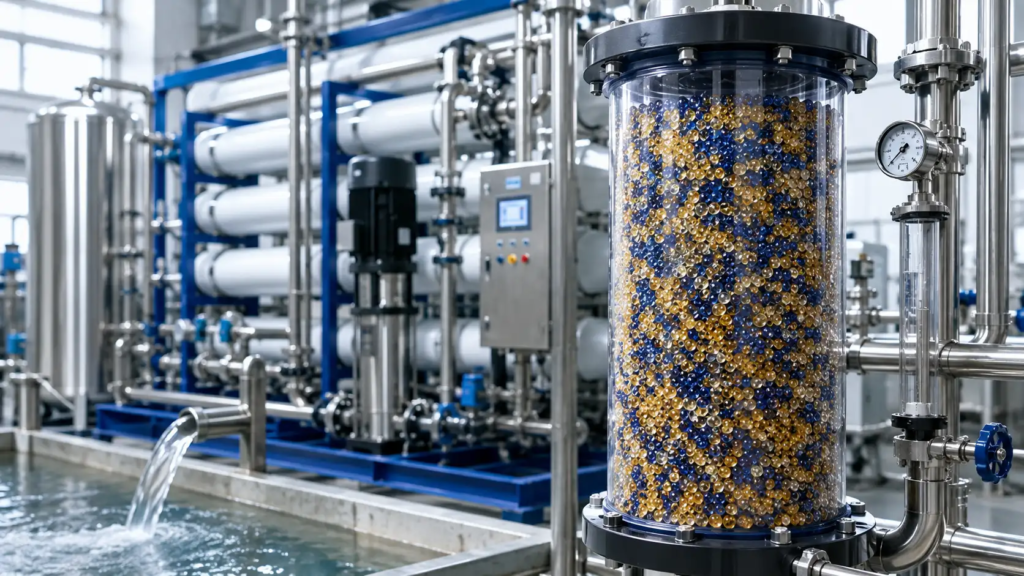
Mixed bed resin is essentially a blend of cation and anion exchange beads packed together into one single tank or cartridge. Combined, they remove both positively and negatively charged ions in a single pass, giving you high-purity, low-conductivity water as the result.
Wondering if mixed-bed resin is right for your system? This guide walks through how it works, where it gets used, and what you should check before buying.
How Mixed-Bean Resin Works
A standard mixed bed holds two resin types blended together inside one single vessel:
- Cation resin in a hydrogen (H⁺) form, which grabs onto positively charged ions like calcium, magnesium, sodium, and iron
- Anion resin in hydroxide (OH⁻) form, which grabs onto negatively charged ions like chloride, sulfate, and bicarbonate
As water flows through the resin, cations trade spots with hydrogen ions, and anions trade spots with hydroxide ions at the same time. Those hydrogen and hydroxide ions then pair up and form pure water (H₂O), leaving almost no dissolved ions behind.
Picture ion exchange resins as tiny magnets that latch onto contaminants and refuse to let go. Cationic resins snag the positively charged stuff. Anionic resins snag the negatively charged stuff.
This gives mixed bed resin an edge over a single resin type. It’s also why a mixed bed setup usually beats a two tank (dual bed) system for final polishing.
Mixed Bed vs. Dual Bed vs. Reverse Osmosis
These three approaches tackle overlapping but different problems, so let’s look at each one separately.
- A dual-bed system uses separate cation and anion tanks, making it a good choice for high water volumes. It also costs less and is easier to regenerate on-site than a mixed-bed system.
- Mixed bed puts both resins together inside a single vessel to reach maximum purity, and most of the time it works as a final polishing step rather than being the main treatment stage.
- Reverse osmosis (RO) removes most dissolved solids through a membrane, and mixed-bed resin then removes whatever ions remain, together producing near-zero conductivity water.
Common Ratios and Resin Types
Mixed-bed resin doesn’t come in one single fixed formula. The cation-to-anion ratio shifts depending on water chemistry and what the application calls for.
- Standard general-purpose blends: are commonly supplied around a 60:40 or 40:60 cation-to-anion equivalence, though ratios vary by manufacturer and water chemistry.
- Color-indicating resins: carry a dye that shifts color (often blue to gold or amber) as exchange capacity gets used up, giving a visual cue for when it’s time to replace them.
- Nuclear-grade and ultrapure resins: go through manufacturing and rinsing to tighter purity specs for semiconductor, pharmaceutical, and power industry use, where even trace organic or ionic contamination matters.
There’s no single “best” ratio out there; the right blend really comes down to your feed water’s ion load and the output purity you need.
Where Mixed Bed Resin Is Used
- Laboratory and analytical water systems
- Semiconductor and microelectronics manufacturing, where ultrapure water is essential
- Power generation, for boiler feedwater and condensate polishing
- Pharmaceutical manufacturing
- Spot-free rinse systems for window cleaning and vehicle detailing
- Aquarium and reef tank water preparation
Signs Your Resin Needs Attention
Keep an eye out for these indicators that mixed-bed resin is exhausted or contaminated:
- Rising conductivity or TDS readings in the output water
- Color-indicating beads shifting to their spent color
- A visible color band or layering forming inside a clear tank, which signals resin separation
- Reduced flow or increased pressure drop through the vessel
A lot of operations just toss out the spent resin and swap in new resin, while regeneration on an industrial scale usually gets handled by specialized facilities.
Common Mistakes to Avoid
- Improper storage: Resin needs to stay slightly moist, and letting it dry out or freeze can damage the beads and cut their service life short.
- Ignoring separation: Shipping vibration or poor installation can cause the resin beads to separate, and this reduces water quality until they’re remixed.
- Wrong ratio choice: Using a general-purpose blend where ultrapure specs are actually needed, or going the other way around, either wastes money or leaves quality falling short.
- Skipping checks: Skip regular conductivity monitoring, and resin can quietly wear itself out, letting ions slip through without anyone noticing.
How to Choose the Right Mixed Bed Resin
Before you buy, get clear on these points first:
- Required output purity: Are you after general deionized water, or do you need ultrapure grade for semiconductor or pharma work?
- Feed water chemistry: high hardness or a heavy anion load might call for a different ratio than the standard 50:50 or 60:40 blends.
- Volume and flow rate: this affects how you size the vessel and whether a dual-bed setup upstream might actually save you money.
- Regeneration vs. replacement: figure out if on-site regeneration is realistic for you, or if going with replaceable cartridges just makes more sense day to day.
- Indicator resin or not: a color-changing resin gives you an easy visual way to keep tabs on when it’s running low.
Matching these factors to a resin’s specification sheet is the most reliable way to avoid over- or under-buying capacity.
FAQs
Can mixed-bed resin be regenerated at home?
Does mixed-bed resin remove chlorine or bacteria?
Nope. Ion exchange resin only handles dissolved ions. Chlorine, organic compounds, and microorganisms are a different story entirely, and you’d need activated carbon or some other filtration stage to deal with those.
Is deionized water from mixed-bed resin safe to drink regularly?
How long does mixed-bed resin typically last?
Honestly, it depends more on your feed water quality and how much volume runs through it than on the calendar. That’s exactly why watching output conductivity tells you more than trying to stick to some fixed replacement date.
Can mixed-bed resin help with PFAS removal?
What’s the difference between a mixed bed and softening resin?
Softening resin just trades hardness cations, calcium and magnesium, for sodium and doesn’t touch anions at all. Mixed-bed resin goes further and pulls out both cations and anions, which is why you get deionized water out of it instead of just softened water.
Final Thoughts
If you’re specifying resin for a laboratory, industrial, or manufacturing system, reach out to a resin supplier. They can review your water analysis and flow requirements before you place an order.