Well Water Whole House Filtration: How to Pick the Right System From Your Test
The best well water whole house filtration system is the one your water test asks for. There’s no single winner. Most homes need a sediment filter first, then one stage for each problem the test finds, set up in the right order.
Why well water needs its own plan
City water gets cleaned and checked before it reaches you. Well water doesn’t. The EPA says over 43 million Americans use private wells, and federal drinking water rules don’t cover them.
A USGS study of about 2,100 private wells found that roughly 1 in 5 had at least one contaminant above a health limit. Most of it came from nature, like rocks and soil, not pollution. So you can’t judge well water by how it looks. A filter made for city water also often won’t fix a well’s real problems.
Step 1: Test your water first
Buying a system without a test is like buying glasses without an eye exam. Use a state certified lab. The EPA suggests testing every year for four things:
- Coliform bacteria, which show that surface water may be getting in
- Nitrate
- Total dissolved solids, which means everything dissolved in the water
- pH, which tells you how acidic the water is
For picking equipment, also ask for iron, manganese, and hardness. Add sulfur if you smell rotten eggs. Add tannins if your water looks like weak tea. Test for arsenic at least once, especially when you buy a home.
Not sure a home kit is enough? Our guide on choosing a water test kit for well water explains what kits can and can’t show you.
A few EPA reference numbers help you read your results. Iron above 0.3 mg/L usually means orange stains. Manganese above 0.05 mg/L usually means black or brown stains. A pH below 6.5 can eat away at pipes.
Nitrate above 10 mg/L (measured as nitrogen), arsenic above 0.010 mg/L, and any bacteria are health concerns. You can’t see, taste, or smell any of them. Only a test finds them.
Step 2: Match each problem to a fix
Sand and grit
A sediment filter catches sand and silt, a bit like a window screen catches bugs. It protects everything after it, so it goes first.
Iron and manganese
Sometimes water comes out clear and turns orange in the glass. Other times it looks rusty right away. Either way, the usual fix is an oxidizing filter. It turns dissolved metal into tiny bits, traps them, and then rinses itself clean.
A softener can take out a little dissolved iron, but too much iron clogs it. Our water softener repair guide shows what that looks like.
Rotten egg smell
Hydrogen sulfide gas causes that smell. An oxidizing filter usually removes it. If only your hot water smells, check your water heater first. The problem often starts there, not in the well.
Hard water
Hardness comes from calcium and magnesium. It’s the white crust on faucets and the spots on glasses. Filters don’t remove it. A softener does, using tiny resin beads that swap hardness for sodium or potassium.
Tea colored water
Tannins from rotting leaves and plants cause that color. A special resin grabs them, but iron ruins this resin, so remove iron first. Our guide to tannin removal from well water walks you through it.
Bacteria
A positive bacteria test means surface water is getting in. A broken well cap or a cracked casing are common causes. Fix the problem, disinfect the well, and test again.
For ongoing protection, add a UV light certified to NSF/ANSI 55 Class A. These units must deliver a strong dose (40 mJ/cm²) and include a sensor with an alarm. UV works a bit like sunlight on germs. Iron or cloudy water blocks the light, so UV always goes last.
Nitrate and arsenic
Carbon filters don’t remove nitrate. Options include special resin, reverse osmosis (a very fine membrane that water squeezes through), or distillation. Don’t boil water to get rid of nitrate, because boiling makes it stronger. Babies face the most risk.
Arsenic is often treated only at the kitchen tap with a reverse osmosis unit certified for arsenic. That’s the water you drink and cook with. Treating one tap usually costs less than treating the whole house.
Acidic water
Water with a pH below 6.5 can pull copper or lead out of your pipes. It may also leave blue green stains. An acid neutralizer fixes this. It adds a little hardness, so it goes before the softener.
Step 3: Put your well water whole house filtration stages in order
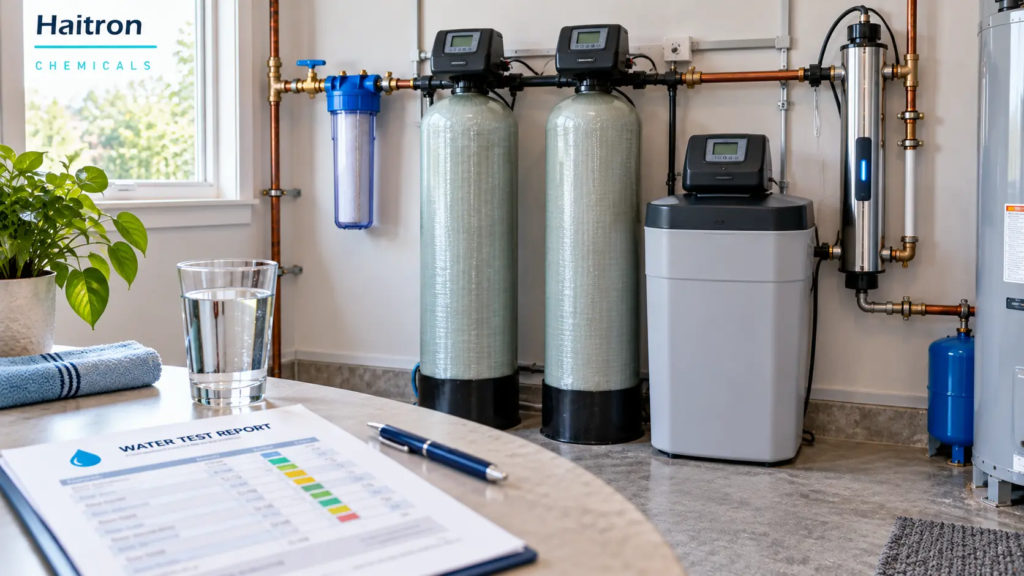
Each stage protects the next one. A typical order looks like this:
- Sediment filter
- Acid neutralizer, if pH is low
- Iron, manganese, or sulfur filter
- Water softener
- Tannin resin, if needed
- Carbon filter for taste and smell, if needed
- UV light
- Reverse osmosis at the kitchen sink, if nitrate or arsenic show up
Don’t worry, you won’t need all eight. Most wells need two to four.
Step 4: Size it to your well
Many guides size systems by how many bathrooms you have. With a well, your pump usually sets the limit. Ask your well driller for its flow rate in gallons per minute. You can also time how fast a bucket fills at an outdoor tap while the pump runs.
Next, check the backwash flow on each tank’s spec sheet. Backwash is how a tank rinses itself clean. If your pump can’t push enough water, the tank never gets fully clean and wears out early. This is one of the most common reasons well filters stop working.
Also add up the pressure each stage loses. Small drops add up fast.
What well water whole house filtration can’t do
It can’t fix a well that keeps letting bacteria in. That well needs repair. It won’t soften water unless a softener is part of the setup. Carbon and sediment filters won’t remove nitrate or reliably remove arsenic.
A softener also isn’t a lead treatment you can trust. Our article on whether a water softener removes lead explains why. And no system promises safe water unless you keep testing.
Check certifications and total cost
A certification means an outside group tested the product’s claims. Look for NSF/ANSI 42 for taste and smell, 53 for health contaminants, 44 for softeners, 55 for UV, and 58 for kitchen reverse osmosis. Only the contaminants listed on the certificate count.
Compare costs over 10 years, not just the price tag. Add installation, cartridges, media, salt, UV bulbs, backwash water, and yearly lab tests. Cartridge systems often cost less up front but more to run on water with lots of iron.
FAQs
Will a whole house filter lower my water pressure?
A little. Every stage causes a small drop. A system sized for your busiest water use keeps that drop small. Clogged cartridges cause most big drops.
Can I install it myself?
Simple cartridge filters are a common DIY job. Tanks, softeners, and UV lights need a drain, power, and correct settings. Some areas require a licensed plumber, so check your local rules.
Should I test again after installing?
Yes. Test right after installation to confirm it works. Then test every year, since well water can change with the seasons.
Can one filter fix every problem?
Rarely. Most wells have more than one issue, and each needs its own stage. That’s why testing and the right order matter more than any single product.
Does Haitron sell complete home filter systems?
No. Haitron makes ion exchange resin, the tiny beads used in softeners and tannin systems. If you have resin questions, you can send your water test to our technical team.
Your next step
Book a lab test, match each result to a fix above, and list the stages you need in order. Then ask installers for quotes that show backwash flow and running costs. That’s how well water whole house filtration turns from a guess into a clear, simple plan.