Water Treatment for Hospitals: Systems, Standards and Mistakes to Avoid
Water treatment for hospitals explained: how softening, carbon, RO, ion exchange and UV work together, which standards apply (AAMI ST108, ISO 23500, CMS) and the common mistakes to avoid.
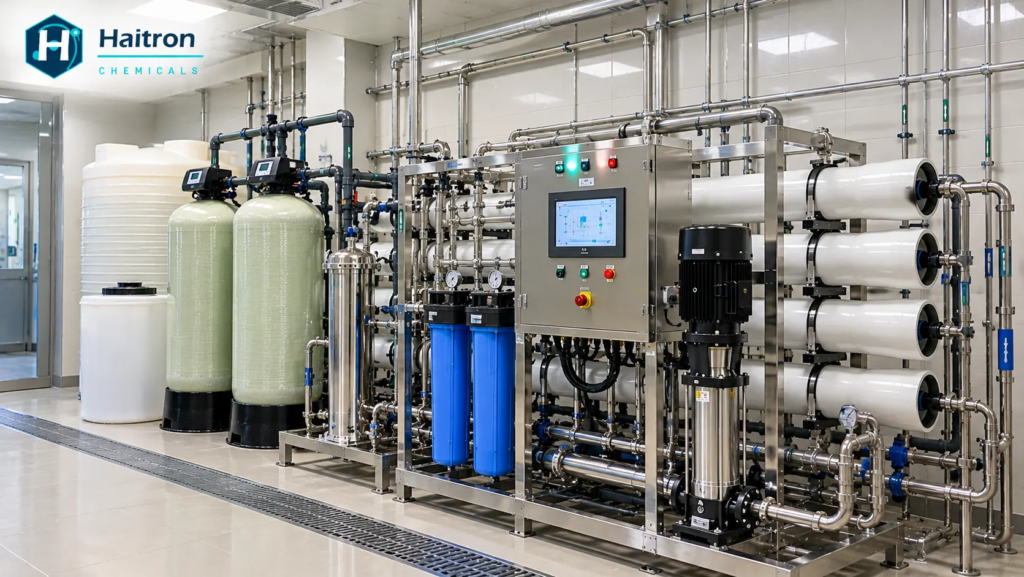
Water treatment for hospitals is the set of steps that makes incoming city water safe and fit for every clinical and building use. One system never fits all. Drinking taps, sterilizers, dialysis units and boilers each need different water. Most hospitals combine softening, carbon filtration, reverse osmosis, ion exchange and UV, then test the results on a schedule.
Think of a kitchen. You wouldn’t use one knife for bread and fish. Hospital water works the same way.
Why do hospitals need special water treatment?
Hospitals need special water treatment for three reasons. Patients are more vulnerable to waterborne germs. Equipment needs water purer than tap water. Some chemicals that are safe to drink can harm patients during treatment. Legionella grows in warm, still pipes, and minerals scale sterilizers and boilers. Good treatment controls all of these risks.
The US Centers for Medicare and Medicaid Services (CMS) made this a requirement in its 2017 survey memo QSO 17 30. The memo says hospitals must have water management policies that limit Legionella and other opportunistic germs. It also notes that 15 percent of US Legionnaires’ disease outbreaks between 2000 and 2014 were linked to hospitals.
What water quality does each hospital department need?
Each department needs water matched to its risk. General taps need safe, disinfected drinking water. Sterile processing needs utility water for cleaning and critical water for final rinses and steam. Dialysis needs highly purified water with almost no chemicals or endotoxins. Boilers and laundry mainly need soft water to stop scale.
| Area | What the water must do | Typical treatment | Key reference |
|---|---|---|---|
| Taps, showers, ice machines | Stay free of Legionella and other germs | Disinfection, point of use filters, temperature control | CMS memo (2017), ASHRAE Standard 188 (2018) |
| Sterile processing, cleaning | Clean without spots or scale | Softening, filtration | AAMI ST108 (2023), utility water |
| Sterile processing, final rinse and steam | Leave nothing on instruments | RO, deionization or distillation | AAMI ST108 (2023), critical water |
| Dialysis | Remove chlorine, chloramine, metals and endotoxins | Carbon, softener, RO, UV, ultrafilter | ISO 23500 series (2019) |
| Laboratories | Give consistent purity for tests | RO plus mixed bed polishing | CLSI GP40 (2012) |
| Boilers, cooling towers, laundry | Prevent scale and corrosion | Softening, dealkalizing, chemical dosing | Equipment maker specs |
How does water treatment for hospitals work, step by step?
Most hospital water treatment systems work as a chain. Water is filtered and softened, then carbon removes chlorine. Reverse osmosis takes out most dissolved salts and microbes. Ion exchange polishing and UV finish the job. The treated water then circulates in a closed loop to each point of use.
- Sediment filtration catches sand, rust and pipe debris.
- Softening comes next. A water softener for hospitals swaps calcium and magnesium for sodium using strong acid cation resin. This protects RO membranes, sterilizers and boilers from scale.
- Activated carbon removes chlorine and chloramine. This step matters most for dialysis.
- Reverse osmosis pushes water through a very tight membrane, like a super fine coffee filter. Most salts, bacteria and endotoxins stay behind.
- Polishing uses a mixed bed ion exchange resin or an EDI unit to remove the last traces of ions for critical and lab water.
- UV disinfection kills bacteria in the loop without adding chemicals. It doesn’t remove anything, so it works alongside filters, not instead of them.
- Distribution keeps the water moving. Dead legs, which are pipe sections where water sits still, breed biofilm.
Filtration, RO, ion exchange or UV: which does what?
No single technology does everything. Filters remove particles. Carbon removes chlorine. RO removes dissolved salts and microbes. Ion exchange removes specific ions. UV kills microbes. A medical grade water filter on its own won’t meet critical water or dialysis needs, so hospitals layer these steps together.
| Technology | Removes | Doesn’t remove | Best hospital use |
|---|---|---|---|
| Cartridge filter | Particles, rust | Dissolved salts, chemicals | Pretreatment, point of use |
| Activated carbon | Chlorine, chloramine, some organics | Salts, most microbes | Dialysis, RO protection |
| Softener (cation resin) | Calcium, magnesium | Most other ions, microbes | Boilers, sterilizers, laundry |
| Reverse osmosis | Most salts, bacteria, endotoxins | Some dissolved gases, very small molecules | Dialysis, critical water |
| Mixed bed resin or EDI | Trace ions | Microbes, particles | Lab water, critical water polishing |
| UV | Kills bacteria and viruses | Chemicals, particles | Loop disinfection |
What standards govern water treatment for hospitals?
Key references include the CMS memo QSO 17 30 (2017) for Legionella control and the Joint Commission water management standard, in effect since 2022. AAMI ST108 (2023) covers water for medical device processing. ISO 23500 (2019) covers dialysis water, and ASHRAE Standard 188 (2018) covers building water risk management.
ST108 changed the game. Its older guidance, AAMI TIR34, was advisory. ST108 sets binding requirements, including monthly testing of critical water for bacteria and endotoxins. Water treatment for hospitals is now a documented, audited process, not a one time install.
Real example: when a Legionella fix harms dialysis patients
In a 2009 paper in Critical Care, Nicholas Hoenich described a hidden risk. Hospitals sometimes add disinfectants such as hydrogen peroxide to fight Legionella. RO doesn’t remove very small molecules like this, so without enough carbon, residues can reach dialysis patients.
Ronco, Levin and Hoenich raised the same concern in Blood Purification (2010) about silver stabilized hydrogen peroxide and chlorine dioxide. The lesson is simple. Facilities and renal teams must talk before anyone changes a chemical.
Common mistakes in water treatment for hospitals
Most failures in water treatment for hospitals come from planning, not equipment.
- Treating the whole building as one system.
- Buying a hospital grade water filter and assuming it covers dialysis or sterile processing.
- Skipping carbon checks, which lets chloramine slip through.
- Running softener or polishing resin past exhaustion. Spent resin leaks hardness and ions back into the water.
- Leaving dead legs and unused outlets in quiet wards.
- Changing disinfectant chemistry without telling dialysis staff.
What are the limits of water treatment for hospitals?
Even good water treatment for hospitals has limits. UV gives no lasting protection further down the pipe. RO sends part of the feed water to drain. Resin needs regeneration or replacement, and membranes foul over time. No equipment works without a written water management plan, a trained team and regular lab testing.
Tips for choosing a healthcare water purification system
- Test your incoming water first. Hardness, chloramine and silica change the design.
- Map every use to the quality it needs before you buy anything.
- Build in redundancy, such as twin softeners or two RO units, so maintenance never stops surgery.
- Ask suppliers for validation support and test data, not just equipment.
- When comparing companies supplying high purity water systems for hospitals, check consumable quality too. Demineralization stages rely on strong base anion resin to remove silica and carbonate.
- Apply the same thinking to a water treatment system for surgery centers, just at a smaller scale.
Conclusion
Hospital water isn’t one problem. It’s several smaller ones, each tied to a different department and standard. Map the needs first, then build the treatment chain, then test it on a schedule.
The best water treatment for hospitals pairs the right technology with the right consumables and a clear plan. If you’re upgrading softeners, demineralizers or polishing units, request a quote and our team will match resin to your water and system.
FAQs
How often should hospital water be tested?
Under AAMI ST108 (2023), critical water is tested monthly for bacteria, endotoxins and chemistry. Utility water is tested quarterly. Legionella sampling follows your water management plan.
Are point of use filters enough for high risk wards?
They’re a useful extra barrier in units like ICU or transplant wards. They don’t replace building wide water management, and they need changing on the maker’s schedule.
Can tap water be used for dialysis?
No. Drinking water still holds chlorine, chloramine and metals that can harm dialysis patients. It needs carbon, RO and further treatment to meet ISO 23500.
Does every hospital need a water softener?
Most do where the supply is hard. Softening protects boilers, sterilizers, laundry machines and RO membranes from scale.
What does Haitron supply for hospital water systems?
Haitron makes ion exchange resins, including strong acid cation, strong base anion and mixed bed resins, used in softening and high purity water systems. Our team can match resin to your existing equipment.