Water Treatment Chemicals: Types, Uses and How to Choose Them (2026 Guide)
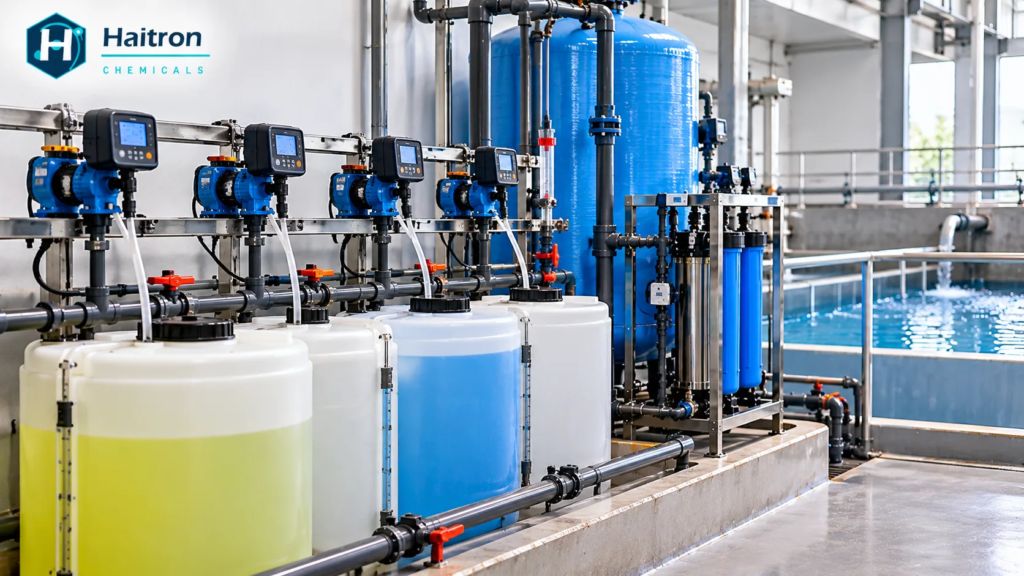
Water treatment chemicals are substances added to water to remove dirt, kill germs, balance pH and protect pipes and equipment. The main groups are coagulants, flocculants, disinfectants, pH adjusters, scale and corrosion inhibitors, biocides and resin regenerants. Most plants use several together, and each one has a single clear job.
The logic is the same for municipal water treatment systems, a boiler house or a food factory. You clean the water, make it safe, then keep it stable on its way to the tap or the process line.
What Are Water Treatment Chemicals?
Water treatment chemicals are products dosed into raw water, processed water or wastewater to change its quality. They clump fine particles so they settle, kill bacteria and viruses, correct acidity, and stop scale and rust. They’re grouped by what they do, not by their chemistry, so one plant may use five or more.
Think of them as a team. One player gathers the mess. Another kills the germs. A third guards the pipes. If one player is missing, the others can’t cover for it.
How Does Water Treatment Work, Step by Step?
Most drinking water treatment follows one order: coagulation, flocculation, sedimentation, filtration, disinfection and final conditioning. Chemicals drive the first two steps and the last two. Filtration in the middle is mostly physical. Industrial plants often add softening or ion exchange after filtration when they need higher purity water.
Here’s the water purification process in plain words:
- Coagulation. A coagulant like alum cancels the electric charge on tiny particles, so they stop pushing each other away.
- Flocculation. Slow mixing and a polymer gather those particles into bigger clumps called floc. It’s like rolling loose snow into a snowball.
- Sedimentation. The heavy flock sinks to the bottom of a tank.
- Filtration. Sand, carbon or membranes catch what’s left. This is the water filtration process most people picture.
- Disinfection. Chlorine, chloramine, ozone or UV light kills microbes.
- Conditioning. pH is adjusted and corrosion inhibitors are added so the water doesn’t eat the pipes.
Wastewater treatment uses many of the same chemicals. It adds biological steps and sludge handling on top.
What Types of Chemicals Does a Water Treatment Plant Use?
A typical water treatment plant uses six core groups: coagulants, flocculants, disinfectants, pH adjusters, corrosion and scale inhibitors, and biocides. Plants with ion exchange units also use regeneration chemicals such as salt, acid and caustic soda. The right mix depends on your source water and the quality you need at the end.
| Category | Common examples | Main job | Typical use |
|---|---|---|---|
| Coagulants | Alum, ferric chloride, polyaluminum chloride (PAC) | Destabilize fine particles and color | Municipal and wastewater plants |
| Flocculants | Polyacrylamide polymers | Build large, fast settling floc | Clarifiers, sludge dewatering |
| Disinfectants | Chlorine, sodium hypochlorite, chloramine, chlorine dioxide, ozone | Kill bacteria, viruses and parasites | Potable water treatment |
| pH adjusters | Lime, caustic soda, soda ash, sulfuric acid | Control acidity so other chemicals work | Nearly every plant |
| Corrosion inhibitors | Orthophosphates, silicates | Form a protective film on metal | Distribution pipes, boilers |
| Scale inhibitors | Antiscalants, phosphonates | Keep calcium and silica dissolved | RO membranes, cooling towers, boilers |
| Biocides | Oxidizing and nonoxidizing biocides | Control algae, slime and Legionella | Cooling towers |
| Regenerants | Salt, hydrochloric acid, caustic soda | Recharge ion exchange resin | Softeners, demineralizers |
One fact ties this table together. Coagulation depends heavily on dose and pH. That’s why pH adjusters and coagulants are almost always dosed as a pair.
Which Chemicals Are Used in Each Industry?
Each sector leans on a different part of the toolkit. Municipal plants focus on clarity and disinfection. Boilers and cooling towers focus on scale, corrosion and biology. Food plants need consistent, clean water that won’t change product taste. Matching chemicals to the application matters more than picking the strongest product.
| Application | Main concern | Chemicals and technologies used most |
|---|---|---|
| Municipal drinking water | Turbidity, germs, pipe corrosion | Coagulants, chlorine or chloramine, pH adjusters, orthophosphates |
| Boilers | Scale and corrosion at high heat | Softening resin, oxygen scavengers, pH control, demineralization |
| Cooling towers | Scale, slime, Legionella | Antiscalants, biocides, corrosion inhibitors |
| Food and beverage | Taste, hardness, purity | Softening, carbon filtration, food grade resins |
| Industrial wastewater | Solids, metals, discharge limits | Coagulants, flocculants, pH adjusters, chelating resin |
Which Chemicals Make Drinking Water Safe?
Chlorine is the most common disinfectant in drinking water treatment. It’s affordable, it works fast, and it leaves a residual that keeps protecting water as it travels through pipes. Many utilities use chloramine, a mix of chlorine and ammonia, for the distribution network because it lasts longer and forms fewer regulated byproducts.
A few key facts:
- Disinfection needs both enough chlorine and enough time. A common target is at least 0.5 mg/L of free chlorine after 30 minutes of contact.
- Chlorine can react with natural organic matter and form disinfection byproducts. That’s why modern plants settle and filter water before the main disinfection step.
- Chemicals used in potable water treatment usually need a health effects certification before a utility will buy them.
Where Do Ion Exchange Resins Fit In?
Ion exchange is a water purification technology that removes dissolved ions, such as calcium, magnesium, nitrate or metals, by swapping them for harmless ions held on resin beads. Coagulants can’t remove dissolved salts. So plants add ion exchange after filtration when they need soft, demineralized or ultrapure water.
A home water softener is the simplest example. Hard water flows through beads loaded with sodium. The beads grab calcium and release sodium. When they’re full, a salty brine rinse recharges them.
Industry uses the same idea at a larger scale. A strong acid cation resin handles softening and boiler feedwater. A mixed bed resin polishes water in a single pass for electronics and power plants. Water treatment for food industry processes often relies on food grade and adsorption resins for decolorization and deashing. You can compare all our ion exchange resins by family to match your feed water.
The upside is simple. Chemicals are used only during regeneration, not dosed nonstop. The catch is that chlorine, iron and organics can foul or damage resin, so good pretreatment matters.
How Do You Choose the Right Water Treatment Chemicals?
Start with a full raw water analysis, then match each chemical to one clear goal. Run a jar test to find the lowest dose that works. Check certification, equipment compatibility, sludge volume and safe storage. The cheapest drum is rarely the cheapest program once you count sludge, downtime and repairs.
Practical tips:
- Test raw water every season. Turbidity can jump after heavy rain.
- Jar test before switching coagulants. A beaker test costs far less than a failed clarifier.
- Match the polymer’s charge to your particles.
- Log doses and results so problems show up early.
- Ask water treatment services providers for data sheets and certificates, not just prices.
What Common Mistakes Should You Avoid?
The most common mistakes are overdosing, ignoring pH, chlorinating water still rich in organics, and storing incompatible chemicals together. Each one raises cost or risk. Most are easy to prevent with jar tests, routine monitoring and clear storage rules at every water treatment facility.
- Overdosing coagulant. Too much can push particles apart again and create extra sludge.
- Chlorinating before removing organics. This raises byproduct levels.
- Storing acids next to hypochlorite. Mixing them releases toxic chlorine gas.
- Sending chlorinated water straight onto resin or RO membranes without dechlorination.
- Buying uncertified water treatment products for drinking water use.
What Are the Limits of Water Treatment Chemicals?
Water treatment chemicals can’t fix everything. They don’t remove most dissolved salts, they create sludge that needs disposal, and some form byproducts. Storage and handling carry real safety risks. For high purity water or reuse, chemical dosing usually works alongside membranes, UV or ion exchange rather than replacing them.
Conclusion
Good water treatment solutions start with a clear goal, a real water test and the smallest set of chemicals that gets the job done. Coagulants and flocculants clean. Disinfectants protect. Conditioners stabilize. Ion exchange handles the dissolved ions that chemicals leave behind.
Your next step is simple: test your feed water, list what you need to remove, then choose water treatment chemicals and resins that match that list, not a generic catalog.
FAQs
Are water treatment chemicals safe in drinking water?
Yes, when certified products are dosed within approved limits. Residual chlorine may leave a slight taste, but it keeps water protected in the pipes.
What’s the difference between a coagulant and a flocculant?
A coagulant neutralizes particle charges. A flocculant then binds those particles into larger clumps that settle faster.
Is PAC better than alum?
Often, PAC works across a wider pH range and produces less sludge. A jar test on your own water is the only reliable way to decide.
Can water be treated without chemicals?
Partly. UV and membranes cut chemical use, but most public systems still keep a chlorine or chloramine residual to protect water in the network.
Does Haitron supply resins for water treatment?
Yes. Haitron manufactures strong and weak acid cation, strong and weak base anion, chelating, mixed bed and food grade resins, and you can request a quote through our contact page.