What Is Chloramine in Water? Safety, Testing and Removal Made Simple
What is chloramine in water? It’s a disinfectant your water company makes by adding a small amount of ammonia to chlorine. It kills germs and lasts longer in pipes than chlorine alone. At the levels allowed in US tap water, it’s safe to drink, cook with, and bathe in.
More than one in five Americans already drink chloramine treated water, says the US EPA. Most people never need to act, but a few groups and some home water systems do.
What is chloramine in water, in simple terms?
Think of chlorine as a sprinter. It kills germs fast, but it gets tired over miles of pipe. Chloramine is more like a long distance runner. It works more slowly, but it keeps going all the way to your tap.
The type used in drinking water is monochloramine (NH₂Cl). Two other types can form when the chemistry goes wrong.
| Type | Formula | What it means for you |
| Monochloramine | NH₂Cl | The disinfectant utilities want. Mild taste and smell. |
| Dichloramine | NHCl₂ | Unwanted. Forms when pH is low or there’s too much chlorine. Stronger smell. |
| Nitrogen trichloride | NCl₃ | Unwanted. Strong taste and smell, even at tiny amounts. |
Why do water companies use chloramine?
- It lasts longer, so it protects water in long pipe networks and storage tanks.
- It forms fewer trihalomethanes (THMs). These are chemical byproducts that form when chlorine reacts with natural matter in water, like old leaves.
- Most people find its taste and smell milder than chlorine.
It isn’t new. Denver has used it since about 1917, and the CDC dates wider US use to 1929.
Chloramine vs chlorine: the key differences
| Question | Chlorine | Chloramine |
| Made from | Chlorine alone | Chlorine plus ammonia |
| How fast it kills germs | Fast | Slower |
| How long it lasts in pipes | Shorter | Much longer |
| Taste and smell | Noticeable “pool” smell | Milder |
| Fades if water sits out? | Yes, fairly quickly | No, it can take weeks |
| Removed by boiling? | Partly | No |
| Removed by ordinary carbon? | Yes, quickly | Slowly, needs long contact or catalytic carbon |
| US safety limit | 4 mg/L | 4 mg/L |
Most water systems run around 1 to 2 mg/L, which is well under the limit. (mg/L means milligrams per liter. One gram stirred into a 1,000 liter tank is 1 mg/L.)
Is chloramine in tap water safe?
People who ask what chloramine is in water usually want to know one thing next: is it safe? For drinking, cooking, and bathing, yes. The CDC says chlorine or chloramine up to 4 mg/L is unlikely to cause harm.
There is one fair trade off. Chloramine can form other byproducts called nitrosamines, which the Water Quality Association lists as suspected carcinogens. Scientists are still studying them, but it’s not a reason to panic.
Who needs to remove chloramine?
| Who or what | Why | What to do |
| Home dialysis patients | Chloramine in the blood can damage red blood cells. | Follow your doctor’s or machine maker’s water instructions. |
| Fish, turtles, and frogs | It goes straight into their blood through gills or skin. | Use a water conditioner labeled for chloramine. |
| Rubber parts at home | It wears out natural rubber, like toilet flappers, faster than chlorine. | Swap in chloramine resistant parts when they fail. |
| Water softeners | It slowly damages softener resin. | See the softener section below. |
How to tell if your water has chloramine
The easiest way is to ask your water company. Check its yearly water quality report or just call.
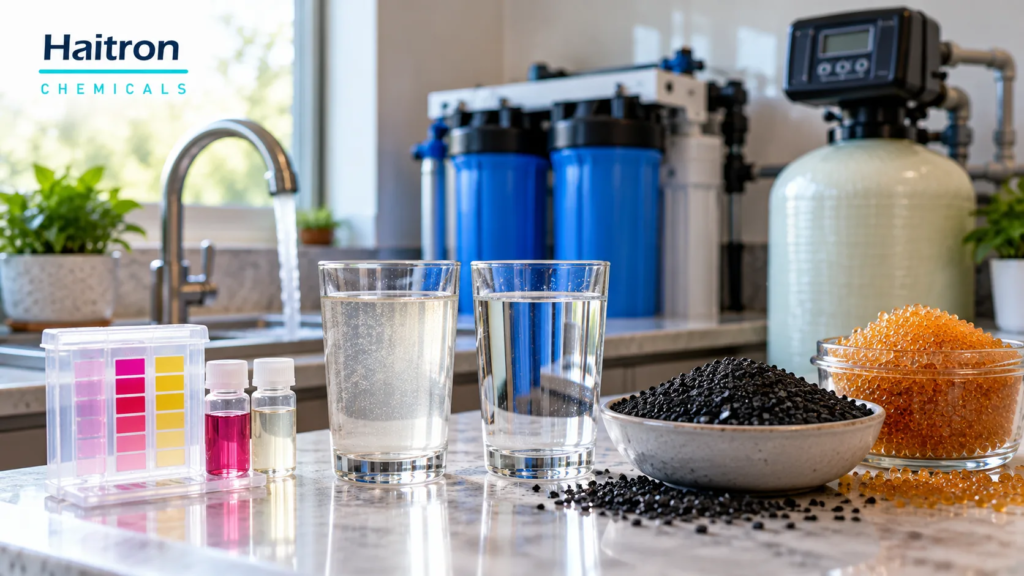
You can also test it yourself. Buy pool or aquarium test strips that show both free chlorine and total chlorine. Chloramine shows up in total chlorine, but barely in free chlorine.
For example, say your strip reads 0.2 mg/L free chlorine and 1.8 mg/L total chlorine. Most of your chlorine is “combined,” so your water likely has chloramine. Strips read in rough steps, so treat this as a quick check, not a lab result.
How to remove chloramine from water
| Method | Does it work? | Notes |
| Boiling | No | Chloramine doesn’t boil off like chlorine. |
| Letting water sit out | No | It can take weeks to fade. |
| Water softener | No | Softeners remove hardness, not disinfectants. |
| Regular carbon pitcher or tap filter | Partly | Carbon needs about 10 minutes of contact. Fast pitchers may not remove much. |
| Catalytic carbon filter | Yes | The best everyday choice for the whole house or under sink use. |
| Reverse osmosis (RO) system | Yes, through its carbon | The carbon prefilter does the work, not the membrane. |
| Vitamin C | Yes | Good for bath water, small batches, and shower filters. |
| Aquarium conditioner | Yes | Pick one labeled for chloramine, since it also handles leftover ammonia. |
When you shop, look for a chloramine reduction claim certified to NSF/ANSI standards. A filter that only says “chlorine taste and odor” may not be enough, and a basic fish dechlorinator isn’t either. If you’re not sure which system you need, our guide on water softener vs water filter explains what each one fixes.
Chloramine and your water softener
A water softener won’t remove chloramine, but chloramine does affect your softener. As a resin maker, we hear this question a lot.
Softener resin is made of tiny plastic beads. Think of each bead as a ball of netting held together by knots called crosslinks. Chlorine and chloramine slowly cut those knots. Over time, the beads swell, soak up water, and turn soft and mushy.
Soft beads pack together, which slows water flow and lets more hardness slip through. Two steps help protect your softener:
-
Put a carbon filter first. A catalytic carbon tank before the softener removes chloramine before it reaches the resin.
-
Choose resin with more crosslinks. More crosslinking usually means better resistance to damage. Our strong acid cation resin comes in two grades: 001×7 (7% DVB) and 001×8 (8% DVB). The 8% grade gives up a little capacity for a tougher bead.