Water Softener for RV: How It Works, What Size You Need and How to Use It
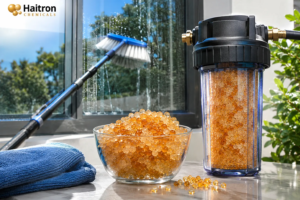
A water softener for RV use is a small portable tank of resin beads that sits between the campground spigot and your rig. As water flows through, the beads swap calcium and magnesium for sodium, so scale stops building up in your water heater and faucets. Most units need no power and recharge with plain table salt.
Water hardness changes from park to park. The right size depends on where you camp and how much water you use. Here’s how to choose, set up and recharge one, and the mistakes that cost people their soft water.
How does an RV water softener work?
It uses ion exchange. Picture the resin beads as tiny parking spots holding sodium. Hardness minerals grab those spots more strongly, so they push the sodium out and take its place. When every spot is full of hardness, a rinse with salty water flips them back and reloads the sodium.
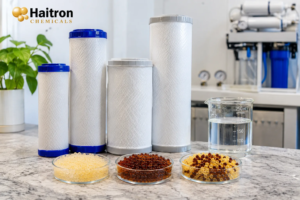
Most portable units have ¾ inch garden hose fittings and run on water pressure alone. Inside is the same kind of softening resin used in home systems, usually a strong acid cation resin.
Do you need a water softener for RV living?
Not always. If your water tests soft, skip it. It’s worth having if you camp at hard water parks, travel full time, or keep seeing white crust on fixtures, spotty dishes and soap that won’t lather. Test before you buy, because many kits include hardness test strips.
Camping World (2023) advises picking a unit that works with a pressure regulator and causes only a small pressure drop. Morton’s on the Move makes the honest point that you don’t strictly need one, but you may like it a lot if your favorite campground has hard water.
What size RV water softener do you need?
Divide the softener’s grain capacity by your water hardness in grains per gallon (gpg). The answer is roughly how many gallons you’ll get before recharging. Treat that number as a ceiling, not a promise. For example, 16,000 grains of 15 gpg water gives about 1,070 gallons at most.
Grains per gallon is just a hardness unit, like miles versus kilometers. Test strips often show ppm instead. One gpg equals about 17.1 ppm.
| Water hardness | 8,000 grain | 10,000 grain | 16,000 grain |
|---|---|---|---|
| 5 gpg (about 86 ppm) | 1,600 gal | 2,000 gal | 3,200 gal |
| 10 gpg (about 171 ppm) | 800 gal | 1,000 gal | 1,600 gal |
| 15 gpg (about 257 ppm) | 530 gal | 670 gal | 1,070 gal |
| 25 gpg (about 428 ppm) | 320 gal | 400 gal | 640 gal |
Maximum gallons between recharges (grain capacity ÷ hardness)
Real capacity depends on how much salt you use. WECO rates its 10 by 18 inch tank at 9,300 to 18,600 grains. That’s roughly 600 to 1,200 gallons at 15 gpg, using 2.5 to 9.3 lbs of salt per regeneration.
Real owners see the same spread. On Thor Forums, one RVer said a small On The Go unit needs recharging every 7 to 10 days, while a larger TravelSoft lasts 4 to 6 weeks, depending on the source water.
Check flow too. RecPro rates its 8,000 grain model at 2 gallons per minute and its 16,000 grain model at 3. Bigger tanks usually mean better shower pressure.
How do you set up a water softener for RV hookups?
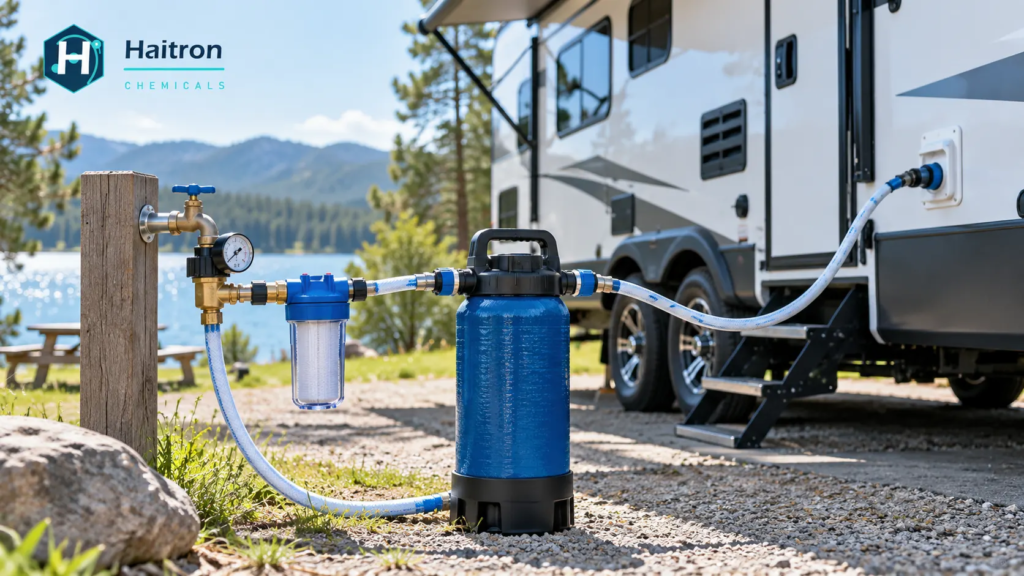
Place it upright near the spigot. Flush a new unit first until the water runs clear. Then connect: spigot, pressure regulator, softener IN port, softener OUT port, RV. Use drinking water safe hose for every link. Many owners also run a sediment filter before the softener to keep grit off the resin.
The Pro+Aqua manual says to flush for about 5 minutes on first use. One Thor Forums owner lays the short hose in a wide curve instead of coiling it, to cut pressure loss.
That same owner warns that one of their appliance manuals advised against softened water. Check yours, especially for ice makers and dishwashers.
How do you recharge an RV water softener?
Disconnect it, open the cap, and pour in table salt. Reconnect and run a slow trickle so brine soaks the resin. Then rinse until the water no longer tastes salty. Most portable units take about 30 minutes. Always use the salt amount your manufacturer lists, since it varies by tank size.
For example, the Pro+Aqua manual calls for 4 lbs of table salt in its 16,000 grain unit. That manual also warns not to drain the salty rinse water onto grass.
Regenerate before you store the unit, empty some water out, and keep it somewhere cool and shaded. In freezing weather, drain it fully.
Common mistakes with a water softener for RV trips
- Believing the gallon claim on the box. A seller’s “2,000 gallons” from 16,000 grains only works on water softer than 8 gpg.
- Skipping the first flush, which sends resin fines into your lines.
- Dumping brine on lawns or landscaping.
- Testing only at the spigot. Test at an inside faucet after recharging, as RV owners on the Jayco forum do.
- Storing it full of hardness, so it’s spent before your next trip.
Tips and honest limitations
Carry test strips and a spare box or two of salt. A Good Sam forum member tracks gallons with an inline flow meter, so he knows when capacity runs low. Some full timers own two softeners and swap them during recharge.
Know the limits, too:
- A softener removes hardness. It doesn’t remove bacteria, chlorine taste or sediment.
- Salt free “conditioners” don’t remove hardness minerals at all.
- Softened water carries a little added sodium.
- Resin life claims vary by seller. Blu Tech says 7 to 9 years, while one review site says about five.
Curious what goes inside? Browse our ion exchange resin products.
Conclusion
A water softener for RV travel is worth it when you camp on hard water. Test your water, size the unit with the simple grains math, and recharge before soft water runs out. Your next step: test the water at your next park, then read more water treatment guides before you buy.
FAQs
Does an RV water softener lower water pressure?
Slightly. Pick a unit with a flow rating that matches your shower and sinks, and keep hoses short.
Can I use it at home or for washing my rig?
Yes, many sellers market them for car and boat washing. RecPro notes home pressure runs higher than an RV’s typical 45 to 50 PSI, so add a regulator.
Can I replace the resin instead of buying a new unit?
Often, yes. Several makers, including RecPro, sell resin refill kits.
Does it work on campground well water?
Yes for hardness. WECO says its units remove only low levels of iron, so pretreat heavy iron or sediment.
Does Haitron make resin for RV softeners?
Haitron manufactures strong acid cation softening resin. For bulk or OEM supply, ask our resin specialists.