Water Softener for Ice Maker: Do You Need One, or a Filter?
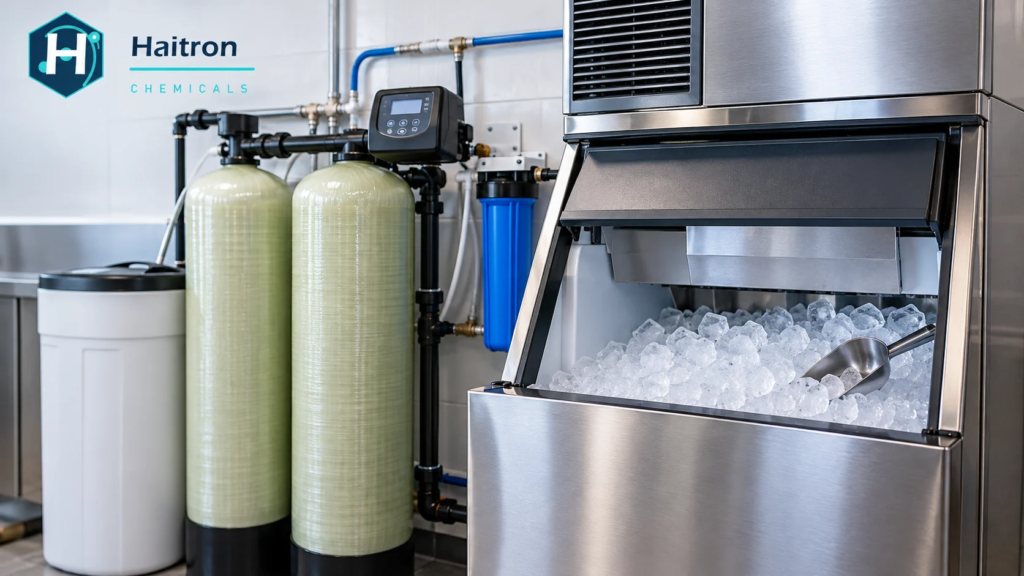
A water softener for ice maker protection stops calcium scale, but it isn’t the full answer. Scotsman, a major ice machine maker, doesn’t recommend a softener as the only water treatment for its machines. For most ice makers, the best fix is a dedicated ice machine water filter with a scale inhibitor and carbon. A softener earns a place only alongside it.
Here’s how hard water hurts ice makers, what each option does, and how to choose.
How does hard water damage an ice maker?
Hard water carries calcium and magnesium. As water freezes and drains, these minerals leave scale on the evaporator, floats, switches and water lines. Scale slows ice making, causes cloudy or clumped cubes, and leads to costly repairs. The evaporator is the cold metal plate where ice forms, like the bottom of a freezer tray.
Netsol Water notes that scale sticks to floats, switches and evaporator plates, and recommends treating water when you install the machine. CW Services, a Texas appliance repair firm, links hard water in ice makers to mineral film on cubes, clogged lines and ice that sticks together.
Should you use a water softener for ice maker water?
Not by itself. A softener swaps calcium and magnesium for sodium, so total minerals stay about the same. It doesn’t remove sediment, chlorine or taste. And if it ever fails and sends brine through, the salt can badly damage the machine’s metal parts. That’s why makers prefer filtration first.
Scotsman’s Product Application Bulletin 2007-01 explains this clearly. Softening changes the minerals rather than removing them. Water left in a cubeless sump at the end of the freeze cycle still holds concentrated minerals either way. The sump is the small reservoir that recirculates water over the evaporator.
Scotsman also admits softened water can make cleaning easier in some cases. Some softener sellers do recommend it. Even so, the machine maker’s advice should win, since it also sets the warranty terms.
Water softener vs water filter for ice maker: which is better?
For most ice machines, a filter is better. A good ice machine filter combines fine sediment filtration, carbon for chlorine and taste, and a polyphosphate scale inhibitor. A softener only handles hardness. Use a softener as an extra step on very hard water, not as a replacement.
| Option | What it does | Stop scale? | Improves taste and odor? | Removes sediment? | Watch out for |
|---|---|---|---|---|---|
| Water softener | Ion exchange swaps calcium and magnesium for sodium | Yes | No | No | Brine failure risk, added sodium, salt refills |
| Scale inhibitor (polyphosphate) | Keeps minerals from sticking | Reduces it | No | No | Doesn’t remove hardness |
| Carbon block filter | Traps chlorine and fine particles | No | Yes | Yes | Cartridge changes |
| Combined ice machine cartridge | Carbon plus fine filter plus scale inhibitor | Reduces it | Yes | Yes | Flow and size limits |
Think of polyphosphate like a nonstick coating. The minerals stay in the water but can’t easily grip metal surfaces.
How do ice machine water filtration systems work?
Most ice machine water filtration systems use one cartridge with three layers of protection. A tight carbon block traps dirt and cuts chlorine. Silver in the carbon resists slime growth. A slowly dissolving polyphosphate inhibits scale. You swap the cartridge on a schedule, usually about every six months.
A real example is the Manitowoc Arctic Pure Plus filter, which uses all three layers. Its larger single model is rated for 15,000 gallons and machines making up to 600 pounds of ice a day. It flows up to 0.75 gallons per minute and works between 35 and 125 PSI. Manitowoc advises flushing a new cartridge for ten minutes and having your water tested by a professional.
When does a commercial ice maker water softener make sense?
It makes sense when your water is very hard and the building already needs softening, such as a restaurant or hotel kitchen. Feed the ice machine through its own filter after the softener. Keep the softener well maintained so brine never reaches the machine. Always check the ice machine maker’s guidance first.
A water softener for commercial ice machines uses the same process as a home unit. Cation resin for water softening holds sodium and trades it for hardness. During water softener resin regeneration, brine flushes the hardness away and reloads the beads. If that cycle fails or the valve sticks, salty water can slip downstream. That’s the brine risk Scotsman warns about.
Kitchens planning a full system can see how treatment fits together in food and beverage water treatment.
How to prevent calcium buildup in ice makers
- Test your ice maker water hardness before choosing any treatment.
- Install an ice maker water filter with a scale inhibitor, sized to your machine’s daily output.
- Change cartridges on schedule, or sooner if water pressure drops.
- Clean and descale the machine as the manual directs.
- Protect filters from freezing, since cracked housings leak.
- Add a softener only on very hard water, and only as an extra step.
Common mistakes to avoid
- Running a water softener for ice maker lines with no filter after it.
- Assuming a filter removes hardness. Most only slow scale.
- Picking a cartridge too small for your daily ice output.
- Ignoring your refrigerator or ice machine manual. Some owners report their fridge manual warns against softened water.
- Skipping softener maintenance, which raises the brine risk.
Honest limitations
No filter or softener replaces regular cleaning. Polyphosphate slows scale but doesn’t stop it completely on very hard water. Softened water adds sodium, and more hardness removed means more sodium added.
Ice machine water quality also depends on sanitation, so mold and slime still need routine cleaning.
Conclusion
A water softener for ice maker scale can help, but it works best as a partner, not a solo act. Start with a proper ice machine filter, test your hardness, and follow your machine maker’s advice. Your next step: test your water this week, then match the treatment to the results.
FAQs
Does softened water make clearer ice?
Not necessarily. Scotsman explains that commercial cubers make clear ice because minerals stay behind in the sump water. Softening doesn’t change that.
How often should I change an ice machine water filter?
Manitowoc suggests about every six months, or sooner if water pressure drops.
Can I use one filter for two ice machines?
Only if its rated capacity and flow cover both machines’ combined daily output.
Is reverse osmosis better than a softener for ice?
It removes more minerals, but it can affect pressure and some machines need it set up a certain way. Ask your ice machine maker first.
Does Haitron make resin for ice machine softeners?
Haitron manufactures softening resin among its ion exchange resin products. For a matched recommendation, talk to our technical team.