Water Softener Control Valve: How It Works, Types and How to Choose One
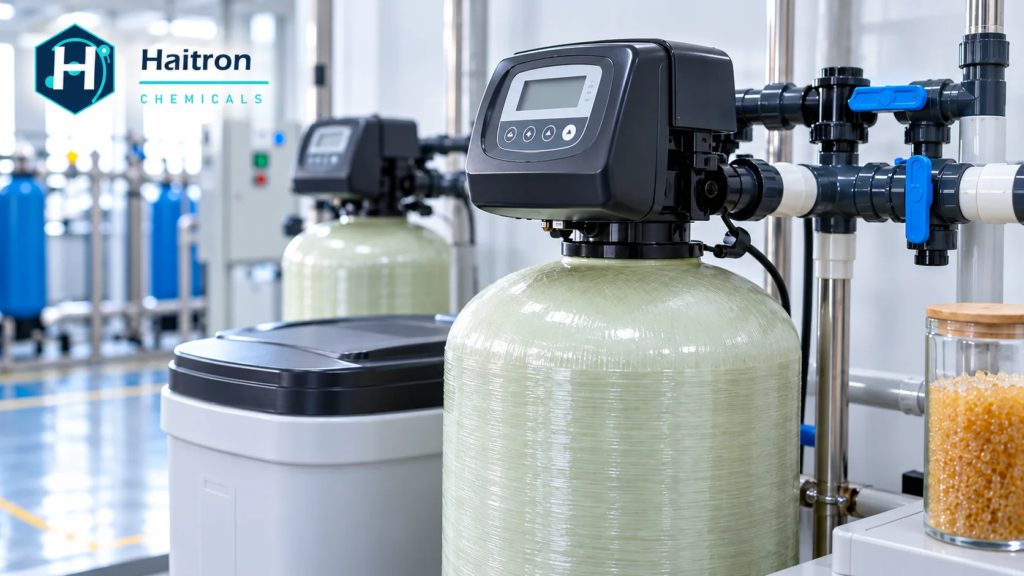
A water softener control valve is the head on top of the resin tank that decides where your water goes and when the softener cleans itself. In normal use, it sends hard water through the resin to your taps. When the resin fills up with hardness, it runs a cleaning program called regeneration, then switches back.
Get the valve right and your softener just works. Get it wrong and you’ll see hard water, wasted salt or a busy drain. This guide covers how it works, the main types, sizing, warning signs and the mistakes people make most.
What does a water softener control valve do?
It does two jobs. During service, it routes water down through resin beads that swap calcium and magnesium for sodium. During regeneration, it steps through a fixed program that flushes and recharges the resin, then returns to service. Think of it as the program dial on a washing machine, but for your softener.
Manufacturers describe it as the main control center that directs and regulates every cycle of a softener. Most valves also work with a bypass valve, which lets water skip the softener while you service it.
How does the regeneration cycle work?
Most softeners run five steps in order. The valve moves to each one by itself and controls the flow rate at every step. Here’s what happens:
- Backwash: Water flows up through the tank, loosening the bed and carrying dirt and broken beads to the drain.
- Brine draw: A salt solution of about 8 to 12 percent flows through the resin and strips off the hardness.
- Slow rinse: Fresh water pushes the brine through slowly to finish the exchange.
- Fast rinse: A quick rinse clears leftover brine and packs the bed.
- Brine refill: Water goes back into the salt tank so brine is ready for the next cycle.
Some valves send brine up from the bottom instead of down from the top. That’s called upflow brining. According to Aquatell (2022), the brine enters undiluted at the bottom of the bed, and most high efficiency softeners use this layout.
What types of control valves can you buy?
You can sort valves two ways. First, by how they decide to regenerate: on a fixed schedule (time clock) or after a measured volume of water (metered). Second, by how they move water inside: a sliding piston with seals, or rotating discs. For softeners, metered valves are usually the more efficient choice.
| Type | How it works | Good fit | Watch out for |
| Time clock | Regenerates every set number of days | Steady, predictable use | Regenerates even when you’re away |
| Metered (demand initiated) | A meter counts gallons and regenerates when capacity runs low | Most homes and businesses | Needs correct hardness and capacity settings |
| Piston | One piston slides through seals and spacers to open each port | Easy repair with rebuild kits | Seals and O rings are wear parts |
| Disc | Rotating discs line up different ports | Owners wanting fewer rubber parts | Internal parts differ a lot by brand |
| Twin alternating | Two tanks; one serves while the other regenerates | Round the clock demand | More cost and space |
Dowdens explains that time clock valves regenerate on a set day count regardless of use, while metered valves track volume and save salt and water by regenerating only when needed. Water Technology magazine notes that piston valves contain a piston, seals, spacers, O rings and a brine valve, while disc valves use rotating discs to open ports.
Real examples include the Fleck 5600SXT and Clack WS1, both common metered valves. Autotrol takes a different route, with discs opened by a camshaft.
How do you size a water softener control valve?
Match the valve to four things: your tank diameter, your peak flow, your pipe size and the thread on top of the tank. A valve that doesn’t fit the tank can’t backwash or brine it correctly, and one that’s too small for your flow will drop your water pressure.
Clack’s 2025 catalog lists its 1 and 1.25 inch valves for softener tanks 6 to 21 inches across, its 2 inch valves for tanks up to 48 inches, and its 3 inch valves for 18 to 63 inch tanks. Dowdens rates the WS1 at up to 102 liters per minute of service flow and the WS1.25 at up to 129. One inch valves typically take a riser pipe of 1.050 inches outside diameter.
Two small parts matter here. The injector works like a straw that pulls brine from the salt tank. The drain line flow control works like a washer that limits backwash speed. That’s why a replacement Fleck 5600SXT is ordered by tank diameter, so it ships with the matching injector and drain line flow control.
Before you buy, write down your hardness, tank diameter, riser size, pipe size, power supply and distance to a drain. Installation manuals commonly call for a drain line of at least ½ inch.
Why must valve settings match your resin?
A water softener control valve only moves water. The resin does the actual softening. The valve’s capacity setting tells it how many gallons the resin can treat before it needs brine. Set it too high and hard water slips through. Set it too low and you burn salt for nothing.
Capacity depends on resin volume, resin type and salt dose. Most home and light commercial softeners use strong acid cation resin. Whenever you replace the resin or change the bed volume, reprogram the valve. Ask your resin supplier for capacity data at the salt dose you plan to use. Specialty jobs may call for other resins from a full range of ion exchange resins.
What are the signs of a failing water softener control valve?
Watch for hard water soon after regeneration, water running to the drain nonstop, a brine tank that’s empty or overfilled, a blank screen or error code, leaks at the head, or salt that never goes down. Each sign points to a different part, so check the simple causes first.
If the brine tank has no water, no brine is being made. Too much water usually means the refill control or float isn’t shutting off, or the drain line is restricted. If the salt level never drops, look for a hard salt crust (a “bridge”) or a blocked injector before blaming the valve.
Common mistakes to avoid
People make the same few errors with a water softener control valve:
- Switching flow direction in the menu only. Aquatell (2022) warns that changing between upflow and downflow also needs internal parts swapped, not just a setting.
- Reusing the old injector on a new tank size. It needs to match the tank.
- Forgetting to update hardness after moving to a new water source.
- Opening the valve without bypassing it and releasing pressure first.
- Trusting one seller’s repair prices. Published figures vary widely and often come from companies selling replacements, so get two local quotes.
Tips and honest limitations
Dowdens recommends a preventive check every 12 to 24 months, depending on water quality. Schedule regeneration overnight when nobody’s using water, and keep a seal kit on hand if you have a piston valve.
Know the limits, too. A new valve can’t rescue worn out or fouled resin. A softener removes hardness, but it doesn’t make contaminated water safe to drink. For larger commercial or industrial systems, see our water treatment applications.
Conclusion
The water softener control valve is a small part, but it decides how well your whole system performs. Choose a metered valve for efficiency, match its size to your tank and flow, and keep its settings tied to your resin. Your next step: test your hardness, measure your tank, then talk to our technical team about the right resin for your system.
FAQs
Can I replace only the valve and keep my tank?
Yes, if the new valve fits your tank’s thread, riser diameter and tank size, and comes with the right injector.
How long does regeneration take?
Often about 60 to 100 minutes, but your valve’s programmed step times decide it.
Is a metered valve worth it over a time clock?
Usually, yes. It regenerates only after real use, so it saves salt and water when demand changes.
Can one valve run two tanks?
Twin alternating valves can. One tank stays in service while the other regenerates.
Does Haitron sell control valves?
Haitron’s catalog focuses on ion exchange resins. Our team can help you match resin and capacity settings to your existing valve.