What Is a Resin Trap? How It Works, Sizing and Installation
A resin trap is a small strainer fitted after an ion exchange unit that catches resin beads if they ever escape the vessel. Think of the drain catcher in your kitchen sink. Water flows through, but the solid bits stay behind.
It’s cheap insurance for the pumps, membranes, pipes and appliances downstream of your softener or demineralizer.
One quick note: in composites work, Fibre Glast uses the same name for a vacuum pot that keeps liquid resin out of a vacuum pump. This guide covers water treatment only.
How does a resin trap work?
Water leaving a softener, demineralizer or mixed bed passes through a slotted screen inside the trap housing. The slots are smaller than the resin beads, so water passes and beads stay behind. Most ion exchange beads are roughly 0.3 to 1.2 mm across, so the opening must be smaller than the smallest bead you want to catch.
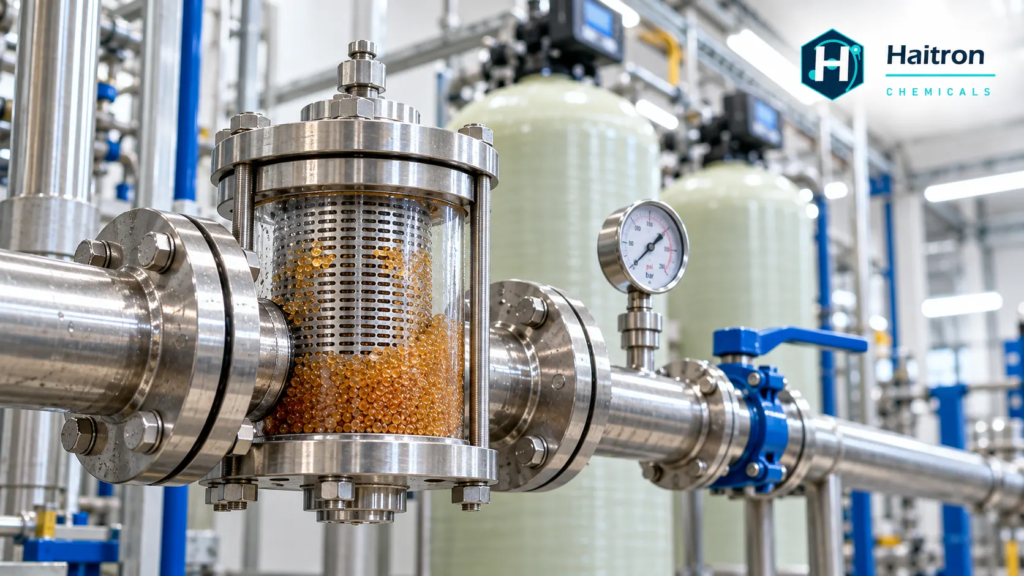
Many industrial units use wedge wire screens. These are V shaped wires wound with one continuous slot. The shape resists clogging and leaves a large open area, so pressure loss stays low.
Water can flow inside to outside or the other way round, depending on the design.
Why do resin beads escape in the first place?
Beads escape when the screens inside the vessel fail. Ecolab’s Nalco Water names the usual causes: corrosion, chemical attack, heat damage, sudden flow changes, age and water hammer. Once the underdrain cracks, beads travel downstream and can foul RO membranes, filters, pumps, tanks and piping.
In homes, the weak point is usually the distributor basket or riser tube at the bottom of the softener tank, according to InspectAPedia. Fine particles often mean worn out resin. Whole beads usually mean a broken basket.
Backwash is another risk. Suppliers of wedge wire traps note that temperature driven flow changes can wash expensive resin straight down the drain. That’s why many plants put a trap on the backwash line too.
Do you need a resin trap for a water softener?
For most homes it’s optional but smart, especially if your water feeds an RO unit, a tankless heater or an ice maker. A simple strainer after the softener stops beads before they reach your taps. In commercial and industrial plants, Nalco Water describes a trap on every media system as best practice.
The classic warning sign is tiny amber or yellow beads in faucet aerators and showerheads. Netsol Water recommends a Y strainer behind the softener for exactly this reason. Once beads get into household pipes, they’re very hard to flush out.
One catch: plastic bits from water heater dip tubes made between 1993 and 1997 can look like resin. If beads only appear on the hot side, check the heater first.
Which type should you choose?
| Type | Best for | Strengths | Watch out for |
|---|---|---|---|
| Wedge wire screen in a flanged housing | Industrial ion exchange and demineralizers | Low pressure loss, strong, slot made to order | Higher upfront cost |
| Basket strainer with mesh | Commercial softeners | Easy to open and clean | Mesh can tear or bend over time |
| Y strainer | Home and light commercial softeners | Cheap, compact, easy to buy | Small capacity, needs a fine screen |
| Self cleaning inline trap | Plants that can’t stop for cleaning | Flushes captured beads without shutdown | More parts, higher cost |
Housing materials matter too. Johnson Screens builds its screens mostly from 304 stainless steel. PVC suits smaller sizes. The Italian maker ILMAP now offers fiberglass traps for large custom sizes without the cost of stainless fabrication, as reported by Tecpro.
How do you size a resin trap filter?
Match three things: slot size, flow and pressure. Pick a slot smaller than the smallest bead in your bed. Size the body for peak flow, not average flow. Then check the maker’s pressure drop at that flow. For a real example, Nalco’s RT20 model is a 2 inch trap rated for 100 gpm.
Slot sizes can be very fine. Johnson Screens, as listed on Water Online, makes slots as small as 0.001 inch in 0.001 inch steps.
Here’s a useful habit. Ask your resin supplier for the bead size range of your strong acid cation resin or anion resin. Then choose the slot from real data, not guesswork.
Where should a resin trap be installed?
Fit it on the treated water outlet of each ion exchange vessel, as close to the vessel as practical. Add one on the backwash or drain line, since that’s where beads are often lost. Place isolation valves on both sides so you can open the trap without draining the whole system.
A few installation tips:
- Check the flow arrow on the housing before you tighten anything.
- Add a pressure gauge before and after the trap. A rising gap between the two means it’s filling up.
- Leave room to pull the screen out. Cramped installs rarely get inspected.
What makes a mixed bed resin trap different?
A mixed bed unit polishes water to very high purity, often for boilers, labs or electronics. The trap does the same job, but the stakes are higher. Resin escaping here can reach the most sensitive and costly equipment in the plant, so gauges and regular checks matter more.
If you run a mixed bed ion exchange resin system, treat the trap as part of the unit, not an extra. The same goes for condensate polishing units, where escaped beads could travel back toward the boiler.
Common mistakes to avoid
- Choosing a slot that’s too big. Broken bead fragments slip straight through.
- Skipping the gauges. You won’t know the trap is clogging until flow drops.
- Never opening it. A trap only helps if someone looks inside.
- Treating the trap as the repair. It catches beads; it doesn’t fix the cracked underdrain.
- Forgetting the backwash line, where resin loss often happens.
What are the limits?
It can’t catch fines smaller than its slot. A finer slot catches more, but it also adds pressure drop and clogs faster. And it only treats the symptom. If beads keep showing up, the vessel internals or the resin itself need attention.
Conclusion
A resin trap is a small, low cost part that guards everything downstream of your ion exchange system. Size the slot from real bead data, install it where you can inspect it, and check it at every service. If you find beads, bypass the unit and inspect the underdrain right away. Need resin matched to your vessel? Talk to our technical team.
FAQs
How often should the trap be checked?
Check it at every routine service and whenever the pressure gap across it rises. Any resin you find is an early warning that something inside the vessel needs attention.
Is it the same as a sediment filter?
No. A sediment filter sits before the softener and catches dirt. The trap sits after the unit and catches escaped beads.
Can the trap lower water pressure?
Yes, if it’s undersized or full of beads. A correctly sized, clean trap adds only a small pressure loss at normal flow.
How is it different from an underdrain?
The underdrain sits inside the vessel and is the first barrier holding resin in. The trap sits outside in the pipework as a backup if that barrier fails.
Does Haitron make resin for these systems?
Yes. Haitron manufactures SAC, WAC, SBA, WBA, chelating and mixed bed resins, and its technical team supports customers from resin selection to commissioning. See our resin range.