pH of Deionized Water: Why It’s Not Always 7
The pH of deionized water is 7.0 at 25°C in theory, because pure water holds equal amounts of acid and base ions. In real life, DI water exposed to air usually reads lower, often around 5.6.
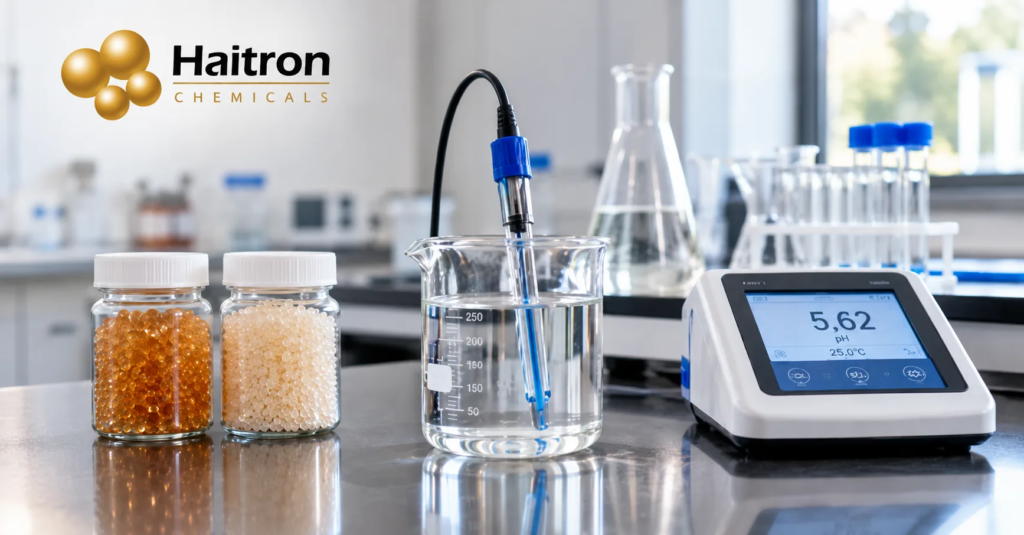
The pH of deionized water is 7.0 at 25°C in theory, because pure water holds equal amounts of acid and base ions. In real life, DI water exposed to air usually reads lower, often around 5.6. That’s because it absorbs carbon dioxide and forms a weak acid.
So both answers are right. One is the textbook value, and the other is what your meter shows. This guide explains the gap, compares DI water with distilled and tap water, and shows you how to measure it properly.
What Is the pH of Deionized Water?
Fresh, sealed deionized water has a pH of about 7.0 at 25°C, which is neutral. Once it touches air, it picks up carbon dioxide and drops to roughly 5.6. Puretec Industrial Water (2024) notes that high purity water at 18.2 megohm cm resistivity has a neutral pH.
Deionized water, or DI water, is water with nearly all dissolved salts removed. Ion exchange makes it. Resin beads swap mineral ions for hydrogen and hydroxide ions, which then join to form more water.
Think of it as an empty room. With almost no ions inside, the tiniest visitor changes the whole mood.
Why Does the pH of Deionized Water Drop in Air?
DI water has no buffering capacity, so it can’t resist change. Carbon dioxide from the air dissolves into it and forms carbonic acid, the same mild acid in soda water. Even this tiny amount lowers the pH of deionized water from 7 toward 5.6.
A buffer is like a shock absorber. Tap water has minerals that soak up small acid hits. DI water has none, so every bump shows.
ASTM D5128 (2014) shows how sensitive this is. Very pure water containing 0.001 mg/L of hydrochloric acid has a calculated pH of 6.94. Add just 1 mg/L more acid and the pH shifts by 2.38 units.
Does Temperature Change the pH of DI Water?
Yes. The neutral point itself moves with temperature. Pure water reads 7.47 at 0°C, 7.00 at 25°C and 6.14 at 100°C, according to Chemistry LibreTexts data. It stays neutral at every temperature, because acid and base ions remain equal.
So hot DI water reading 6.6 isn’t necessarily acidic. Always note the temperature beside any pH reading. Most good meters correct for it automatically.
DI Water vs Distilled Water vs Tap Water: How Do They Compare?
| Water type | Typical pH | Why | Buffered? |
|---|---|---|---|
| Theoretical pure water at 25°C | 7.00 | Equal H+ and OH− ions | No |
| Fresh DI water, sealed system | Close to 7 | Ions removed, no air contact | No |
| DI water exposed to air | About 5.6 | Absorbs CO2, forms carbonic acid | No |
| Distilled water exposed to air | Usually below 7 | Same CO2 effect after distilling | No |
| Tap water | 6.5 to 8.5 (US EPA guidance range) | Dissolved minerals and treatment | Yes, partly |
| pH 7 buffer solution | 7.00 | Designed to resist change | Yes |
So is distilled water acidic? Only slightly, and only after it meets air. Both distilled and DI water are neutral when pure. The small drop comes from carbon dioxide, not from the water itself.
How Do You Measure the pH of Deionized Water Accurately?
It’s hard. Pure water conducts electricity poorly, so standard pH probes drift and give unstable readings. ASTM D5128 recommends online flowing measurement for low conductivity water. For grab samples, its sister method ASTM D5464 is used, and it allows a small salt addition to help the electrode respond.
Here are practical tips that work:
- Measure in a flowing stream, not an open beaker, when you can.
- If you must use a beaker, fill it gently and read right away, before CO2 creeps in.
- Use an electrode designed for low ionic strength or pure water.
- Record the temperature with every reading.
- Trust resistivity or conductivity as your main purity check, and treat pH as a supporting number.
The pharmaceutical industry works this way too. Under USP <645>, Stage 3 adds saturated potassium chloride (KCl) to the sample, then requires a pH between 5.0 and 7.0. Conductivity, not pH, is the main test.
What Affects DI Water pH in a Real System?
Your resin matters most. A two bed system uses strong acid cation resin to remove metals, then anion resin to remove acids. A mixed bed ion exchange resin blends both for the final polish.
When a mixed bed starts to run out, pH can swing. Puretec (2024) explains that the direction depends on which ions break through first. If cation capacity runs out first, salts slip into the water and pH tends to rise. If anion capacity runs out, acids slip through and pH falls.
Silica and weak acids are a special case. A strong base anion resin removes them, and if it’s tired, they leak first.
Common Mistakes to Avoid
These are the errors that cause most confusion:
- Calling DI water “contaminated” because it reads 5.6. That’s normal after air contact.
- Measuring in an open beaker after stirring. Stirring pulls in more CO2.
- Using pH test strips. They’re too crude for unbuffered water.
- Ignoring temperature when comparing readings.
- Judging water purity by pH alone instead of conductivity.
What Are the Limits of a pH Reading on DI Water?
A pH number on pure water tells you little about purity. Two samples can share the same pH yet differ widely in conductivity. Electrodes can also degrade in pure water. ASTM notes that pure water’s aggressive nature can cause drifting signals. For quality control, resistivity or conductivity is the better yardstick.
Final Thoughts
The pH of deionized water is 7 in theory and closer to 5.6 once air gets in. Neither number means something’s wrong. Your next step is to check conductivity or resistivity first, then measure pH in a flowing stream with the right probe. Want to see where ion exchange water is used? Explore our water treatment applications.
FAQs
Can I calibrate a pH meter with DI water?
No. Calibrate with certified buffer solutions, usually pH 4 and pH 7. DI water has no buffering, so its reading moves too easily to serve as a reference point.
Does boiling DI water bring the pH back to 7?
Briefly. Boiling drives out dissolved CO2. But the water reabsorbs CO2 as it cools in open air. Cool it in a sealed container if you need to slow that down.
Why does my DI water read pH 8 or higher?
Often, an exhausted resin bed is letting alkaline salts slip through. A faulty or poorly conditioned electrode can also be the cause. Check resistivity, and recalibrate the meter with fresh buffers.
Is DI water corrosive to metal pipes?
High purity water is aggressive toward many materials, which is why DI systems often use plastic or stainless steel piping. Ask your system supplier to confirm which materials suit your water quality.
Does Haitron make resin for producing DI water?
Yes. Haitron manufactures mixed bed, strong acid cation and strong base anion resins used in deionization and demineralization systems. You can request a quote through the contact page.