Macroporous Ion Exchange Resin: How It Works and When It Beats Gel Resin
A macroporous ion exchange resin is a cross-linked polymer bead with permanent pores built into its structure. Those pores stay open even when the bead is dry, so water and large dissolved molecules can reach exchange sites deep inside it. A gel resin has no fixed pores. It only opens up when it swells in water, and even then the gaps between its polymer chains are tiny.
That single difference explains almost everything a buyer needs to know. Macroporous beads tolerate organic fouling better and survive harsh cycling longer, but in exchange they hold less capacity per liter and use more regenerant.
Which side of that trade you want depends on your feed water, not on the headline number on the datasheet.
What makes a resin macroporous
Most ion exchange resin beads start the same way: styrene polymerized with divinylbenzene (DVB), which cross-links the chains into a 3D network. Sulfonate that network and you get a strong acid cation resin. Attach quaternary ammonium groups and you get a strong base anion resin.
Gel and macroporous beads can carry identical chemistry. The difference is made during polymerization. For a macroporous bead, the manufacturer adds a porogen, usually a solvent that dissolves the monomers but not the finished polymer. Once the porogen is washed out, it leaves a sponge of permanent channels behind.
The pores are big by resin standards. Gel resins have spaces of roughly 30 Angstroms at most when swollen. Macroporous resins typically range from about 20 to well over 1,000 Angstroms, with internal surface areas often between 50 and 500 m²/g.
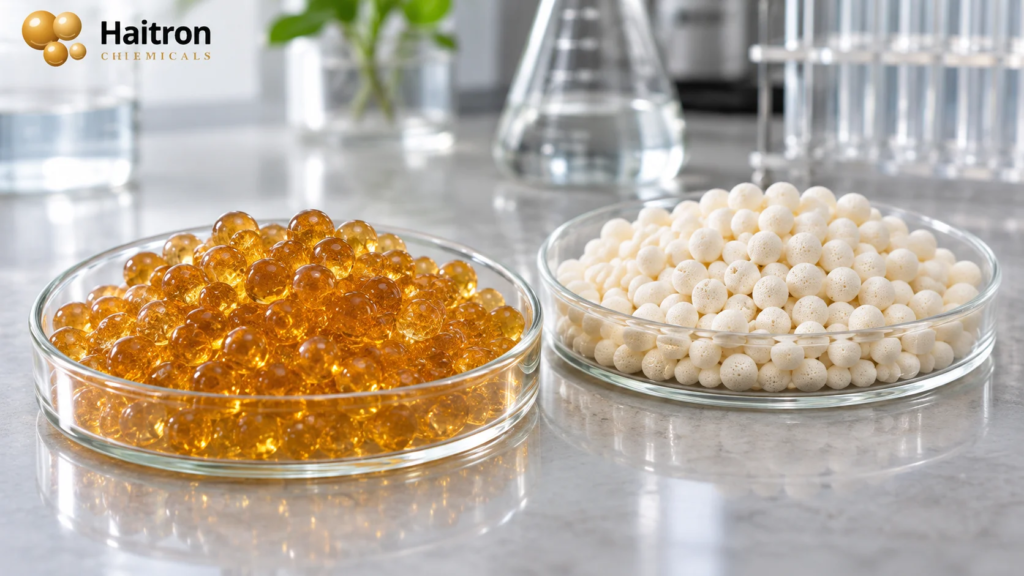
You can usually tell the two apart by eye. Gel beads look clear and amber, like small glass marbles. Macroporous beads are opaque and look more like chalk or frosted glass.
How macroporous ion exchange resin works
The exchange reaction is the same in any ion exchange resin. A sodium ion on a sulfonic group trades places with a calcium ion in the water. Later, brine or acid pushes the calcium back off and the bead is ready to run again.
The pores change what happens around that reaction in two ways.
First, large molecules move in and out freely. Humic acids, tannins and sugar color bodies are big enough to wedge into a gel bead and stay stuck. They slowly coat the exchange sites until the operator notices falling capacity and longer rinses, which is what the industry calls organic fouling.
In a macroporous bead the same molecules travel through open channels, so the regenerant can carry most of them back out.
Second, the bead can take more cross-linker without becoming too tight for ions to enter, and more cross-linking means a harder, stiffer bead.
Every regeneration makes resin shrink and swell, and those repeated swings crack weaker beads over time (resin people call this osmotic shock). A highly cross-linked macroporous bead shrugs off far more of those cycles. For reference, a standard gel softening resin sits at about 8% DVB.
Macroporous vs gel resin: what you gain and what you pay
Buyers often compare total capacity, see the gel number is higher, and stop there. That’s only half the picture.
| Property | Gel type | Macroporous |
|---|---|---|
| Pore structure | No fixed pores, about 30 Å swollen | Permanent pores, tens to thousands of Å |
| Typical SAC total capacity | About 2.0 eq/L | About 1.7 to 1.8 eq/L |
| Organic fouling | Traps large organics | Releases most organics on regeneration |
| Osmotic and mechanical strength | Lower | Higher |
| Regenerant and rinse demand | Lower | Higher |
| Bead density | Heavier | Lighter |
On clean feed water, gel wins. It holds more ions per liter and regenerates more efficiently, so it simply costs less to run. A macroporous bed on low organic water is paying for protection it will never use. Its larger internal surface also exposes more polymer to oxidants such as free chlorine, so it isn’t automatically the tougher choice in every condition.
On organic heavy or variable water, the picture flips. A gel bed may start with more capacity, but fouling eats into it run after run. A macroporous bed starts lower and holds its usable capacity much longer, which often means fewer resin changes over the life of the system.
Gel technology keeps improving, too. Newer high cross-linked gel cation resins with evenly spaced cross-links now handle osmotic stress well enough for duties that once called for macroporous beads, including condensate polishing.
And the chemistry of the foulant matters as much as the bead structure. Macroporous resin reduces fouling risk. It doesn’t remove it.
Macroporous cation exchange resin vs macroporous anion exchange resin
A macroporous cation exchange resin is usually a sulfonated styrene product. Its main advantage is physical: it resists breakage in systems with frequent regeneration, high temperatures or sudden swings in water quality. It also keeps its pores in non-aqueous liquids. That’s why macroporous cation beads work as solid acid catalysts in chemical processing, where a gel bead would shrink and lock away its exchange sites.
For a standard softener or demineralizer on reasonably clean water, a gel grade such as our strong acid cation resin usually gives the better capacity for the money. Our cation exchange resin guide covers how strong and weak acid types differ.
A macroporous anion exchange resin is where the structure earns its keep most often. Natural organic matter is mostly negatively charged, so it lands on the anion bed. That makes the anion resin the first place fouling shows up and the first place macroporous beads pay off. Common uses include:
- Organic scavenger beds that catch humic and fulvic acids ahead of a demineralizer
- Treating surface water or well water with high tannin levels
- Decolorizing sugar syrups and other food solutions, where color bodies must load and release cycle after cycle
If your feed has low organics and the job is silica or general anion removal, a gel strong base anion resin remains the standard choice. See our anion exchange resin article for how Type I and Type II resins compare.
The mixed bed rule many people miss
Bead density matters in a mixed bed resin unit, because the cation and anion must separate cleanly on backwash before regeneration. Macroporous beads are lighter than gel beads because of their pores.
So the common pairing is a heavier gel cation with a lighter macroporous anion, which separates well. A macroporous cation with a gel anion is avoided, because the two densities end up too close to separate cleanly and the layers mix.
“Macroporous resin” doesn’t always mean ion exchange
Search for macroporous resin and you’ll find two different product families under one name.
The first is macroporous ion exchange resin, with functional groups that trade ions. The second is nonionic polymeric adsorbent: porous styrene DVB beads with no exchange groups at all, sometimes above 700 m²/g of surface area. Adsorbents pull organics out of solution by hydrophobic attraction. They won’t soften water or remove nitrate.
Before you ask for a quote, check the datasheet for a functional group (sulfonic, carboxylic, quaternary ammonium or amine) and a total capacity in eq/L. No functional group means it’s an adsorbent. Food and beverage plants sometimes need both kinds, and our food-grade and adsorption resin range includes a macroporous grade for juice refining, decolorization and deashing.
How to decide in four checks
- Organic load. Look at TOC or permanganate demand in your water analysis. High organics point to a macroporous anion bed.
- Feed stability. Seasonal surface water and blended sources swing hard. Variable feed favors macroporous beads.
- Operating stress. Frequent regenerations, high temperature or non-aqueous service favor macroporous. Clean, steady, ambient water favors gel.
- Cost per usable equivalent. Compare the capacity you’ll actually get over the resin’s life, not price per liter on day one.
Many plants end up with a mix: gel cation for capacity, macroporous anion for fouling resistance. That’s often the most economical setup for industrial water treatment on surface water.
Quick questions
Can I swap gel resin for macroporous resin in the same vessel?
Usually yes, but recheck freeboard, regenerant dose and rinse volume. Macroporous beads swell differently and generally need more regenerant.
Do macroporous ion exchange beads last longer?
In high organic or high stress service, often yes, because they resist fouling and cracking. On clean water, a quality gel resin can last just as long.
What should I send a supplier?
Your water analysis, flow rate, vessel size and the treated water quality you need. With those numbers, our team can recommend the right resin type and structure instead of guessing.