Condensate Polishing: What It Is, How It Works and How to Choose a System
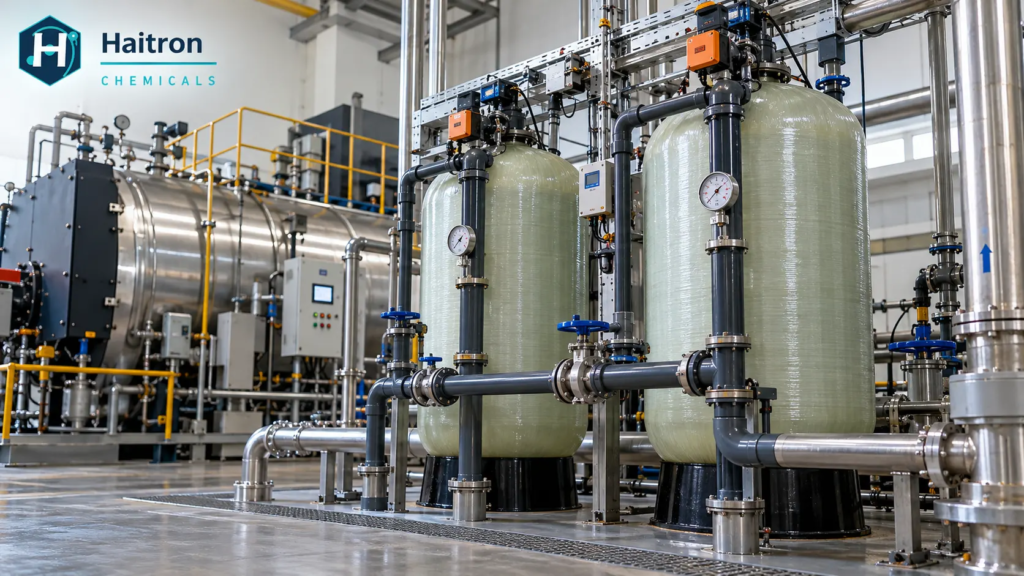
Condensate polishing is the cleaning of steam condensate before it goes back to the boiler. A polisher filters out tiny rust particles and uses ion exchange resin to remove dissolved salts like sodium, chloride and silica. This protects boilers, steam generators and turbines from damage.
Below, we explain why clean condensate still needs polishing, the main types of polishers, and the choices that decide how well yours works.
Why Condensate Needs Polishing
In a steam plant, water is boiled into steam, the steam spins a turbine, and then it cools back into water. That water is called condensate, and it goes back to the boiler to start the loop again.
Because the same water loops over and over, even tiny bits of dirt build up. It’s like reusing bathwater: a little grime each time soon adds up.
Condensate picks up two kinds of contamination:
- Particles: mostly iron and copper rust from pipes and heaters. Plant workers call this “crud.”
- Dissolved salts: sodium, chloride, sulfate and silica. These often sneak in through a leaking condenser tube. Plants that cool their condensers with seawater are especially at risk, Ovivo notes.
If these impurities stay in the system, they cause buildup and corrosion in boilers and turbines. That lowers efficiency and can damage expensive equipment. EPRI (the Electric Power Research Institute) has long recommended polishing for fossil fuel power plants.
How Condensate Polishing Works
A polisher does two jobs at the same time.
First, it filters. It traps loose rust particles. Many plants also add a separate filter before the polisher to catch oil and solids, which keeps the resin cleaner.
Second, it swaps ions. Resin beads grab unwanted dissolved salts and release harmless ones instead. Cation resin trades sodium and other positive ions for hydrogen. Anion resin trades chloride, sulfate and silica for hydroxide. Hydrogen and hydroxide then join to make pure water. It’s the same basic idea used to make ultrapure water.
Since condensate is already fairly clean, a polisher often needs cleaning because it’s clogged with crud, not because its resin is used up. Wigen points out that rising pressure drop is just as common a trigger as exhausted resin.
Types of Condensate Polishers
There are three main designs. Each one fits a different need.
| Deep bed mixed bed | Powdered resin (precoat) | Separate beds | |
| How it works | A tank with mixed cation and anion beads, about 3 to 4 feet deep | A thin layer of finely ground resin coated on filter elements | Cation and anion resins kept in separate layers or tanks |
| Best at | Removing dissolved salts; handling condenser leaks | Filtering crud; saving space | Simpler recharging with less mixing of resins |
| Downside | Bigger tanks; needs a resin recharging system | Small resin amount, so it gets used up by ammonia quickly | Less common; depends on the design |
| After use | Recharged | Thrown away and replaced | Recharged |
| Common in | Nuclear plants; plants with seawater cooled condensers | Plants where crud control matters most | Some fossil fuel plants |
Deep Bed Mixed Bed
This is the standard choice when purity matters most. POWER magazine notes that nuclear plants normally use deep bed polishers because their steam systems are very sensitive. Big units often run several tanks side by side. One US nuclear reactor design, for example, calls for at least four deep mixed bed trains.
Powdered Resin (Precoat)
Here, the resin is ground very fine and coated onto filters. It catches particles very well. But since there’s so little resin, ammonia uses it up much faster than a deep bed. When it’s spent, the coating is washed off and replaced.
Separate Beds
In this design, cation and anion resins aren’t mixed. An EPRI review found these systems can still meet its purity targets, and recharging them is simpler. Mixed beds remain much more common, though.
Hydrogen Form vs Ammonium Form
Most plants add ammonia to the water to keep pH high and slow corrosion. But ammonia is also something the cation resin likes to grab. That creates the biggest operating choice.
| Hydrogen form | Ammonium form | |
| What happens | Resin removes ammonia along with the bad stuff | Resin is already full of ammonia, so ammonia passes through |
| Sodium leakage | Lowest | Higher |
| Run length | Shorter | Longer |
| Skill needed | Simpler to run | Needs well trained operators |
Most condensate polishing plants run their cation resin in hydrogen form, according to Purolite’s application guide. Ammonium form isn’t harmful by itself, but Power Engineering notes it can let a little more sodium slip through.
Higher pH makes this harder. POWER magazine reports that polishers are usually designed to cut 10 ppb of sodium down to under 2 ppb. At pH 9.6, that sodium competes with about 2,300 ppb of ammonia. At pH 10.0, where many combined cycle plants now run, it competes with about 11,800 ppb. More ammonia means shorter runs and more risk of sodium leaking through.
Recharging Resin Inside or Outside the Tank
Deep bed resin can be recharged inside the service tank, or moved to a separate recharging system.
- Outside the tank (external): keeps acid and caustic far from the steam system and allows better separation of the two resins. POWER cites sodium leakage of about 3 µg/L or less.
- Inside the tank (internal): simpler, but resins can mix more. The same source says sodium leakage can reach about 10 µg/L.
Mixed up resins are the main problem. If cation beads end up in the caustic, or anion beads in the acid, they won’t work properly. Some plants add an inert resin layer, a neutral bead that settles between the two, to create a buffer zone.
How to Choose the Right Resin
As a resin maker, here’s what we’d check with any supplier:
- Crosslink strength: tougher, more crosslinked cation resin holds up better. Purolite suggests the highest practical crosslink, noting a 12% macroporous resin may lower sodium leakage.
- Bead strength: polishers run at high flow and move resin around, so ask for attrition and crush strength data.
- Size and separation: cation and anion beads must separate cleanly. Ask for particle size and settling data.
- Heat limits: check the anion resin’s temperature limit against your condensate temperature.
- Resin ratio: match the cation to anion ratio to your ammonia load and contaminants.
Our strong acid cation resin family lists this use in its applications, and our mixed bed resin pairs cation and anion resins for high purity work. For high flow duty, always confirm the exact grade and bead strength against your design.
Common Problems and What to Check
| Problem | Likely cause | First check |
| Sodium rises early | Ammonium form breakthrough or mixed up resin | Operating form, separation quality |
| Pressure drop climbs | Crud buildup or broken beads | Upstream filter, backwash |
| Sulfate or organics leak | Fouled anion resin or damaged cation resin | Lab analysis of a resin sample |
| Short runs | High ammonia or weak recharging | Ammonia dose, chemical quality |
Conclusion
Good condensate polishing comes down to three choices: the right design, the right operating form and the right resin. Start by reviewing your sodium, conductivity, pressure drop and run length data. Then compare them with the problem table above to spot where your polisher needs help.
FAQs
What is a condensate polishing unit?
It’s the full set of tanks, filters and recharging equipment that cleans condensate in a power plant. Big plants often run several polisher tanks side by side.
How is a polisher different from a demineralizer?
A demineralizer cleans raw water full of dissolved minerals. A polisher cleans returning condensate that’s already fairly pure, so filtering rust matters just as much as removing salts.
Does a polisher remove ammonia?
In hydrogen form, yes, which shortens each run. In ammonium form, ammonia passes straight through.
Can Haitron supply resin for my polisher?
Yes. Haitron makes strong acid cation, strong base anion and mixed bed resins. Share your condensate analysis and design data with our team, and we’ll help match the right grades for your condensate polishing system.