Legionnaires’ Disease and Cooling Towers: How They’re Linked and How to Prevent Outbreaks
Learn how legionnaires’ disease and cooling towers are linked, how Legionella spreads through mist, and the steps that prevent outbreaks.
Legionnaires’ disease and cooling towers are linked because towers hold warm water and spray fine mist that can carry Legionella bacteria into the air. People catch the disease by breathing in that contaminated mist. Good water management, steady disinfection and regular cleaning keep the bacteria from growing in the first place.
Cooling towers have caused some of the largest community outbreaks in recent years, so this matters well beyond one rooftop.
What Is Legionnaires’ Disease?
Legionnaires’ disease is a serious type of pneumonia caused by Legionella bacteria. People get it by breathing in small water droplets that contain the bacteria. Symptoms usually start 2 to 14 days after exposure. It’s treated with antibiotics, and the CDC says about 1 in 10 people who get it die from complications.
The name comes from a 1976 outbreak at a Philadelphia convention hotel. CNN, citing the CDC, reports 180 people got sick and 29 died.
Common symptoms include cough, fever, shortness of breath, muscle aches and headaches. Some people also feel confused or have diarrhea.
Most healthy people exposed to Legionella don’t get sick. People 50 or older, current or former smokers and people with chronic lung disease or weak immune systems face the highest risk.
What Is Legionella and Where Does It Grow?
Legionella is a bacterium that lives naturally in lakes and streams at low, harmless levels. It becomes dangerous when it multiplies in building water systems. Warm temperatures between 77°F and 113°F (25°C to 45°C), stagnant water, sediment and slimy biofilm help it thrive. Cooling towers often run in exactly that temperature range.
Biofilm is the slippery layer you feel on the inside of a dog’s water bowl left out for a few days. Legionella hides and grows inside that layer, sheltered from disinfectant.
Besides cooling towers, Legionella can grow in hot tubs, decorative fountains, large plumbing systems, hot water tanks and showerheads.
What Is the Link Between Legionnaires’ Disease and Cooling Towers?
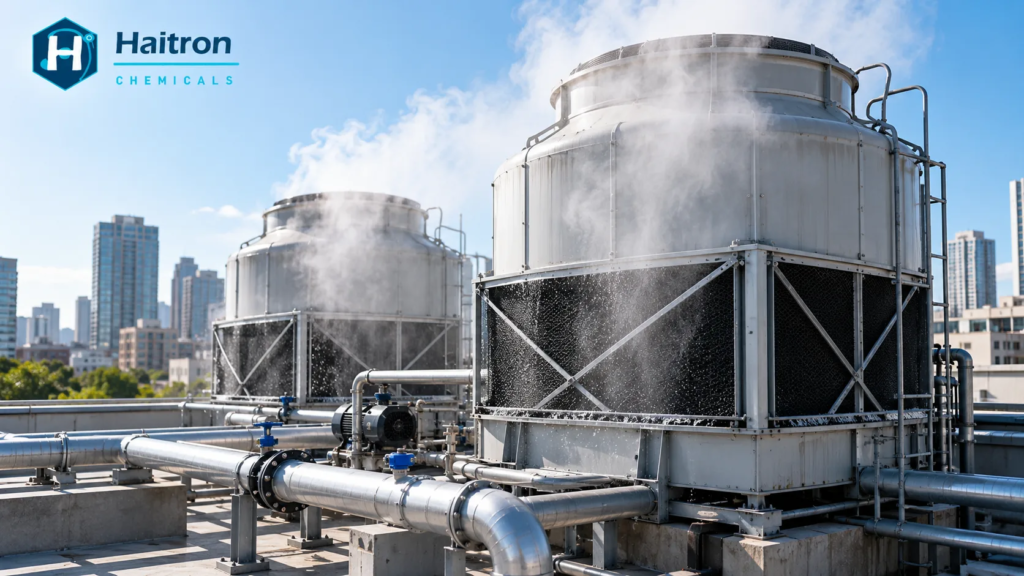
A cooling tower removes heat from a building by letting warm water evaporate as a fan blows air through it. That process releases fine mist, called drift, into the open air. If the tower water contains Legionella, the wind can carry the droplets to people on nearby streets and in nearby buildings.
Here’s a recent example. In summer 2025, New York City traced a Central Harlem outbreak to 12 cooling towers on 10 buildings, including Harlem Hospital. By September, it had been linked to seven deaths.
Cooling tower outbreaks aren’t new. In 1993, the CDC identified cooling towers as the source of outbreaks in Massachusetts, Rhode Island and a Michigan state prison. A CDC study of 196 US cooling towers, reported in 2018, found signs of Legionella in about six out of seven.
How Is Legionnaires’ Disease Spread?
Legionnaires’ disease spreads when people breathe in mist containing Legionella. Less often, people get sick when drinking water containing the bacteria goes down the wrong pipe into the lungs. In general, it doesn’t spread from person to person. You can’t catch it by touching someone who has it.
What about air conditioning? The cooled air from a home or car air conditioner doesn’t spread it. The risk comes from large building systems that use water and create mist, such as cooling towers.
Legionnaires’ Disease vs Pontiac Fever: What’s the Difference?
Legionella causes two illnesses, together called legionellosis. Legionnaires’ disease is pneumonia and can be deadly. Pontiac fever is a milder, flu-like illness without pneumonia that usually clears on its own. Both come from breathing in the same contaminated mist.
| Feature | Legionnaires’ disease | Pontiac fever |
|---|---|---|
| Type of illness | Pneumonia (lung infection) | Milder flu like illness |
| Symptom onset | Usually 2 to 14 days after exposure | Usually within a few days |
| Severity | Serious; about 1 in 10 die (CDC) | Usually resolves without treatment |
| Treatment | Antibiotics, often in hospital | Usually rest and fluids |
| Spread | Breathing in contaminated mist | Breathing in contaminated mist |
How Do You Prevent Legionella in Cooling Towers?
Prevention rests on a written water management program. ASHRAE Standard 188 sets the framework, and the CDC’s cooling tower toolkit explains it in plain steps. The core idea is controlling four growth factors: sediment and biofilm, temperature, water age and disinfectant level. Then you test, record results and act fast when numbers drift.
| Growth factor | Why it matters | What to do in the tower |
|---|---|---|
| Sediment and biofilm | Shelters bacteria from disinfectant | Clean the basin and fill regularly; control scale and corrosion |
| Temperature | 77°F to 113°F favors growth | You can’t avoid it in most towers, so other controls must be strong |
| Water age | Stagnant water lets bacteria multiply | Avoid dead legs; recirculate standby towers before restart |
| Disinfectant level | Too little lets bacteria grow | Dose biocide continuously and check the residual often |
Practical tips:
- Keep drift eliminators in good shape. They catch most of the mist before it leaves the tower.
- Treat a tower that sat idle as high risk. Clean and disinfect before restarting.
- Test for Legionella on the schedule your plan sets, and keep the records.
- Control scale in the makeup water. Deposits give biofilm a place to grip.
The CDC has found that almost all Legionella outbreaks it investigated came from problems that better water management could have prevented. That’s the hopeful part: Legionnaires’ disease and cooling towers don’t have to go together.
What Common Mistakes Lead to Outbreaks?
Most cooling tower outbreaks trace back to gaps in routine care rather than unusual events. Biocide feed fails without anyone noticing, a tower restarts after sitting idle, or test results get filed instead of acted on. Each gap gives Legionella time to multiply in warm, misty water.
- Treating the water management plan as paperwork instead of daily practice.
- Restarting a stagnant tower without cleaning and disinfecting it.
- Ignoring damaged drift eliminators.
- Letting scale, sludge and biofilm build up in the basin.
- Testing for Legionella but not responding to positive results.
What Are the Limits of Prevention?
No program reduces the risk to zero. Legionella occurs naturally, warm towers favor it, and tests take days to return results. Prevention lowers the odds sharply, but it only works when owners, operators and water treatment providers follow the plan every single day.
Where Does Water Treatment Fit In?
A clean, stable tower is easier to disinfect. Many sites soften their makeup water with strong acid cation resin to cut hardness scale, or use a dealkalizer to lower alkalinity before water enters the system.
These steps don’t kill Legionella. They support the biocide program by reducing the deposits where biofilm forms. You can see how Haitron resins support cooling and industrial water treatment applications across different sectors.
Conclusion
Cooling towers are vital for big buildings, but they can spread deadly bacteria when water care slips. The fix isn’t complicated. It just needs to be consistent.
Your next step: if you own or manage a building with a tower, review your written water management plan this week. Consistent care is what breaks the link between Legionnaires’ disease and cooling towers.
FAQs
How is Legionnaires’ disease diagnosed?
Doctors usually use a urine test and a sample from the lungs. A chest X ray confirms pneumonia.
Can you get Legionnaires’ disease from a home air conditioner?
No. Home and car air conditioners don’t create the water mist that spreads Legionella.
Is there a vaccine for Legionnaires’ disease?
No. Prevention depends on keeping building water systems clean and disinfected.
Who is responsible for cooling tower safety?
The building owner and manager, usually working with a water treatment provider. Some cities and states add their own registration and testing rules.
Does Haitron make resins for cooling tower makeup water?
Yes. Haitron manufactures strong acid cation resin for softening and other ion exchange resins used in industrial water treatment. You can request a quote through the contact page.