Commercial Water Treatment: System Types, Costs and How to Choose
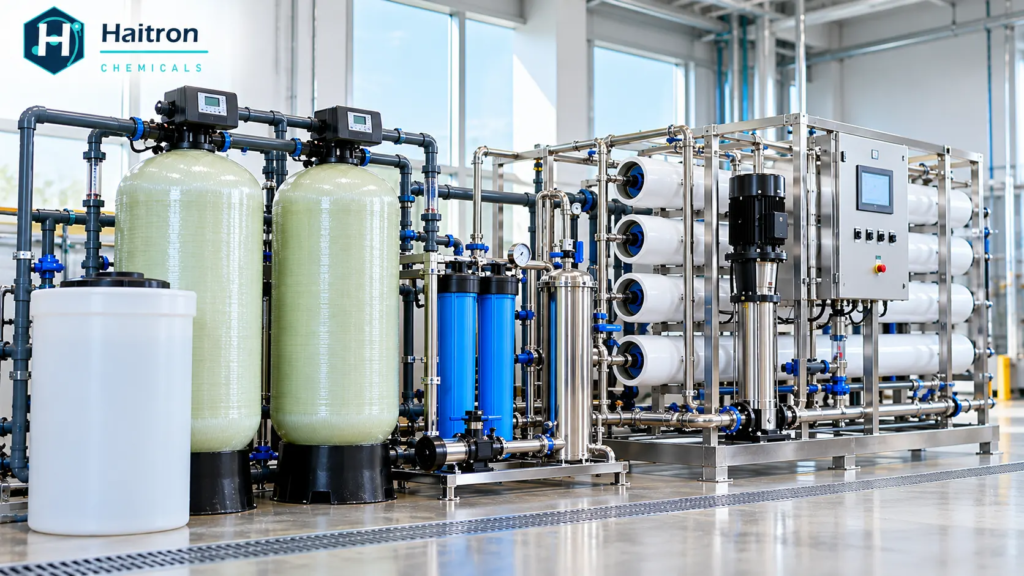
Commercial water treatment means filtering, softening, disinfecting or purifying water so a business gets the exact quality its equipment, products and people need. Most sites don’t need one big machine. They need a short chain of two or three systems, picked from a water test.
Here’s how each system works, what it costs, where buyers go wrong, and how to pick a supplier.
What is commercial water treatment?
Commercial water treatment is any equipment that improves water for a business, from a café’s coffee line filter to a hospital’s boiler feed system. It targets hardness, chlorine, sediment, germs and dissolved salts. Unlike home units, commercial water systems handle bigger flows, longer run times and stricter health rules.
Even good city water carries minerals and chlorine. At home, that’s a nuisance. In a hotel laundry, it means scale, spotty glasses and repair bills. DuPont notes that hospitals and universities need everything from boiler feed water and softening to drinking fountains and deionized lab water.
What are the main types of commercial water treatment systems?
Five technologies do most of the work: filtration, softening, reverse osmosis, UV disinfection and deionization. Filters catch particles and chlorine. Softeners remove hardness. RO strips dissolved salts. UV kills germs. Deionization polishes water to very high purity. Most commercial water purification systems combine several in a set order.
Commercial water filtration
A commercial water filtration system is usually stage one. Sediment cartridges or multimedia tanks trap sand and rust. Activated carbon grabs chlorine, taste and odor, like a sponge soaking up a spill. Commercial water filters range from single cartridges to large tanks, and industrial water filters use the same idea with bigger vessels that backwash themselves.
Commercial water softener
A commercial water softener system swaps calcium and magnesium for sodium using ion exchange resin. Picture millions of tiny beads trading a harmless ion for a scale forming one. When the beads fill up, salt brine recharges them. That’s called regeneration.
The grade of strong acid cation resin inside sets capacity and how often you regenerate. The US Geological Survey classifies water above 180 mg/L as calcium carbonate as very hard, and that’s where a commercial water softener pays off fast.
Commercial reverse osmosis
A commercial reverse osmosis system (often called a commercial RO system) pushes water through a membrane that holds back dissolved salts. Fresh Water Systems says RO membranes remove about 98% of total dissolved solids and flush the rejected contaminants to drain. Hardness and chlorine damage membranes, so pretreatment comes first.
Commercial UV water treatment systems
UV units expose water to 254 nm light, which deactivates bacteria, viruses and protozoa by damaging their DNA. Commercial UV water treatment systems add no chemicals. But UV won’t remove sediment or dissolved solids, and cloudy water or iron blocks the light.
Deionization and polishing
Deionization passes water through cation and anion resins that remove nearly all ions. Labs, electronics and pharma rely on it. A mixed bed ion exchange resin blends both types in one vessel, often as a final polish after RO.
Which commercial water treatment system fits which problem?
Match the system to what your water test finds. Hardness calls for a softener. Chlorine and taste call for carbon. High TDS calls for RO. Germs call for UV. Ultrapure needs to call for RO plus deionization. AMPAC’s advice is to use only as much treatment as the problem needs.
| System | Removes | Not designed for | Common use | Upkeep |
|---|---|---|---|---|
| Sediment or multimedia filter | Sand, rust, silt | Dissolved salts, germs | First stage protection | Cartridge change or backwash |
| Activated carbon | Chlorine, taste, odor | Hardness, salts | Before RO and resin | Media replacement |
| Water softener | Calcium, magnesium | Germs, most salts | Boilers, laundry, kitchens | Salt, resin checks |
| Reverse osmosis | About 98% of TDS | Hard or chlorinated feed | Coffee, ice, food, boiler makeup | Membranes, prefilters |
| UV | Bacteria, viruses, protozoa | Sediment, dissolved solids | Drinking and process water | Lamp and sleeve care |
| Deionization or mixed bed | Nearly all ions | Germs, organics | Labs, electronics, pharma | Regeneration or exchange |
How do real businesses combine these systems?
Most facilities use a treatment train, where each stage protects the next.
- Hotels: a typical setup pairs a softener for laundry, kitchen and HVAC with a separate RO unit for the restaurant and bar, essentially a commercial reverse osmosis water system for drinks only.
- Boilers and cooling towers: softening, filtration and RO are used as pretreatment to improve feedwater for boiler and cooling programs. Where alkalinity causes trouble, a dealkalizer removes bicarbonate first.
- Commercial buildings: EBMUD’s commercial guidebook lists ice machines, cooling tower side streams, drinking water and medical equipment among onsite treatment uses.
What do commercial water treatment systems cost?
Costs swing with flow rate, water quality and purity target. AMPAC puts softeners rated 10 to 500 GPM at about $1,500 to $25,000 for equipment, plus $600 to $6,000 yearly for salt and regeneration water. Budget for installation, membranes, cartridges, UV lamps and service too.
Compare lifetime cost, not sticker price. A cheap unit that regenerates twice as often burns salt, water and resin faster.
What mistakes do buyers make?
Most failures trace back to skipped steps, not bad equipment.
- Guessing instead of testing the water.
- Sizing for average flow, not peak demand.
- Feeding hard or chlorinated water straight into RO membranes.
- Installing UV on cloudy or iron rich water.
- Ignoring chlorine and chloramine, which slowly break down softener resin.
- Buying unbranded resin with no spec sheet for capacity or bead size.
- Keeping no maintenance log.
What are the limits of each system?
No single unit does it all. RO sends part of its feed to drain. Softeners add a little sodium. UV leaves no lasting disinfectant in the pipes. Deionized water is aggressive toward some metals. And commercial water filtration systems only work if cartridges change on time.
In industrial water filtration, those tradeoffs grow with scale, so plan for them early.
How do you choose commercial water treatment companies?
Pick a partner that starts with a lab water test, shows a sizing calculation and names the resin, membrane and lamp specs inside. Ask for NSF/ANSI 44 for softeners, 55 for UV and 58 for RO where they apply. Then check service plans and local support.
For industrial water treatment systems and industrial water filtration systems, ask for references from plants like yours.
What’s the next step?
Good commercial water treatment isn’t about buying the biggest machine. It’s about testing your water, fixing the real problem and protecting each stage with the right pretreatment and media. Book a lab test this month. If your plan includes softening or demineralization, explore Haitron’s water treatment applications and request a resin recommendation matched to your feed water.
FAQs
How often should a commercial water softener regenerate?
It depends on hardness, daily use and resin capacity. Metered valves regenerate on actual gallons used, which usually wastes less salt than a fixed timer.
Is softened water safe to drink?
Generally yes, though it holds a little more sodium. WHO’s drinking water guidelines (2022 edition) set no health based value for sodium. People on low sodium diets often add an RO tap.
Can one system remove everything?
No. Each technology targets specific contaminants, so most sites use two or three stages in sequence.
How long does softener resin last?
Many years with good care. Chlorine, iron and oil damage or foul beads faster, so pretreatment and periodic cleaning extend life.
Does Haitron supply resin for existing systems?
Yes. Haitron makes SAC, WAC, SBA, WBA, chelating and mixed bed resins, and its technical team helps match resin to existing systems.