How to Clean a Humidifier: Easy Steps to Stop Mold, Scale and White Dust
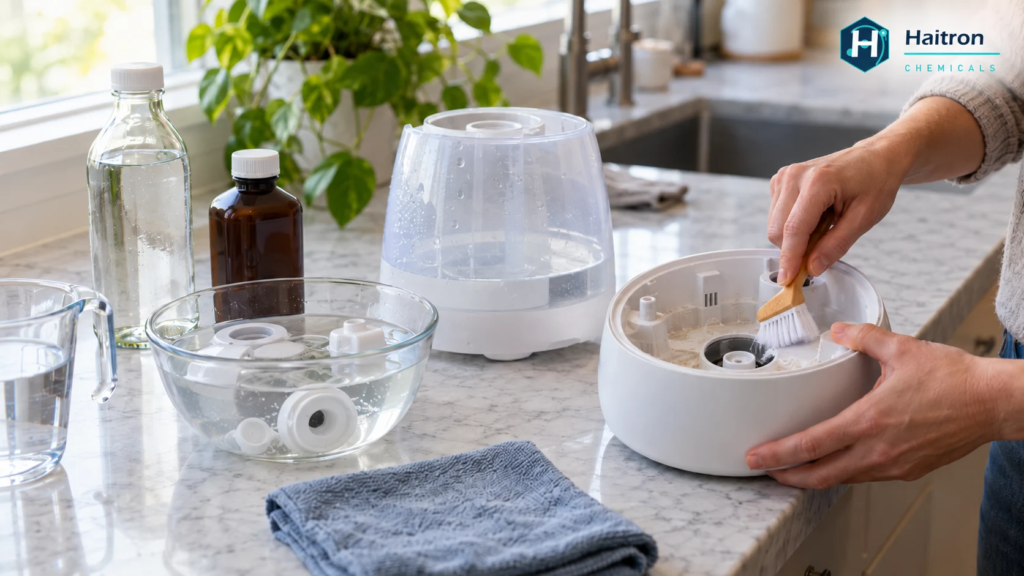
Here’s how to clean a humidifier the simple way: unplug it, soak the crusty parts in white vinegar, then wipe everything that touches water with 3% hydrogen peroxide. Rinse well and let it dry before you refill it. Empty the humidifier tank every day and do this full clean every three days, as the EPA advises.
Why two products? Your humidifier has two different problems. Scale is the hard crust that minerals leave behind, like the white ring inside an old kettle. Germs are bacteria and mold. Vinegar fixes the first problem, and peroxide fixes the second.
What You Need
You only need five things:
- Distilled white vinegar (not apple cider vinegar)
- 3% hydrogen peroxide, the brown bottle from the pharmacy
- A soft bottle brush and an old soft toothbrush
- Clean cloths or paper towels
- Your humidifier’s manual (search the model number online if you lost it)
How to Clean a Humidifier, Step by Step
- Unplug and empty it. If it’s a warm mist humidifier, let it cool first. Pour all the water out of the tank and the base.
- Take it apart. Remove the tank, cap, float, mist nozzle and any humidifier filter or wick. Set filters aside, because they need different care.
- Soak off the scale. Pour undiluted white vinegar into the base. Soak small parts in a bowl of vinegar for 20 to 30 minutes. Levoit, a humidifier brand, suggests 3 cups of vinegar in the tank for 15 to 20 minutes.
- Scrub gently. Brush the tank, base, corners and nozzle. On an ultrasonic humidifier, brush the small metal disc very lightly. That disc is called the transducer, and it shakes water into mist, so never scrape it with anything hard.
- Disinfect. Wipe every surface that touches water with 3% hydrogen peroxide. The EPA and Mayo Clinic both suggest it when your manual doesn’t name another product.
- Rinse well. Rinse with fresh water several times until you can’t smell any vinegar. This keeps cleaning chemicals out of the mist you breathe.
- Dry and refill. Let every part air dry on a clean towel. Put it back together and fill it with fresh water, ideally distilled.
One important rule: never run the humidifier with vinegar inside. That sends vinegar mist into your room.
How Often Should You Clean a Humidifier?
Empty it every day and clean it fully every three days. You’ll see “weekly” or “monthly” advice online, but the EPA’s schedule is stricter and safer.
| When | What to do |
| Every day | Empty the tank, wipe it dry and refill with fresh water. Don’t just top up old water. |
| Every 3 days | Do a full clean: descale if needed, disinfect, rinse and dry. |
| When you see crust | Soak in vinegar. Hard water means you’ll do this more often. |
| When your manual says | Replace the filter, wick or demineralization cartridge. |
| End of season | Clean it, dry it fully, throw away old cartridges and filters, and store it dry. |
Cleaning Tips by Humidifier Type
Every humidifier needs the steps above. But each type has one part that needs extra care.
| Type | How it works | What to focus on |
| Ultrasonic (cool mist) | A shaking disc turns water into mist | The disc and base. The EPA says this type spreads the most minerals and germs into the air. |
| Impeller (cool mist) | A spinning disc throws water into mist | The spinning part, tank and base |
| Evaporative | A fan blows air through a wet wick, which is a spongy pad | The wick. Some brands say to replace it, not wash it. |
| Warm | It boils the water | Crust in the heating area. Let it cool fully to avoid burns. |
Vinegar, Hydrogen Peroxide or Bleach?
Each cleaner does a different job. Here’s a quick guide.
| Cleaner | Best for | Watch out for |
| White vinegar | Dissolving mineral buildup | Health agencies don’t name it for killing germs |
| 3% hydrogen peroxide | Killing germs | Don’t mix it with vinegar in one container |
| Bleach | Killing germs, only if your manual allows it | Never mix it with vinegar, because that makes a toxic gas |
| Dish soap | Greasy film | It won’t remove scale |
How to Get Mold or Pink Slime Out of a Humidifier
Black, green, pink or orange slime means germs are growing. Throw away any wick or filter with growth on it. Then scrub with warm soapy water, disinfect with peroxide, rinse and dry.
If the mold in your humidifier comes back after two full cleans, replace the unit. Mayo Clinic notes that old humidifiers can build up gunk you can’t remove.
Why Scale and White Dust Keep Coming Back
Knowing how to clean a humidifier is only half the job. The real cause of scale and humidifier white dust is the minerals in your water. Ultrasonic and impeller models throw those minerals into the air. The water dries up, and the minerals land on your furniture as fine white powder.
That dust floats in the air you breathe, too. A 2020 University of Alberta study found that an ultrasonic humidifier on tap water raised fine particle levels as high as a polluted city. Distilled water made none. The CPSC says the health effects of breathing this dust aren’t clear yet.
What Is the Best Water for a Humidifier?
The fewer minerals your water has, the less scale and dust you’ll get.
| Water type | Scale | White dust |
| Distilled | Lowest | Lowest |
| Reverse osmosis or deionized | Low | Low |
| Softened | Lower | Still there |
| Carbon pitcher filter | Like tap water | Like tap water |
| Hard tap water or well water | Highest | Highest |
| Spring or mineral bottled water | High | High |
Why does softened water still leave dust? A water softener swaps hard minerals like calcium for sodium. Sodium doesn’t form crust as easily, but it still dries into powder. If hard water is your main problem, our guide on how to remove calcium from water compares the best fixes. Well water often carries other minerals too, which our article on removing manganese from well water explains.
Do Demineralization Cartridges Work?
Sometimes. A demineralization cartridge is a small pod that grabs minerals before they turn into mist. The EPA says results vary a lot. If white dust comes back, the cartridge is used up.
What’s inside matters. Minerals float in water as tiny charged bits called ions. The best cartridges use mixed bed ion exchange resin, which is made of tiny beads that trap both kinds of charged bits. It’s the same idea used to make ultrapure water for labs and electronics. Many cheap pods list only “cationic resin” and carbon, so they may cut the crust but not dust. Hard water also uses up any cartridge faster.
Common Mistakes to Avoid
- Adding oils or cleaners to the water. Mayo Clinic says to add nothing. In South Korea, disinfectants added to humidifier water were linked to more than 1,800 deaths.
- Running vinegar or bleach through the machine.
- Mixing bleach and vinegar.
- Topping up old water instead of emptying the tank.
- Scraping the transducer with metal or rough pads.
- Letting indoor humidity go above 50%. Mayo Clinic suggests keeping it between 30% and 50%. A cheap hygrometer, which is a small gauge that reads air moisture, makes this easy.
- Storing the humidifier while it’s still damp.
When to Replace Your Humidifier
Replace it if crust or slime won’t come off after two full cleans. Do the same if the tank is cracked or a musty smell won’t go away.
Conclusion
Now you know how to clean a humidifier: use vinegar for crust, peroxide for germs, a quick rinse every day and a full clean every three days. Switch to distilled water and you’ll clean far less often. Set a phone reminder today so this simple humidifier maintenance becomes a habit.
FAQs
Is humidifier white dust harmful?
The CPSC says the health effects aren’t clear. It does add tiny particles to your air, so distilled water is the safer choice.
Can a dirty humidifier make you sick?
Yes. Germs from a dirty tank can cause symptoms like the flu. Doctors have also reported an allergic lung reaction called “humidifier lung.” If you have breathing problems while using one, stop and see a doctor.
Can I wash my humidifier in the dishwasher?
Only if your manual says it’s safe. Some models, like Levoit’s Classic 100, say not to.
Does Haitron make the resin used to remove minerals from water?
Yes. Haitron makes ion exchange resins, including mixed bed resin, which is the kind used to take minerals out of water. We don’t sell humidifiers, but our water know-how shaped this guide on how to clean a humidifier and keep it clean longer.